

REVIEW: “Linda Lighton: Love & War, A Fifty-Year Survey, 1975-2025” at Nerman Museum of Contemporary Art
REVIEW
Linda Lighton: Love & War, A Fifty-Year Survey, 1975-2025
Nerman Museum of Contemporary Art
12345 College Blvd
Overland Park, KS 66210
Review by Xiao Faria daCunha
Somehow, the coverage about a Ukrainian woman asking Russian soldiers to carry sunflower seeds in their pockets “so they grow on Ukraine soil” when they die resurfaced on my feed. I pictured sunflowers sprouting out of blood-soaked soil and decomposing bodies, melted flesh mixed with ashes. They grow at 3x the speed in my mind’s eye, yellow petals stretching out like flames. My throat constricted. My eyes were welled with tears. The flowery fire licked my skin, leaving behind a shivering trail of mournful grief and tingling hope. Bright light wrapped up all the ugly things in this world and turns them into something else: an ephemera, a monument, an atlas. I saw flowers everywhere in Linda Lighton’s world.
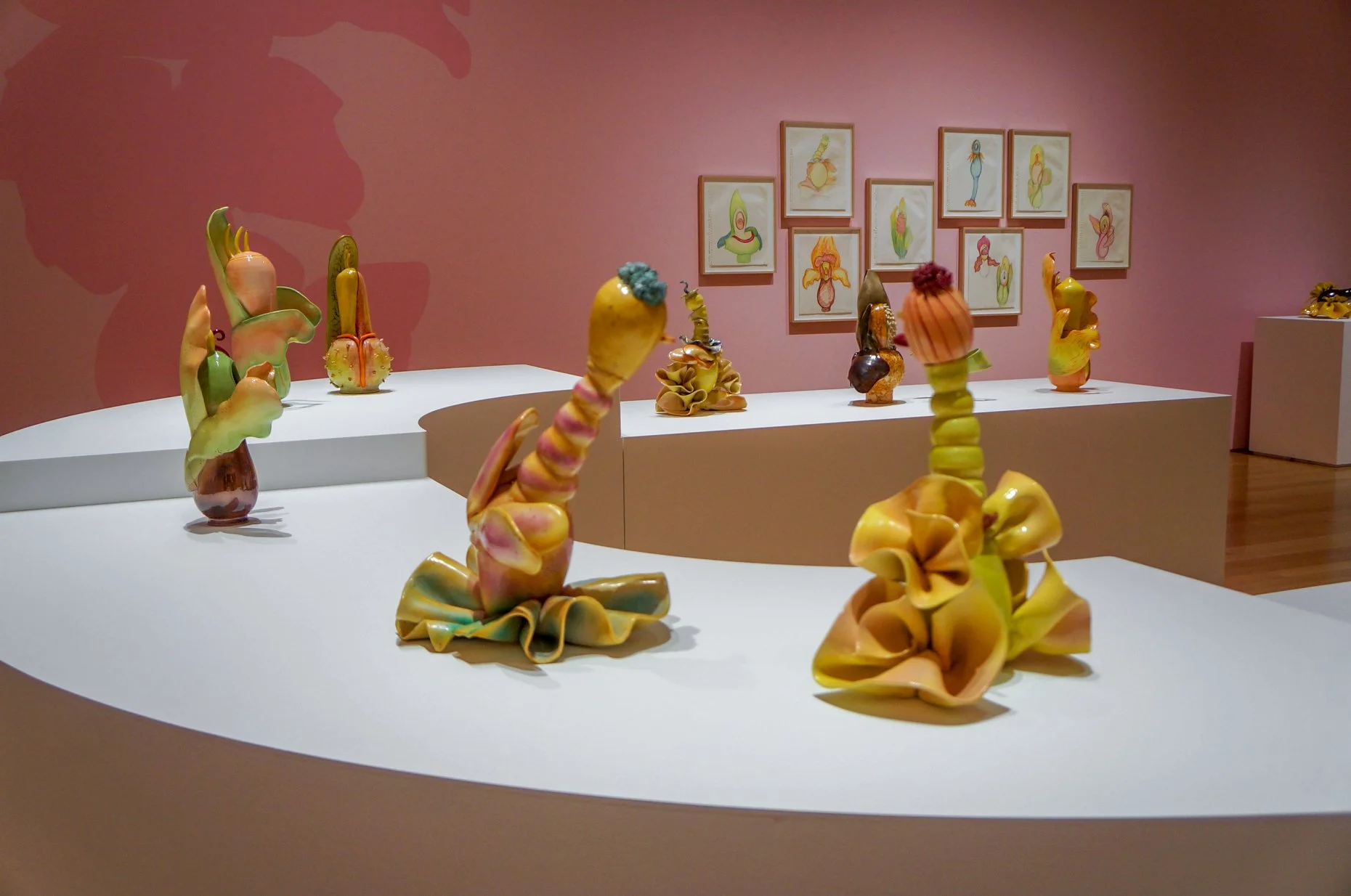
On view at Nerman Museum of Contemporary Art at Johnson County Community College through May 6, 20206, “Linda Lighton: Love & War, A Fifty-Year Survey, 1975-2025” is a thoughtful retrospective exhibition featuring a wide array of ceramic sculptures by Kansas City-based artist, writer, activist, and educator Linda Lighton. Spanning across four gallery spaces, the exhibition provides a glimpse into Lighton’s colorful, botanical, fluid, and relentless world of creativity. As I stepped into the gallery, I was immediately swept off my feet by the natural elements in Lighton’s work. Floras, cacti, crawling veins, cacti… the sight brought me so much joy, I wanted to squeal about how cute they are and touch their petals and tell them how beautifully they bloom like I always did at an arboretum.
I’d recently read that humans and plants, especially flowers, shared more biological similarities than one might initially assume. For example, both were “multicellular eukaryotic organisms,” meaning our DNA sequences were housed in the exact same place, the nucleus, in our cells. We also both rely on mitochondria to generate cellular energies. The most significant similarities, however, is probably the reproductive process where the direct contact of male and female were required for successful reproduction.
There’s no need to shy away from the fact that many of Lighton’s dancing flora creatures resemble human sex organs from the protruding cacti with their sporic tips and cylindrical stems, the voluptuous folds layered at the bottom, the juicy, plump, and enticing curves, to the not-so-subtle presentation of spiky semi-spherical root bulbs at the bottom of some. A few conceptual illustrations hung salon-style near one group of the creatures, reminding me of the Georgia O’Keefe’s Irisis and their audacious praise to human body and sexuality. My eyes lingered on the free-flowing movements of these little ceramic things and imagined them gliding, twirling, spinning, posing, celebrating the raw form of their bodies.
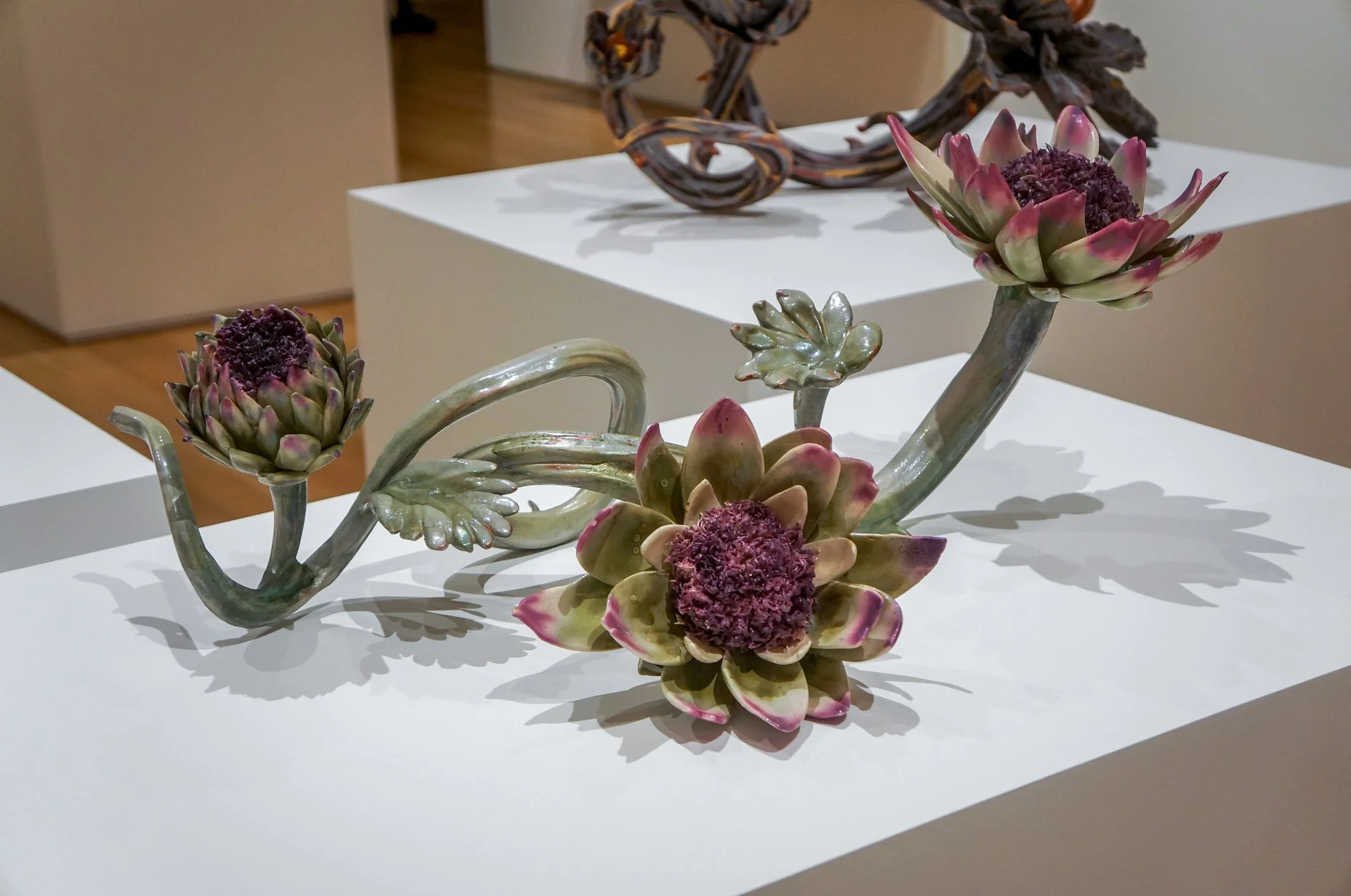
If the botanical creatures were a proud declaration of one’s sexuality, then, Lighton’s ceramic plants would be the direct plead of the deteriorating biodiversity of our land.
Throughout her life, Lighton has lived closely to the earth and its many wonders. The artist spent a significant amount of her younger era on the Native American reservation in Washington State, living without modern plumbing or electricity. This hands-on (quite literally) experience connected the artist deeply with the raw offerings of the Earth. This connection went beyond aesthetics and appreciation, and forged a spiritual and emotional resonance between the artist and the ecosystem that provided with generosity and abundance.
Contrary to the highly saturated colors seen in the previous room, Lighton’s botanical sculptures felt painfully dull. This dullness were not the result of a lack of craftsmanship, if one had even the slightest doubt. Lighton’s skills were breathtaking as always, boasting an astonishing level of details, textures, and subtlety. Rather, it was the artist’s mindful choices of color and texture that created a foreboding appearance. Some plants looked ashen, like they’d just been charred and burned and left behind an empty husk. One desert flower had blue-blackish stems and petals, but the center were bright yellow and orange, pulsing with flaming resilience. Another had brown, withered petals on the outer rings, but the center were soft, pastel oranges blooming upward into the sky. There were also seeds, split open with tentacle-like sprouts wiggling their ways out. The cycle of life and the beauty of the natural world were concentrated in these botanical forms.
Running as profoundly as the artist’s passion for the earth was her dedication to conservation and environmentalism. Nonetheless, Lighton managed to maintain the same openness and compassion even when discussing critical subjects like waste, pollution, and other acts of violence against the Earth.
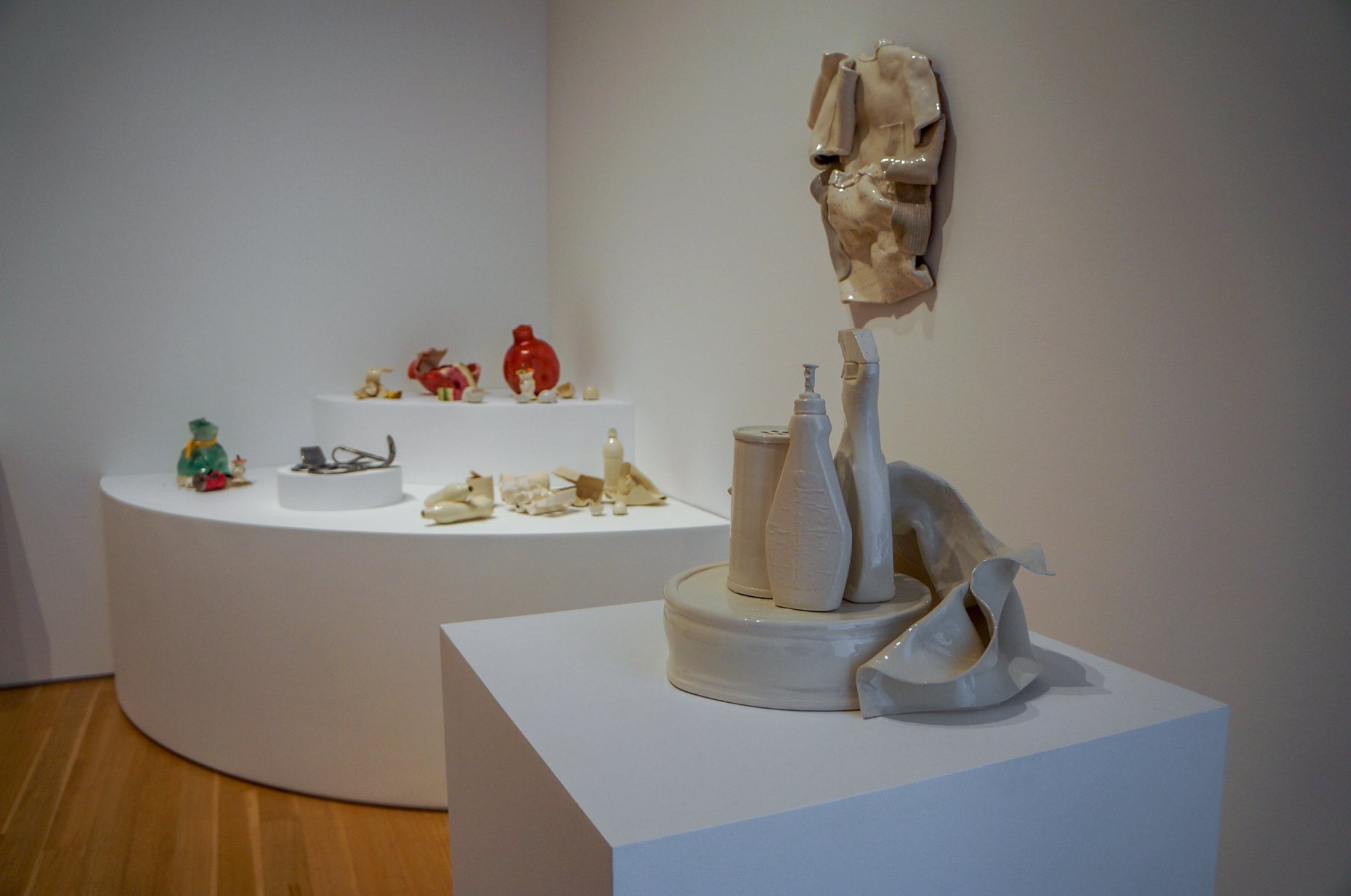
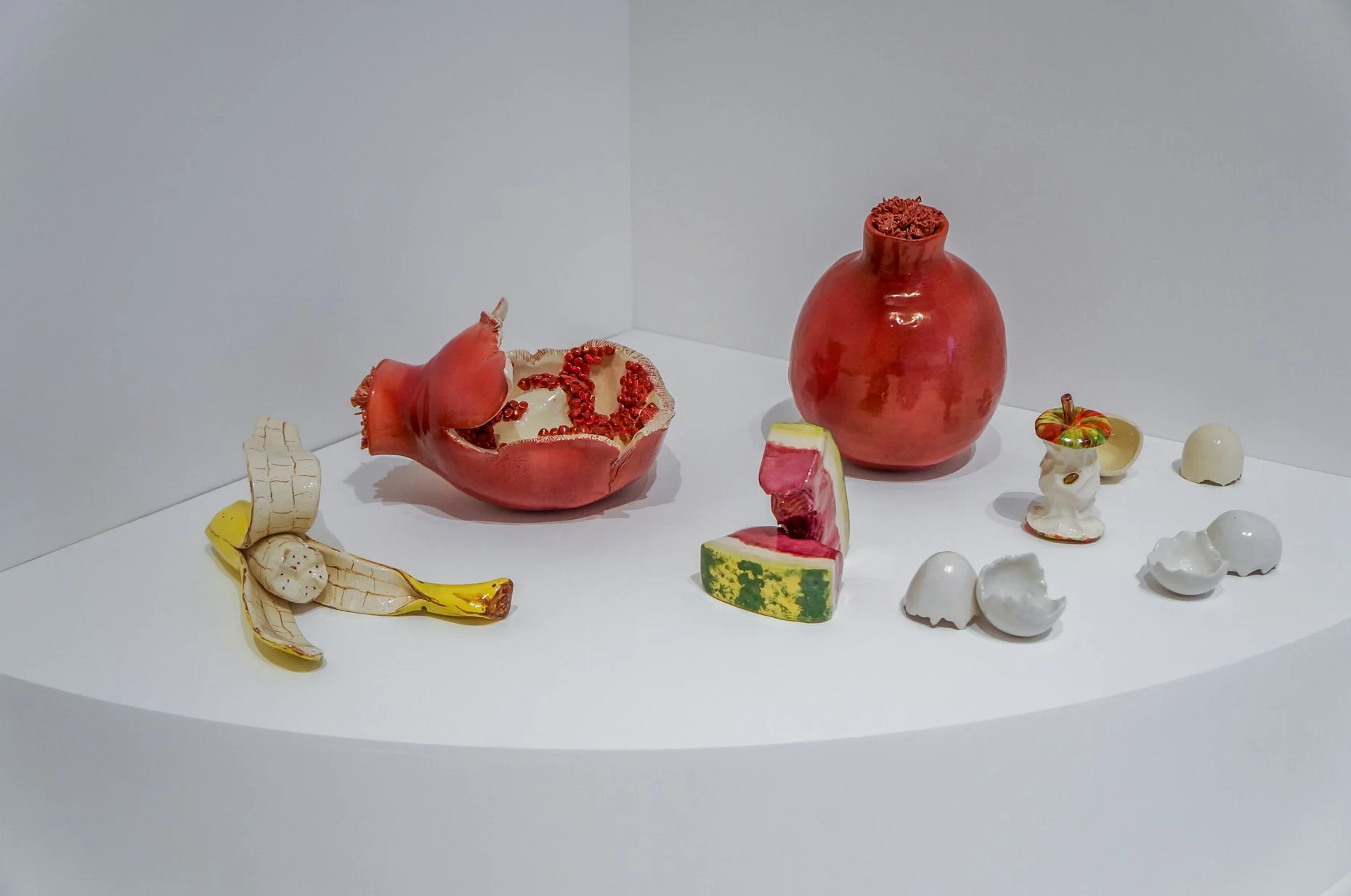
One great example would be her food waste sculptures. Bright, vivid, and hyper-realistic, these sculpture stood between playfulness and mockery. As it usually goes when fine art is employed as a means to capture the ugly by-products of modern living, these pieces (ones I personally referred to as “trash sculptures”) placed what belonged in the garbage bin within the clean walls of a museum.
A half-eaten banana, a piece of watermelon rind broken into halves, empty eggshells and a chewed-down apple. Lighton crafted the contents of a torn household trash bag with dedication and meticulousness. There were even enlarged cigarette butts that made me rethink my stress smoking habit, because the disgusting burnt tobacco and the yellowed filters were not a pretty sight when they stared me right in the face in mega size.
But when we turned around, we saw a loaded shopping bag, name-brand purses, and shampoos and detergent in American flag colors. Waste and consumerism met head-on in the gallery space, not arguing, but silently forcing the viewer to reflect on their spending habit and where their trash went. They were so different from the nature-inspired sculptures, you almost didn’t want them to be in the same exhibition with the rest. You might even gaze away, or rush through this part of the gallery, so that you were at least not reminded of that soda can you tossed casually out of your car window, or the empty hand-soap bottle that could’ve been re-filled.
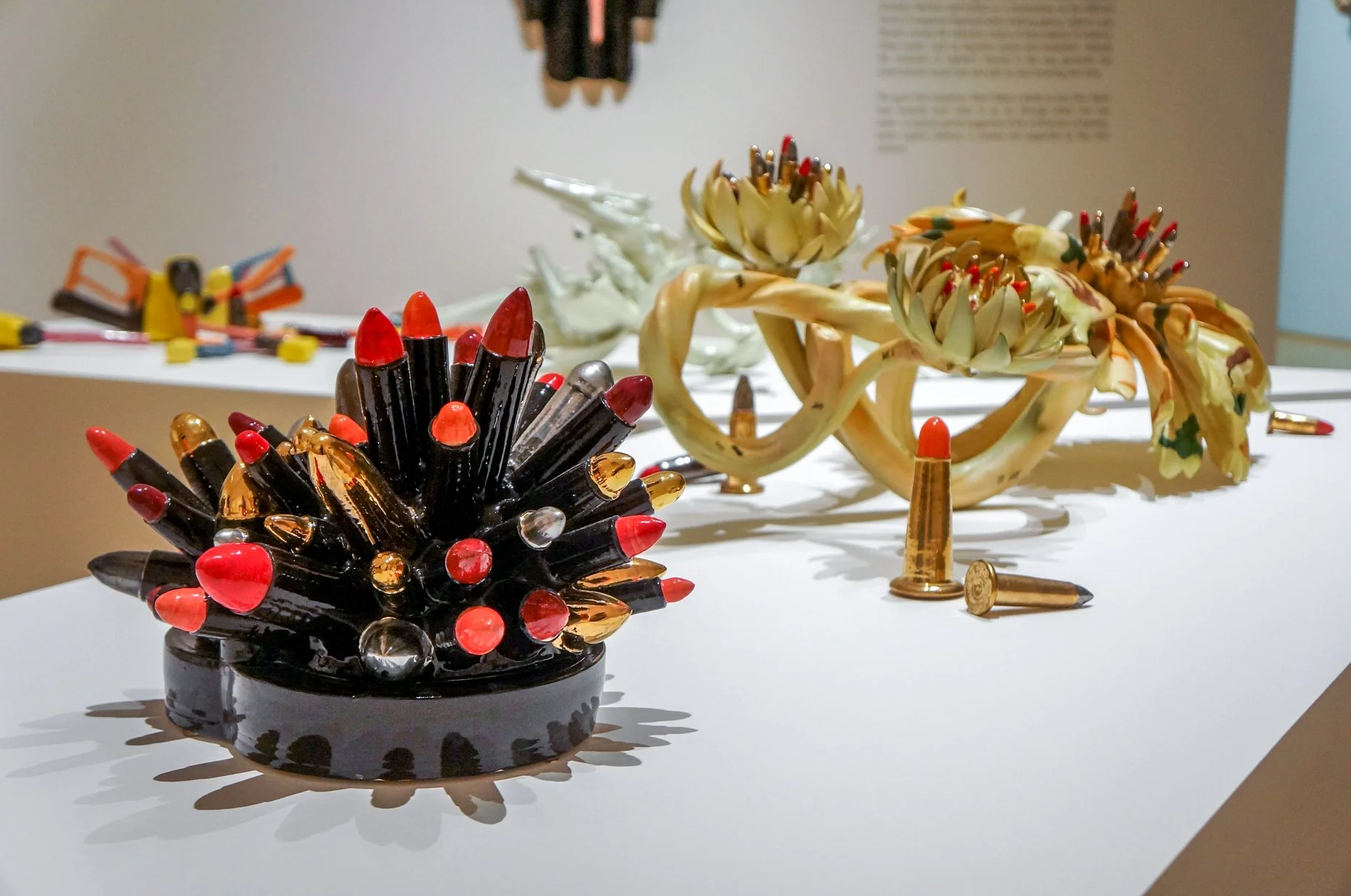
Lighton didn’t stop at putting violence against nature on display, either. She passionately marched on against violent acts against human beings – gun violence.
In the final section of the exhibition, we’ll see sculptures sharing familiar forms with the flora and cacti pieces. Except the petals were replaced by artillery. The bloom of the living became the bloom of death and destruction. Many of the bullets looked like lipsticks, pointing at the worsening global epidemic of femicide. You wonder if the tips were the rouge of makeup or the red of blood. Some of these bullet botanicals were placed around smaller ceramic guns colored like barbie dolls and toy cars, reminding us of the children whose lives were so casually stolen. At this point, I had to take a deep breath to steady myself. My lips were trembling and my chest was tightening. So I turned around, only to be greeted by ivory atlas made with machine guns. These sculptures were too intricate, too gorgeous, too perfectly-crafted.
They were too good to be carrying such pain, loss, grief. But exactly because of the wrongness embedded in such a soft and artistic portrayal of violence, Lighton’s work was enough to make even the most complacent and indifferent pause and think on the crimes committed against humanity in our age. At the same time, it was enough to make even the most tattered, angered, and exhausted soul find some light in a dark age.
Stepping out of “Linda Lighton: Love & War, A Fifty-Year Survey, 1975-2025,” I felt a bit lighter in my soul. I wanted to weep, but also wanted to smile at the sun for it was a beautiful day and the sky was clear and blue.
When all is diminished into nothingness, flowers will eventually grow from scorched grounds.
Life as we know may end at some point, but life itself will always renew.
We’d be okay so long we hold onto this thought.
Like what you’re reading? Consider donating a few dollars to our writer’s fund and help us keep publishing every Monday.