

REVIEW: Peter Weller: “Leon Battista Alberti in Exile: Tracing the Path to the First Modern Book on Painting”
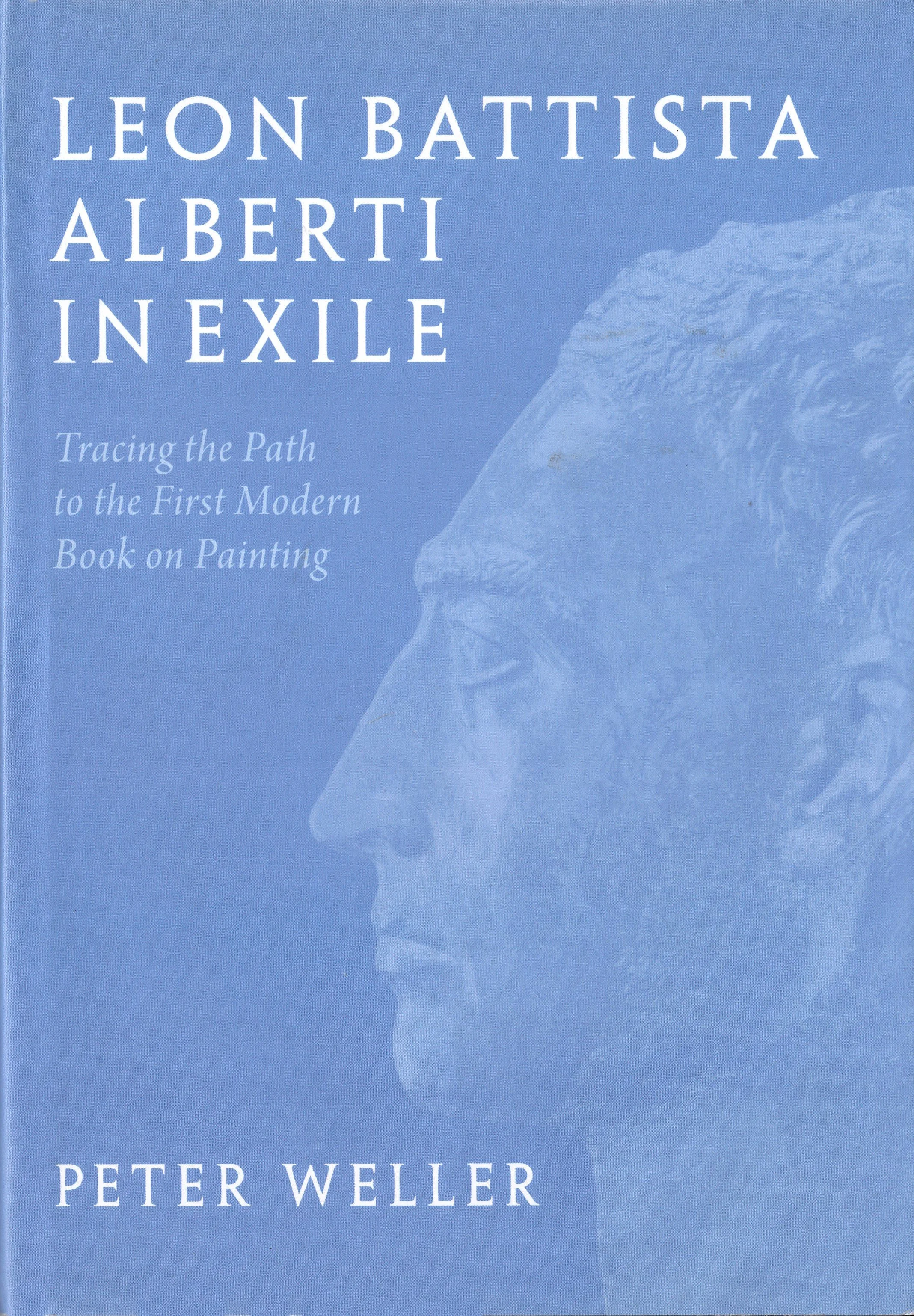
Cover, Leon Battista Alberti in Exile by Peter Weller. Image Courtesy Cambridge University Press.
REVIEW
Leon Battista Alberti in Exile: Tracing the Path to the First Modern Book on Painting
By Peter Weller
Harcover ($130)
Cambridge University Press
By Michael Workman
Peter Weller’s Leon Battista Alberti in Exile: Tracing the Path to the First Modern Book on Painting unfolds as a quietly revelatory study, reframing the familiar narrative around one of the Renaissance’s most polymathic figures. Rather than situating Alberti’s seminal treatise De Pictura purely within the context of his celebrated return to Florence, Weller redirects our attention to the artist’s earlier years spent in exile—in Padua, Bologna, Rome, and even northern Europe. It was in these formative environments, he argues, that Alberti absorbed the intellectual and visual currents that would shape De Pictura into what many regard as the founding text of modern art theory. The shift in emphasis may seem subtle, but its implications are profound: Alberti emerges not only as a Florentine prodigy but as a thinker forged in transit, his modernity born from displacement and encounter.
The book is carefully structured around the chronology of Alberti’s movements, beginning with what Weller calls the “Florence Problem” and then unfolding into extended discussions of his intellectual evolution in Padua, his years of study in Bologna, the resonance of his Roman sojourn, and finally, his return to Florence with a vision already deeply transformed by the wider world. This framework offers a map of intellectual maturation, showing how exposure to varied cultural, artistic, and philosophical traditions gave Alberti a vocabulary for perspective, narrative, and composition that would prove groundbreaking in the mid-1430s and give us De Pictura, the “first modern book on painting.”
Weller writes with the precision of an exhaustively well-researched independent scholar and the clarity of a teacher as he points the way through these histories of conceiving, writing and thinking about art. For instance, Weller notes the work of Pier Paolo Vergerio, who “authored the first modern text mandating painting as art”—an astonishing thing to contemplate in an era when market interests would have us believe painting is the center of all artistic practice, because it is, of course, among the easiest forms to buy and sell. Weller’s account reminds us that painting’s authority was not inherent. It had to be made, defended, and intellectually elevated, which is precisely why the history of its formation remains so consequential. Take this other example laying out the classical roots of humanist enterprise:
Above all, Padua’s culture and politics were linked. The ethics inherent in classical texts were at first superfluous to the grammar of medieval dictatores, whose task was to redact texts to their leanest instruction. Thereafter, Paduan professionals began exploring ancient literature for sociopolitical models, using classics in letters and orations for immediate tangible results. Ronald G. Witt observes that “theirs was an eloquence without a conscience,” relying more on Senecan stoicism than Christian canon. In this regard, Padua was avant-garde in secular appropriation of antiquity’s literary arts.
As urban record-keepers generated humanism, early Paduan annals are most notably personified by thirteenth-century rhetorician Rolandino Patavino and his Cronica in factis et circa facta Marchie Trivixane (Chronicles of the Facts of March of Treviso), commonly called the Rolandina. The account of political-social division before, during, and after Ezzelino is not merely an accumulation of facts, opinions, and traditions but a narrative of witnessed events. Considered a pre-humanist, Rolandino, as both notary and professor of grammar and rhetoric at Padua’s studium, began by compiling notes of his professor, Boncompagno da Signa (1165–1240), whose own book, Liber de obsidione Ancone (1201–2), held history as written art. Boncompagno’s dialogues, also no dry account of events, told of the 1174 attempted siege of Ancona by Venice and Holy Roman Emperor Frederick I, Barbarossa (1122–1190). Ancona’s freedom victory would foreshadow Padua in the Rolandina as an initiative in civic tradition of heralding sociopolitical success to generate communal pride. As opposed to linear scholastic reports specific to Italian communes, the history of Padua began to resemble a classical treatise. A bedrock of rhetoric resonant with republican Roman ideals of victory over tyranny, the Rolandina as celebration of restored political freedom was read aloud to both government functionaries and studium faculty as a civic ritual. Notaries thereafter began to dominate Padua’s intellectual life.
Manifesting new intellectual sophistication beyond that of any since Roman antiquity, Padua saw Lovato Lovati, a jurist immersed in classical literature, as the veritable founder of humanism.
His prose resists dryness, animated instead by perhaps the same palpable sense of discovery that Alberti must have experienced, laid out in the over 200 full-color image plates included in the book that illustrate his education in pictures. The reader feels guided through the cities and courts Alberti inhabited, sensing the scholastic rigors of Bologna, the visual density of Padua, Rome and his eventual return to Florence “in the employ of Pope Eugenius, who also, in 1434, facilitated the return from exile of that astute art patron, Cosimo de’ Medici.” These places are not treated as backdrops but as active agents shaping Alberti’s imagination, feeding into the synthesis that would crystallize in De Pictura. Not without concerns, of course, as Weller notes:
“The papacy hired Alberti as a scribe, thanks in part to his friend Lapo da Castiglionchio and the intervention of Cardinal Albergati. Perhaps more than any other city in which he lived, Rome validated Alberti’s objective to elevate painting to the elan of art—by quoting the ancients using their form, language, ethics, science, and mathematics. His humanist objective was to recuperate a milieu that predated ancient Rome’s conversion to Christianity and apply it to painting, while promoting the values of Cicero, Quintilian, Seneca, and Terence as worthy of emulation. Herein Alberti, like others, risked religion’s antagonism by flirting with a pagan ethos. Alberti never mentions “God” and only alludes to Christ as the apostles’ “friend” in describing Giotto’s Navicella. Regarding antique painter Zeuxis, who parted with his works without recompense, as they were beyond monetary value (pretio emi non possent), Alberti delivers classic hyperbole by insisting that Zeuxis “behaved like a god among mortals.” Thus, the divine appears only as “the gods” of an ancient domain.
“Venetian humanist Pietro Dolfin (1444–1525), in a letter to friend and bishop of Padua, Cardinal Pietro Barozzi (1441–1507), defended a request for transcripts of Alberti’s work (cum pro transcribendis Leonis Baptiste opusculis). Barozzi deemed Alberti irreligious. Dolfin argued that lack of piety on the page was not a stance against Christ. Despite papal employment, Alberti, spurred on by superb humanist training, was further pushing the effort to divest the classics from the grasp of the Middle Ages and religion. Riccardo Fubini brilliantly addressed the significance of disparity and resonance between humanism and secularization, arguing that, although the obsession with a rebirth of classicism could be viewed as an attempted divorce from Christian ethic, the humanist was not so much rejecting medieval canon as discovering new personal growth.
“Mark Jarzombek argues that Alberti’s works, before and including De pictura, suggest an underlying deist ethic of the institutional Church as spiritually defunct. Alberti would tread lightly over this ground, as his critical subtext resembled that of Marsiglio of Padua, condemned as a heretic in 1327 for advocating separation of church and state.”
Throughout the volume, Weller draws on years of research, much of it first articulated in his doctoral work, and here crafts a narrative that is at once rigorous and accessible. The result is not simply a study of Alberti’s emergence as a theorist of painting, but an account of how Renaissance humanism itself came into view through competing claims on antiquity, faith, artistic ambition, and the secular imagination.
In comparison to other Renaissance studies, the book marks a departure. Much art-historical writing has tended to anchor figures like Brunelleschi or Donatello within the specificity of Florence, emphasizing their commissions, guild associations, and stylistic innovations. Weller instead insists on a wider lens. His Alberti is not defined by a single city-state but by a network of influences, obligations, and exchanges, making his intellectual trajectory less local than trans-regional. The approach recalls more recent scholarship that considers the Renaissance as a pan-European phenomenon rather than a Florentine invention, yet Weller remains uniquely focused on how this movement of ideas manifests in Alberti’s visual and theoretical thinking. As in the earlier discussion of Rome, Padua, Bologna, and Florence, place functions here not as scenery but as sites of influence: each city contributes a different claim on antiquity, faith, civic identity, and artistic purpose. The result is a biography that doubles as a cultural map, tracing not only where Alberti went, but how the Renaissance itself emerged through the circulation, friction, and recombination of ideas across institutions, courts, churches, and republics.
The physical book itself is substantial—nearly four hundred pages—and carries the sense of a definitive contribution to the field. I could have read it ten more times and each time foudn something new, the sign of a depth of research that’s arre in the thin sauce of much recent contemporary art theory. Published by Cambridge University Press, it has the authority of a work designed not simply to supplement Alberti studies, but to shift their terms. That shift lies in Weller’s refusal to treat Alberti as a figure contained by Florence, or even by art history narrowly conceived. Instead, Weller lets Alberti come into focus through passage and encounter, showing how his theory of painting was shaped by the worlds he moved through as much as by the works he studied. The book’s scale therefore feels earned: its expansiveness mirrors the breadth of Alberti’s own intellectual formation, positioning De pictura not as an isolated theoretical achievement but as the crystallization of a trans-regional humanist project.
Weller’s work also arrives at a moment when art history is increasingly attentive to displacement, diaspora, exile, and the circulation of knowledge across borders. In this sense, Alberti in Exile feels both timely and corrective, asking us to revisit our assumptions about where and how modern ideas about art first took root. His claim that “sculpture perhaps more than painting” shaped Alberti’s developing thought further unsettles familiar origin stories, widening the frame from painting’s internal evolution to the visual and intellectual environments through which artistic theory was formed. The book’s argument also speaks to the importance of public scholarship: it shows how specialized art history can illuminate broader questions of migration, cultural formation, and the inherited narratives by which artistic origins are still too often explained.
Alberti’s life, read this way, anticipates a recognizably modern condition: the artist-intellectual formed not in isolation, but through a productive independence from any single city, institution, ideological bent or doctrine. That independence is crucial to artistic thought more broadly because it creates the distance from which conventions can be seen as conventions, rather than accepted as natural limits. As Pierre Bourdieu 1 has argued, artistic fields develop through struggles over autonomy from external powers, including religious, political, academic, and market authority; and as Edward Said 2 suggests in his writing on exile, displacement can produce a contrapuntal awareness, a capacity to see more than one world at once. Weller’s achievement is to make that complexity legible beyond the confines of a specialist debate, showing that the Renaissance itself may have depended on precisely such instability.
Ultimately, what the book offers is a new way of seeing the relevance of De pictura, situating it within the lived encounters and visual experiences that made such a text possible. Rather than treating the treatise as the triumphant product of Alberti’s Florentine return, Weller encourages us to read it as a synthesis of exile: a work assembled from the fragments of cities, courts, churches, and cultures through which Alberti passed. In this telling, Alberti is not only the author of the first modern treatise on painting, but a thinker whose wandering gave him the distance to see painting differently, and to imagine it as an intellectual art. Leon Battista Alberti in Exile therefore stands as both biography and reinterpretation, challenging us to reconsider the origins of modern visual culture not as the achievement of singular genius alone, but as the product of movement, estrangement, and a life lived across boundaries.
Michael Workman is Editor-in-chief of Bridge.
FOOTNOTES
¹ Pierre Bourdieu, The Field of Cultural Production: Essays on Art and Literature, ed. Randal Johnson (New York: Columbia University Press, 1993).
² Edward W. Said, Reflections on Exile and Other Essays (Cambridge, MA: Harvard University Press, 2000).
Like what you’re reading? Considerdonating a few dollars to our writer’s fund and help us keep publishing every Monday.