

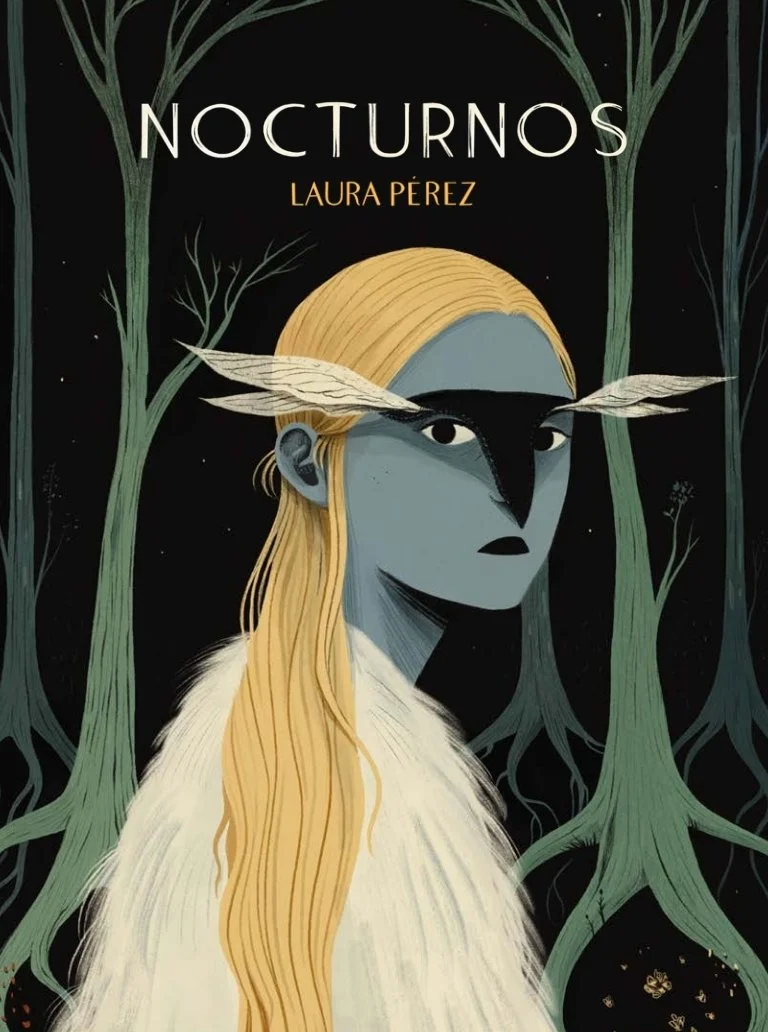
REVIEW: Nocturnos
Written by Laura Pérez
Fantagraphics, 2025 ($29.99), hardcover
Review by Lauren Weiner
The day is divided into two. There is the dark, and there is the light. When the sun is up, the world gets busy. People work, walk, talk, eat, create – live in the light. But when the sun sinks, the world shapeshifts into a different place. Sometimes it’s quiet with lulling televisions, dreams and sleep. Other times, it’s loud and lively, thanks to drink, dance and throbbing music.
Laura Perez's Nocturnos is an ode to the night. Translated by Andrea Rosenberg, Nocturnos shares vignettes of people, places, and things amidst the darkness.
The comic shows the night as intensely alluring; full of secrets and subtle beauty. Sometimes, it’s hushed and lonely, but often it’s teaming with life and togetherness. In the night, Pérez finds meaning, and she wants her readers to do the same.
Nocturnos has panels showing luminous streets, subway platforms, houses, or a humming gas station next to panels depicting dark, foreign forests, crawling insects, and creeping creatures. This is humans trying to separate their man-made world from the natural one.
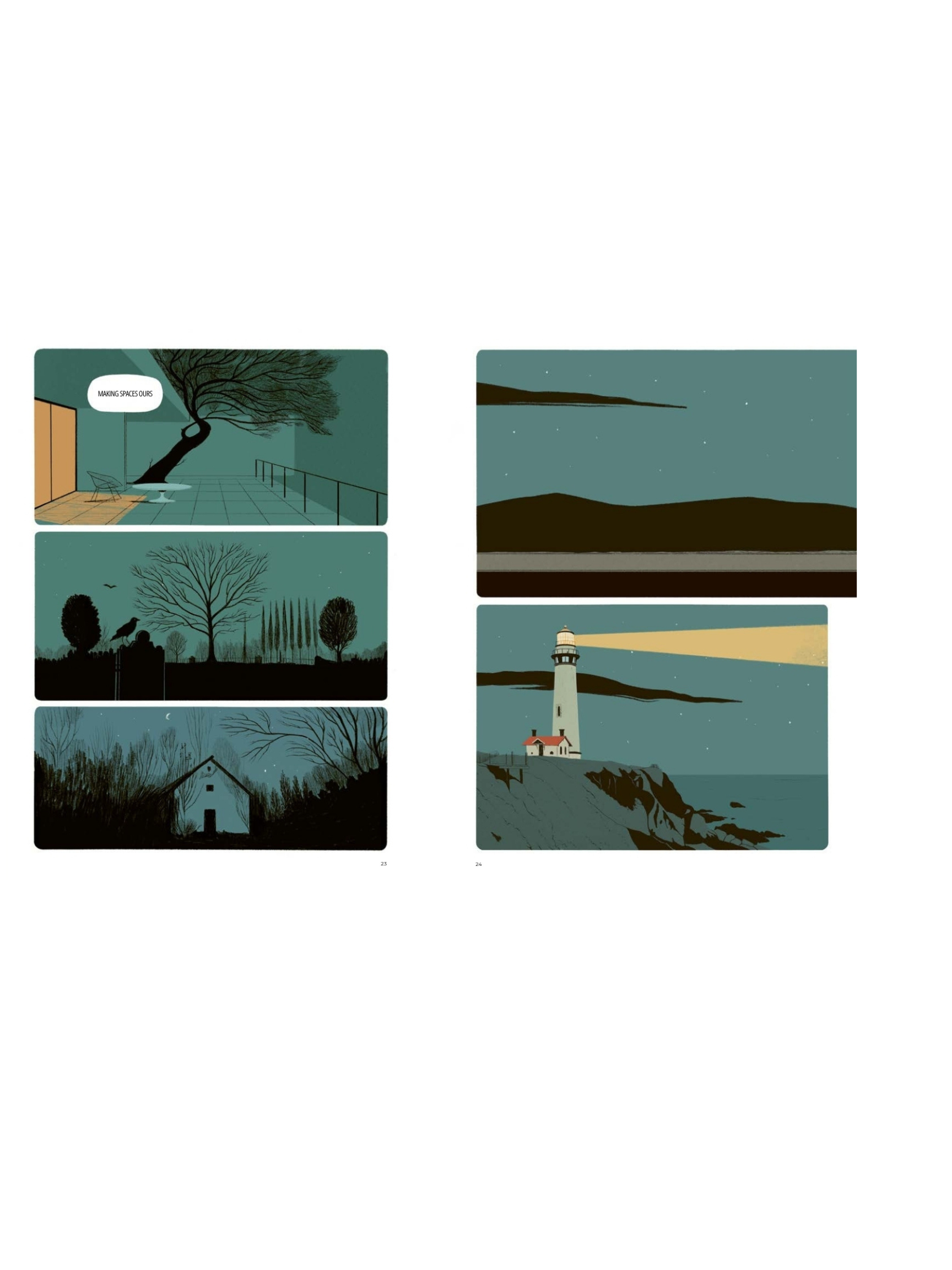
Reminders of human-nature interconnectedness come in the form of an owl who flies through the night sky, one vignette to the next. From someone in the city to animals in the starry meadowlands to a sleepy cabin in the woods. Yet, it’s usually in starker moments – like a tired driver hitting a deer – that the world of people and the world of nature fully collide.
Those sad moments highlight humankind's ugly colonization that dominates the day and trickles into the night. This is not to say there’s only ugliness in man’s separate, civilized night, though. There’s beauty too.
In Nocturnos, that’s shown in a couple’s gentle, bedtime conversations which unfold under warm lamplight. Or at a bar where patrons gulp frothy beers in good company as the world gets dark. Certain things we do during the night have been turned into comforts and rituals that feel best under the moon and stars.
But humans do not own the night. “The night does not belong to us. It has its own denizens,” is Nocturnos’ blunt opening line. We tend to stay away from wild things and walk on our curated city streets; laze about in cozy bedrooms; hide away in the local pub.
Nocturnos shows that, occasionally, people do in fact venture out into the nighttime realm of flora and fauna. It's an instinct. Yet, folks often stay in rented log cabins or well-kempt campgrounds; hold on tightly to creature comforts. These places and things bring a treasured sense of civility and order to the darkness.
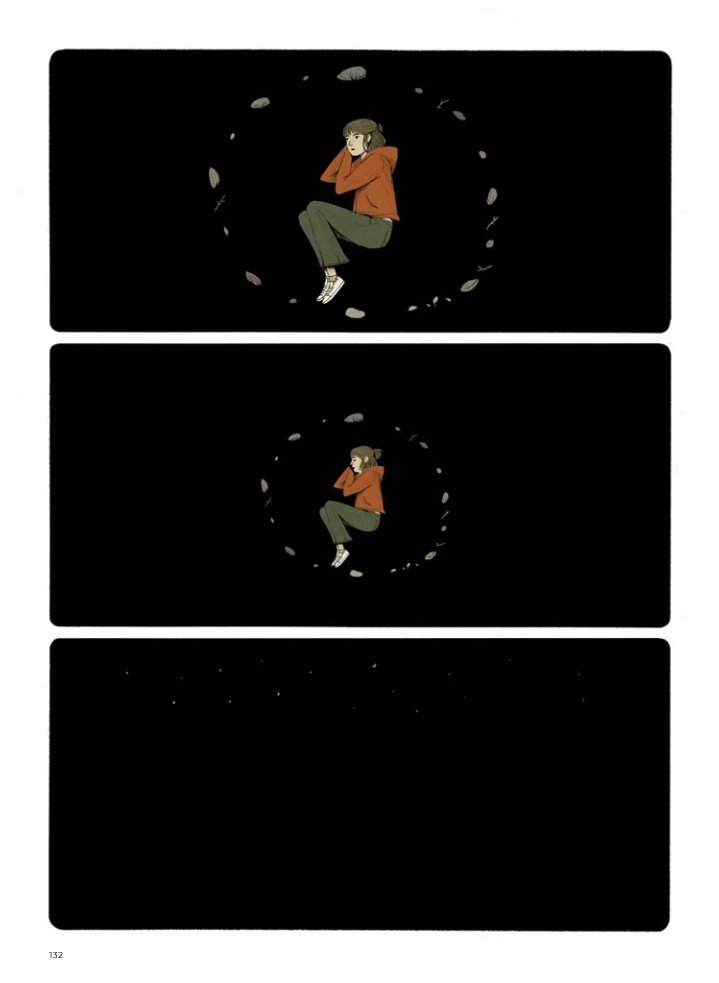
Recretly though, we always crave the unruly, wild night. Three panels on page 132 tell that story without words: a young insomniac is inexplicably drawn outside of her family camper. She wanders through the nighttime forest, eventually stumbling into long-forgotten megaliths. Then and there, she curls up on the grassy ground under the twinkling stars. A peaceful smile crosses her cheeks as she dozes off.
There’s this strange mix of comfort and discomfort that humans find in the ungoverned shadow hours. Night in nature conjures up memories of telling ghost stories; long conversations over the sounds of Cicadas, stargazing, or the smell of S’mores. It often reminds people of their most personal and vulnerable moments.
Still, there’s that discomfort. If the day is like an old friend, the night is more like a strange acquaintance. After all, ‘the witching hour’ often represents malevolent spirits; it stirs up fear, anxiety, and melancholy. There’s something alien in its quality. And we are not its usual denizens.
At night, even in the mind, unfamiliar things lie. One vignette follows a child wandering through a strange dream. Plants overtake his bedroom, giant cats roam the woods outside of it, and a mysterious, mystical lady sits amongst the trees.
A shorter vignette shows a tired woman. She talks to an artificial intelligence model. It recommends a song to her, and the tired woman listens. As she does, she imagines the wind tousling her hair; ruffling blades of glass where little flowers poke through. Thick, fluffy clouds float overhead.
The natural world comes into both of their minds through pure accident — through subconscious thought. This happens often in the quieter hours.
In the darkness, it’s easier to reveal what’s buried deep within. Both good and bad; happy and not. It is a time when humans can unchain themselves from the guiding constructs of everyday life and be free. In this way, there is a global connection.
Nocturnos is a slice of life — a slice of many different lives. Some panels cluster together tightly on a page. A man sits on the couch bathed in blue TV light, and a couple orders dinner at a restaurant. One person passes a cigarette to another, and eccetera. Such panels huddle on one page and point to overarching themes or shared sentiments about the night. It’s very filmic in that way.
Meanwhile, full page illustrations use space to make moments hold heavy, thoughtful weight. These force the reader to slow down, think, and digest the work.
And there’s so much to digest. A few vignettes unpack the heady idea of connected consciousness. Another shares subtle critiques about artificial light. A different story reveals the complexities of A.I. These sequences are fleeting, but hone in on very pertinent matters in their short visit.
The line art is feathery and as delicate as the thematics. Buildings and human structures are simple and clean. Animal and plant life are drawn with more detail, but overall the artistic design is intentionally flat.
The work is really defined by the colors and the lighting. The palette is earthy and jewel-toned, and the rich, moody colors embolden the simple illustrations. Likewise does the playful use of illumination and shadow. Perez shows her readers how these two elements determine the feel and character of a comic page, just as they do in the world outside of it.
As a whole, Nocturnos is gorgeous without being overstated. It’s subtly beautiful, as is the night.
The comic is largely a visual experience. Very few words are written in Nocturnos. The lettering of these laconic words is thin, neat, and uppercase. This appropriately reflects their demand for notice and their stoic aura.
The lettering, color palette, panel layout, shadows – everything in Nocturnos is crafted with intentionality. Every minute detail serves a greater purpose. The result is a graphically beautiful, thematically nuanced work of art that moves readers on a deeply personal level.
Nocturnos unleashes the reader’s buried sorrows, avoided fears, and forgotten joys. Yet, that’s just right below the surface. Deeper at its core, Nocturnos exposes the inexplicable emotions and intricate relationship between humans, nature, and the night.
Like what you’re reading? Consider donating a few dollars to our writer’s fund and help us keep publishing every Monday.
