

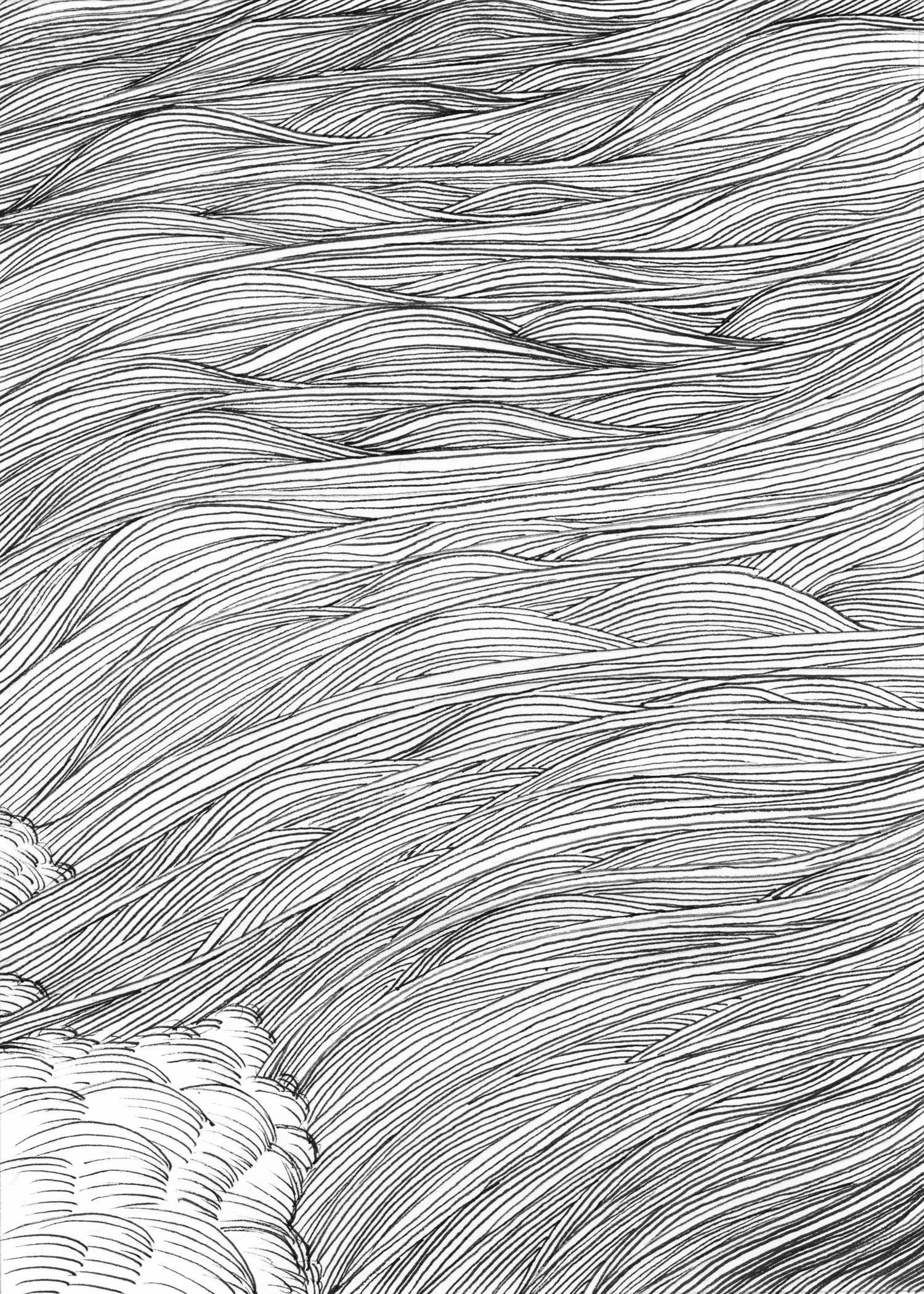
Illustration by Maura Walsh / Black Nail Studio.
FICTION
WHITE HORSE
By Janice Deal
Gal’s daddy—he was Old Morgan, and Gal was Young Morgan because she was his only child, his and Momma’s, there weren’t any sons—called them the white horse. Rapids, he meant. He’d grown up needful but by a river and he would say that riding the white horse was all he needed. What did he mean by that? Gal didn’t know. But when he came upon a river, any river, it was like coming home, he said. Time was a river, he said that too. He taught her to fish.
She hasn’t fished in years, not since the time of Old Morgan’s passing. Daddy. The oncologist said it was cancer got him but what did she know? Gal knew better, it was his devastated heart. He’d loved Gal’s momma but Momma loved whiskey more than any human. She outlived Daddy and he died knowing exactly where the bottle had taken her. She had been a dancer when they met. She got puffy all right.
This morning Gal wakes thinking of him. She hasn’t slept well, again; she thinks maybe she had a dream, and Daddy was in it? Riding a white horse, of course. In Gal’s dreamscape, that’s what he does.
She lifts her head from the pillow and her ear hurts. That new piercing she got. She’s 40 but she wanted a gold ring in the cartilage of her left ear. She wanted it so she went and got pierced, from a studio that punched a hole in her ear with a spring-loaded stud gun. She can do this: just go and spend money on whatever she pleases. She’s a grown woman. A flight attendant. It wasn’t like that growing up, of course, Daddy never more than poor.
She makes herself throw off the covers with energy; where is she going today? Berlin. She’s pretty sure it’s Berlin. She has the usual suitcase all ready. Gal does not have a partner, or a pet; she’s given up on keeping plants alive. In the bathroom, she fingers her ear. It’s hot. Swollen.
Gal turns the starter post earring in its fleshy pillow. It just needs to settle in.
. . .
At O’Hare she learns the pilot is Thad. Gal doesn’t like him. She hates his jokes, which are usually mean. She hates his red ham face.
“Hiya, gorgeous,” he says to her colleague Helen, who is younger than Gal, and prettier. Meek. Thad looks past Gal—he knows what she thinks of him—but then he does a double-take and pulls a face. “Wow, Morgan: cauliflower ear,” he says, then saunters past, smirking. Gal touches her ear and flinches.
“That looks painful,” Helen says sympathetically. She goes back to stocking a galley trolley with cans of soda. “Maybe take the earring out?”
“Right.” Gal goes into the lavatory but when she fingers her ear she can’t find the post back; it's just puffy ear. Maybe the back popped off? But when she presses in, she can feel it, buried in the flesh.
“My ear ate my earring,” Gal informs Helen. But Helen is preoccupied; Thad has just announced the flight’s going to run into turbulence, and Helen hates turbulence.
“I became a flight attendant to face my fears,” she told Gal once.
“How’s that working for you?” Gal had asked. She really wanted to know.
. . .
The flight is rough and when the plane starts shaking Gal tips out a little bit of whiskey from one of the nips—the airplane bottles they serve the passengers. She gives a tiny sip to Helen and then drinks the rest. You’re brave, she tells Helen. Gal herself doesn’t feel brave but maybe the whiskey makes her more so. Momma always said.
The weather’s bad enough that they have to land somewhere in New Brunswick. At least that’s where Thad says they are, over the PA. The landing is bumpy and one of the passengers yells, “It’s a headbanger!” Gal, strapped in her jump seat, is trying not to bump her ear, it hurts like hell.
“Shush,” she says to no one.
. . .
They’ve all gotten vouchers to stay overnight at a hotel that’s next to the airport, and the first thing Gal does is ask the concierge if there’s a doctor someplace. Someone to look at her ear.
“We don’t do that here,” the concierge says. They’ve landed at a small airport; the hotel is no great shakes. The concierge’s vest has a red stain on it.
“Let me take a look,” a man’s voice says. Daddy? No. She turns and there’s Thad standing next to her, his face full and red like always. “I took a first aid class,” he says.
“He did,” Helen says. She’s standing right behind him. “I was there too.”
“My hero,” Gal says drily. But she nods, and says why doesn’t he take a look where the light is better. “There in the lobby,” she says, pointing at a wall of glass that faces the rainy parking lot, but the concierge folds his arms. “Nuh uh. There are other guests here. No need to disturb them.” The lobby is deserted, the handful of passengers from their flight already checked in and gone to their rooms, or through the gale to a restaurant with a yellow sign that’s just across the road. But Gal and Thad look at each other and Gal finally says, “Fine. Can you come to my room? Helen, you too?”
“Have a pleasant stay,” the concierge says to their backs.
The hallway is long and narrow, with flocked wallpaper and no artwork. Just door after door, and a gold-trimmed mirror at the end that reflects the three ghosts of them. Gal’s room is small, with teal-painted walls, and she can tell right away that the bedspreads on the two double beds have been put-upon. “I wouldn’t sit on that,” she warns Helen. She pulls back one of the spreads and a weird orange blanket, which has pills. No bugs, at least. And the bathroom is clean; Thad takes a look at her ear there, under the lights, which are fluorescent.
“Ouch.”
“Sit still.”
Gal is sitting on the closed toilet seat and she can see herself in the mirror; under these lights she looks old, her face rumpled and even greener than Helen’s was when she threw up during the flight. There are no windows in the bathroom but they can still hear the storm, shrieking outside.
“We ain’t going anywhere tonight,” Thad says, almost as an afterthought. He prods at her ear again and she flinches.
“Lemme dig this out.” Gal never sees what he uses—it’s sharp—though he’s quick enough about it. Plenty of blood ends up on the towel Helen laid over Gal’s shoulder.
“You devoured this son of a bitch,” Thad whistles. He puts the earring on the countertop, little pieces of Gal sticking to it. Then he takes a breath in. “Holy shit, Morgan, what the fuck?” He backs away from her suddenly, not even trying to disguise his revulsion.
It's Helen who steps in, her face set. She grabs Gal’s ear and it feels like she twists it. The pain is like nothing Gal’s ever experienced. “Dude,” Helen whispers. She pulls and pulls and then she’s holding her palm out to show Gal: a bloody molar. “Amen,” Helen says, at least Gal thinks she does.
“I’m gonna be sick,” Thad says, and then he is. He uses the sink.
They all end up staying in Gal’s room, the three of them. The storm is so bad and Helen doesn’t want to leave Gal alone. Thad stays too, maybe because Helen’s there and he likes Helen. Maybe because they all feel so strange. Gal doesn’t care who’s there, so long as she’s not by herself. Every time she thinks of the tooth she feels light-headed.
“Here,” she says, and passes around the nips she took from the plane. Helen takes little sips but Gal and Thad down theirs quickly. There’s enough for each of them to have two, but after one nip Helen’s done and so Gal drinks Helen’s second one. She offers it to Thad but he says she had the ear-tooth so she earned it.
Thad takes the one double bed and Helen and Gal take the other. Gal has a fever, it seems. Her ear is a mess: shredded, and it took a long time for the blood to stop. Thad bullied some Band Aids out of the concierge and they’re plastered over the raw worst. Some of them fall off because they aren’t meant to wrap an ear. Gal hands these to Helen without looking at them.
“Don’t tell me how gross they are.”
Helen doesn’t. At least the earring’s out. At least there aren’t any more teeth.
Helen returns from the bathroom and lies down next to Gal, watchful. “Are you missing any teeth?” she asks at one point. “I mean, in your head?” Gal runs her tongue around the inside of her mouth. “I don’t think so,” she says. “Nope, nothing missing.”
“I read about these tumors?” Helen leans up on one elbow. “They’re called, like, teratomas or something. They grow really fast? They can turn into anything. They can turn into teeth.”
“This isn’t helping,” Gal says.
“That’s probably not what it was,” Helen says quickly. “There wasn’t any hair in it.” She thinks for a moment. “Sometimes cells just get lost.”
“Good to know,” Gal says. She turns over, facing towards the window with its blank wet face.
Remarkably, she sleeps. In her dream there’s her daddy—Old Morgan—again, riding the white horse he never rode in life. But as soon as she wakes she hardly remembers it. Something about the river. The room is dim as the dream, and Helen’s sleeping with her mouth open. Thad is a huge ham lump in the next bed. Here they are, together. In just that moment, she lets herself believe it.
Then she is fully awake and things were the way they were. She goes into the bathroom and closes the door before turning on the light. Band Aids dangle from her ear like flypaper. She doesn’t feel feverish anymore, but she really can’t tell how bad it all is. Now Gal remembers that in the dream, Daddy told her to go fishing, that he’d be there at the river.
In the bedroom, Thad is snoring. She can stay here a while or she can go find some river.
“Okay,” she says. She slips out of the room but makes sure to grab a jacket before she does. It’s Thad’s—his pilot’s blazer—but she tells herself she’ll be back before anyone wakes up. Thad won’t even know his jacket was gone. And who knows what happened to her denim coat; maybe she left it on the plane.
According to the concierge, yes, there’s a river behind the hotel. “Be careful,” he warns. “The water’s high.” His vest is still smeared with its red crust.
Gal nods and makes her way out and around the hotel, which is lit like a battleship. There’s no rain now but the wind is high. She hears the river before she sees it. She can hear it even over the wind.
. . .
The house where Gal grew up held her father’s anger and despair, but he always tried with his daughter: he took Gal to the river that bisected the subdivision where they lived. It was maybe a creek but they called it their river. They fished. His love was austere but it was real.
Momma came and joined them by the river sometimes when they were there. She stayed back from the water so as not to scare the fish, but she would dance, moving like the river. Her thickening body moved like the river smelled. Sometimes this was okay—early on it was, when they were still a family. Their kind of family, anyway, the kind that doesn’t endure.
“Shush,” Daddy would say, because sometimes Momma sang when she danced. Her singing eerie like a groan. “Listen, now. Can you hear the river’s music?”
. . .
The water is rushing and black; in the light from the hotel she can see how fast it moves.
“What now, Daddy?” Gal asks. She pulls the pilot coat closer around herself. Thad’s a big man so there’s plenty of coat.
Her stomach growls. She ate a handful of pretzels on the plane. Long ago, she thinks. She’s hungry now.
She was hungry then also: always so hungry, growing up. Momma drank up the grocery money but Daddy always figured it out. He’d make them mac ‘n’ cheese that Momma didn’t eat but Gal did, she ate for both of them. He’d make potatoes and butter the skins. That was dinner. They’d eat that every night, and it was supposed to be filling.
She never got full. Not then. Not now, Gal thinks dreamily.
“Honey.” She hears this over the sound of the rapids.
“Daddy?” Her ear hurting like it does, and the fever’s back, it’s pounding alongside the hunger. That great hunger. The river a comfort, its banks full.
Gal sits down on the edge so that her feet hang over into the water. It’s cold, but Gal only gasps, once, when she drops her legs in, toes stirring silt. The water is strong and rust-smelling. It swirls and that’s scary but also good: its wintry movement, and how white light plays on dark surface, irresistible. Beautiful. She stands and the water is only up to her thighs; she thinks about Helen, making herself fly through the storms. Gal takes a step and then another, the water pulling her along. Brave. She is brave, she’s lived this long. Momma did finally die, this year, her poor old stomach a basket for sarcomas that multiplied like rumors. “I’m always so full,” Momma would say near the end, and Gal brought her soup. Then she went out and got the piercing because a hole you make yourself is hardly a hole. And Momma died before she could devour what was left of Gal.
One time, though. They were all still alive, and Daddy was in hospital, his own cancer blooming; Gal went to their river alone. Ten years old, she fished as best she could, in water that barely moved in the heat and catching a strange dark fish in the last of the day’s light. This fish was flat as paper, with gaping eyes, too ugly to keep but without Daddy she couldn’t get it off the hook. He’d always done that part. She kept it.
She didn’t want to go home but she didn’t want to stay by the nighttime river, either. Finally she kept the fish on its hook and carried it, stinking, to the house, which was dark. Momma hadn’t turned the lights on, Gal knew she hadn’t gotten groceries. It was hard to tell if she even understood Old Morgan wasn’t around to take care.
Gal laid the pole and the fish on the concrete stoop, then quietly let herself in with the key she wore around her neck. Momma was passed out on the couch, but Gal stood over her for a moment. “I caught you a fish, Momma,” she said. “For dinner.” In the morning, both pole and fish were gone.
. . .
“Daddy,” Gal says now.
He left her with Momma but he didn’t mean to; his body betrayed him and he died, that was all. Later she understood this, but for years a part of her still waited for him to come back, she thought he could save her. A part of her, at certain times and in certain weathers, despised them both.
All those years she waited for him, she waited for her life to change. Momma’s face as red as Thad’s but Thad wasn’t so bad now, was he?
It was so hard to tell a person’s heart. One time Momma stayed up and sewed the mermaid costume. It was the best one, and at school next day everyone said so. For Halloween that was. And one time Momma showed Gal how to shimmy.
The water moving fast, up to her chest now, and there went Thad’s jacket, ripped clean off. He’d need it—tomorrow? Today?—whenever they flew out of this place. New Brunswick, the concierge had confirmed. But Gal doesn’t believe that, not for one second. New Brunswick is real. Nothing about this place is real.
At one point Gal looks back at the hotel. She looks back, and it is still lit, but at a great distance; she doesn’t know how she’s made it this far.
Momma used to say, you died alone. The night Momma died Gal got groceries. She made eggs and rice, she lit every light in the house. Gal ate until she was full up and left the lights on till morning. The change had come and if it was too late that was no one’s fault, just life at work.
Amen!
. . .
It just takes minutes, really, but it seems longer. Time’s a river, that’s all. That’s what Daddy said. Gal breathes in the rust smell and it is the smell of life: the one she’s had and the one that might have been.
Listen. The river was surprising, it made no judgements. Here Gal was, Young Morgan. Riding the white horse.
Finally. She made a joyful sound.
Janice Deal is the author of two novels and two story collections. The recipient of an Illinois Arts Council Artists Fellowship Award for prose, Janice has won The Moth Short Story Prize and the Cagibi Macaron Prize. Her books have also been finalists for the Chicago Writers Association Book of the Year, the Flannery O’Connor Award, the Black Lawrence Press Big Moose Prize, and the Many Voices Project annual competition.
Like what you’re reading? Consider donating a few dollars to our writer’s fund and help us keep publishing every Monday.
