REVIEW: What Sparkles We Feel with Our Eyes: A Review of Judith Geichman’s “Wiegala” at Regards
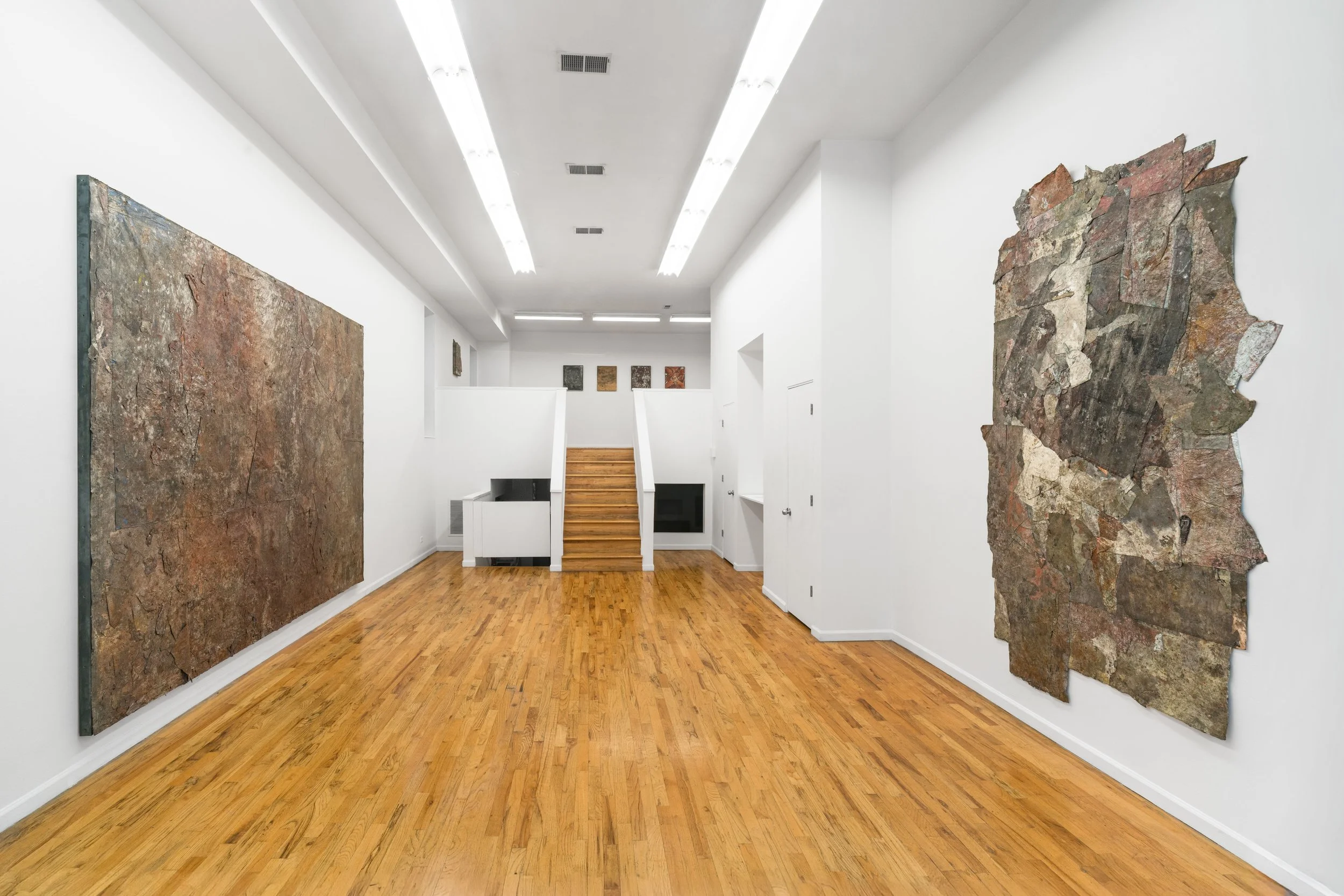
Wiegala, installation view 1. Courtesy the artist and Regards. Photo by @bob.mov.
REVIEW
Judith Geichman: Wiegala
Regards
2216 W Chicago Ave.
Chicago, IL 60622
Review by Curtis Anthony Bozif
In the end, isn’t all art about dying? It’s a question I continue to ask myself as I consider Judith Geichman’s “Wiegala,” on view at Regards through October 24th. The exhibition—the artist’s fifth solo show at the gallery that’s represented her since 2015—takes its name from a lullaby by Ilse Weber, written while the Czech poet was a prisoner at the Theresienstadt ghetto from 1942 to 1944, where she worked as a nurse in the children’s infirmary before volunteering to follow her husband, Wilhelm, with their son Tomáš, to Auschwitz, where she and the boy were murdered. We know of the lullaby only because Wilhelm, who somehow survived, returned to Theresienstadt after the war to recover a collection of his wife’s poems that he had hidden from the Nazis beneath a garden shed.
It’s for posterity as much as for the audiences of today that we make art. Rare is the artist who hopes to outlive their work. For it to matter, art must endure, if only in our memory. Museums abound in the work of the dead. Nietzsche famously said, “We possess art lest we perish of the truth.” And the truth is it, and only because we will all die that we value anything. And before you imagine being tortured forever, consider it’s only because it can die that life evolved the ability to even feel pain, or evolved at all, for that matter. Some art is more explicit in the way it asks us to contemplate our mortality. Assign it a title like “Wiegala,” for example; sometimes it’s context, like the recent passing of Geichman’s partner and husband of almost forty years, the artist and educator Frank Piatek. But some objects, by their very nature, induce such contemplation.
The namesake of the exhibition is an eight-by-twelve-foot industrial-grade plastic tarpaulin that, over the course of nine years in the artist’s studio, performed the role of a drop cloth whereupon a myriad of events, incidents, accidents, excesses, oxidations, stains, residues, smudges, spills, splashes, puddles, drips, drops, flecks, specks and various other bits of debris accumulated. With Weber’s haunting melody as a soundtrack, more deliberate interventions followed. Paint was added, as were scraps; patches were pasted together, and the whole thing, colored mostly bronze, but copper too, rust, ash and soot—are these even colors?—was eventually mounted to a steel frame, lending it an additional weight I wonder if it needed. To the extent that what I’m looking at is there by chance, I wonder too to what extent my very looking, my even being here—and your reading this—are also matters of chance.
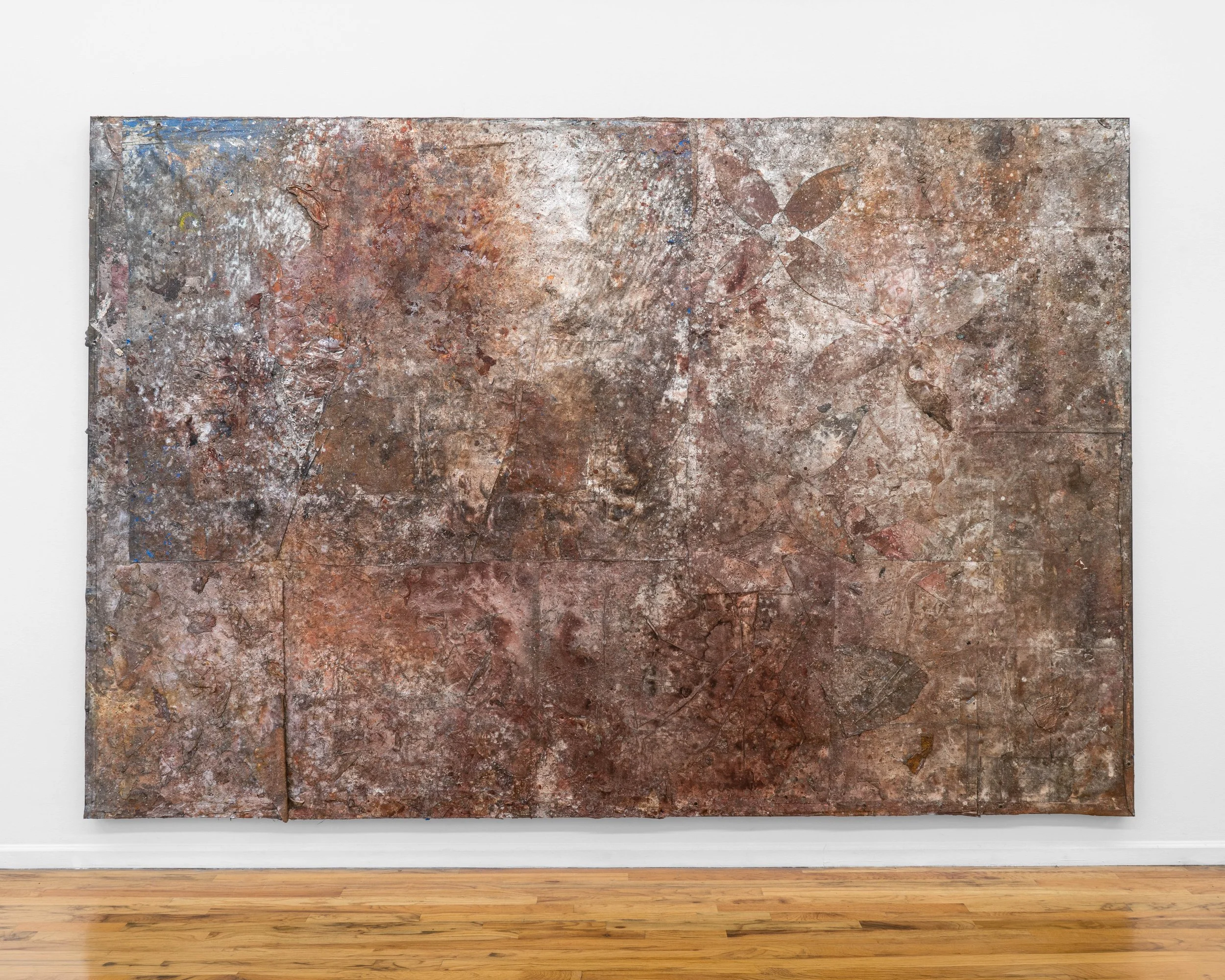
Wiegala, 2026, mixed media on tarp and panel with steel frame, 96 x 144 inches. Courtesy the artist and Regards. Photo by @bob.mov.
Metallic isn’t a color. It’s a quality, a modifier. It can be added to almost any hue in the form of microscopic particles, of say, aluminum or mica. By reflecting light the way it does, a metallic quality throws into greater relief the texture that it covers, so that what sparkles we feel with our eyes. But leaning in, moving from one vector of interest to the next, I find the most touching aspect of the mess before me is where paint, caked on as it is, has chipped away in minute flakes, exposing the sterile blue plastic of the sheet beneath, which feels oddly profane under such gritty iridescence.


Left: Wiegala, 2026, mixed media on tarp and panel with steel frame, 96 x 144 inches, detail 1. Courtesy the artist and Regards. Photo by @bob.mov. Right: Wiegala, 2026, mixed media on tarp and panel with steel frame, 96 x 144 inches, detail 2. Courtesy the artist and Regards. Photo by @bob.mov.
Opposite “Wiegala” is an unmounted mauve and taupe conglomeration of remnants from older works smashed together in such a way as to remind one of what’s left of something after entering a junkyard trash compactor. Amongst the wreckage one finds detritus, crumples, and frayed edges, and in places, the faint trace of what I take to be a tennis shoe tread.

Untitled, 2026, mixed media on paper, 106 x 71 inches. Courtesy the artist and Regards. Photo by @bob.mov.
Rosalind Krauss, in a few memorable passages at the end of The Optical Unconscious, dwells at length on how Pollock painted on the floor, or the “beneathness of the truly horizontal.” The floor, she observes, is lower than the “‘natural’ upright field of vision” represented by the easel picture, the wall, a window, and the “cultural [horizontal] surface of writing,” as upon a desk. It is a place “manifestly below both, below the body.” But working on the floor isn’t what it used to be. It’s remarkable just how unremarkable it’s become. And yet, to Geichman’s practice, the floor is so foundational as to support deep psychomaterial resonances rare among the countless other artists standing over paintings in their studios today.
The stance itself is the stance of the forlorn, the weighed down. Bowing their head as if in mourning, toward the place where all things eventually settle, the artist who paints on the floor pays their respects as if standing over a grave. What’s buried isn’t easy to say. It’s different for everyone, but by trampling her art, Geichman embeds into its substrate the very ground beneath her feet. Grime of all kinds adorns her surfaces. She stomps the very life out of her materials like roadkill run over a thousand times. Each mark: an oily remainder.
Traditional canvases—as one finds upstairs among a sextet of smaller works—are pulled taught across stretchers, they are bodies bolstered against gravity by skeletons. Two of these bodies, their skins so worn as to reveal their bones underneath, remind me that my skin is just as prone to tear and deterioration. A porous membrane upon which blemishes and scars collect, an organ that fades, wrinkles, sags, dries, and falls off in flakes. When images are cheap, stories like excuses, and intelligence grown in datacenters, this work appeals to something—more fundamental.
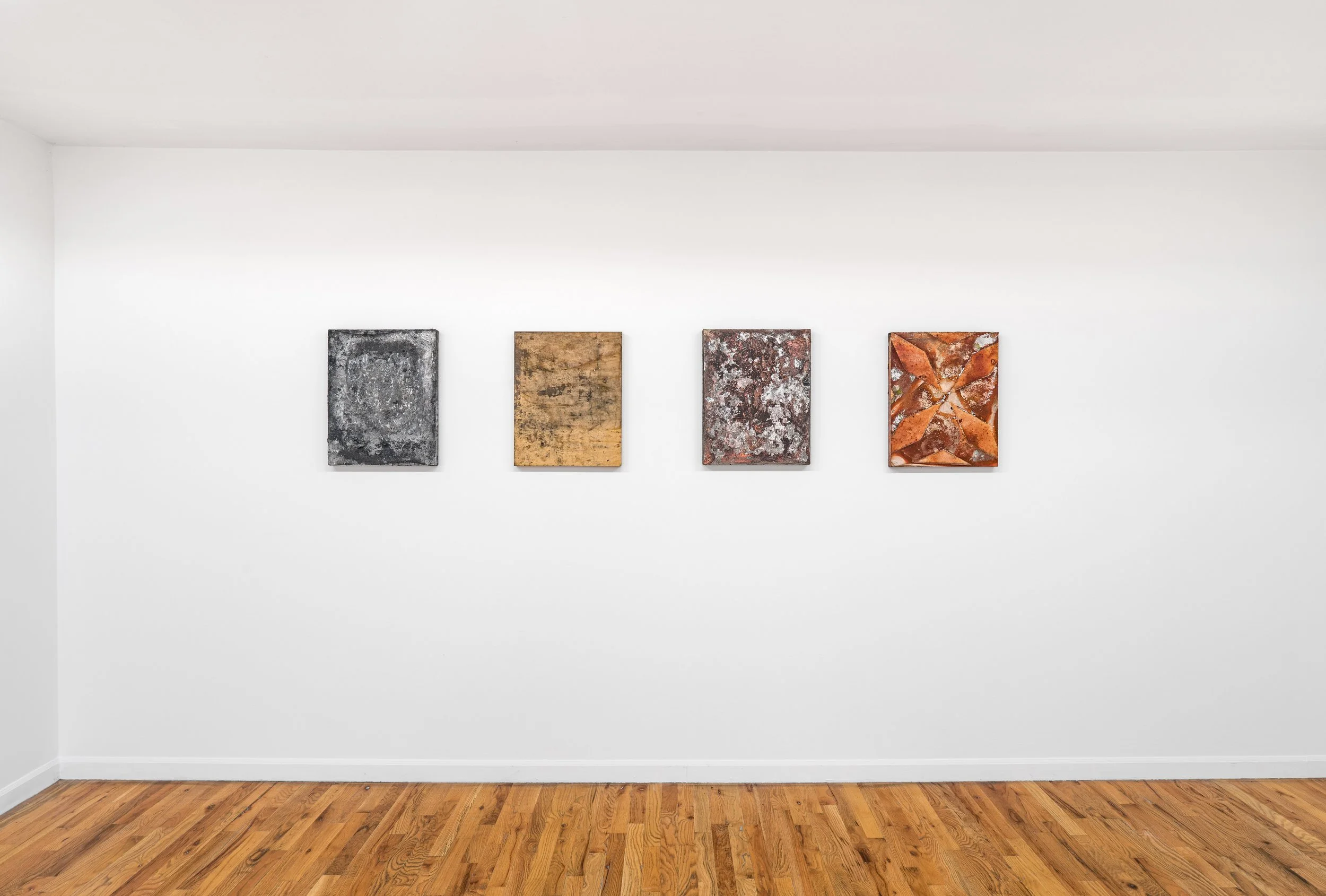
Wiegala, installation view 2. Courtesy the artist and Regards. Photo by @bob.mov.
Geichman, 82, has taught at the School of the Art Institute of Chicago for over five decades. In that time, she has become a beloved mentor and inspiration to generations of painters. “Judith taught me that inquiry doesn’t have to be linear. That I didn’t need to begin a painting with a plan or even an idea. Learning how to respond became more important than knowing where I was going,” recalled Noelle Africh, whom Geichman advised in 2020 and who is now a lecturer in Painting and Drawing at SAIC. “It’s impossible to overemphasize Judith’s effect,” said Molly Zuckerman-Hartung, associate professor in UCLA’s Department of Art, who worked with Geichman from 2004 to 2007, “and when she partnered with Frank, my post-bacc year, the two of them modeled the mind-body synthesis I was desperately seeking.”
I was never lucky enough to have studied with Geichman, but her lesson to Africh is one that my lost, twenty-something self would have surely benefited from as a grad student at Northwestern. And as our brains rot behind screens and we become increasingly out of touch with the world around us, I think we could all use a little “mind-body synthesis.”
When a meditator is distracted or lost in thought, their teacher will often encourage the student to bring their attention back to the body, for it is in the body that we return to the present. Should we ever put our phones down, “be here now,” and attend to art, we do so with our bodies. The Zen philosopher D. T. Suzuki said, “Eternity is the absolute present,” and Wittgenstein wrote, “If we take eternity to mean not infinite temporal duration but timelessness, then eternal life belongs to those who live in the present.” In answering art’s call to attention from across time and space, we become, with it, mutually present. If art is about dying, it’s in the way it keeps us alive.
Like what you’re reading? Consider donating a few dollars to our writer’s fund and help us keep publishing every Monday.