
INTERVIEW: Natasha Mijares
INTERVIEW
Natasha Mijares
By Ruby Djuna Haack
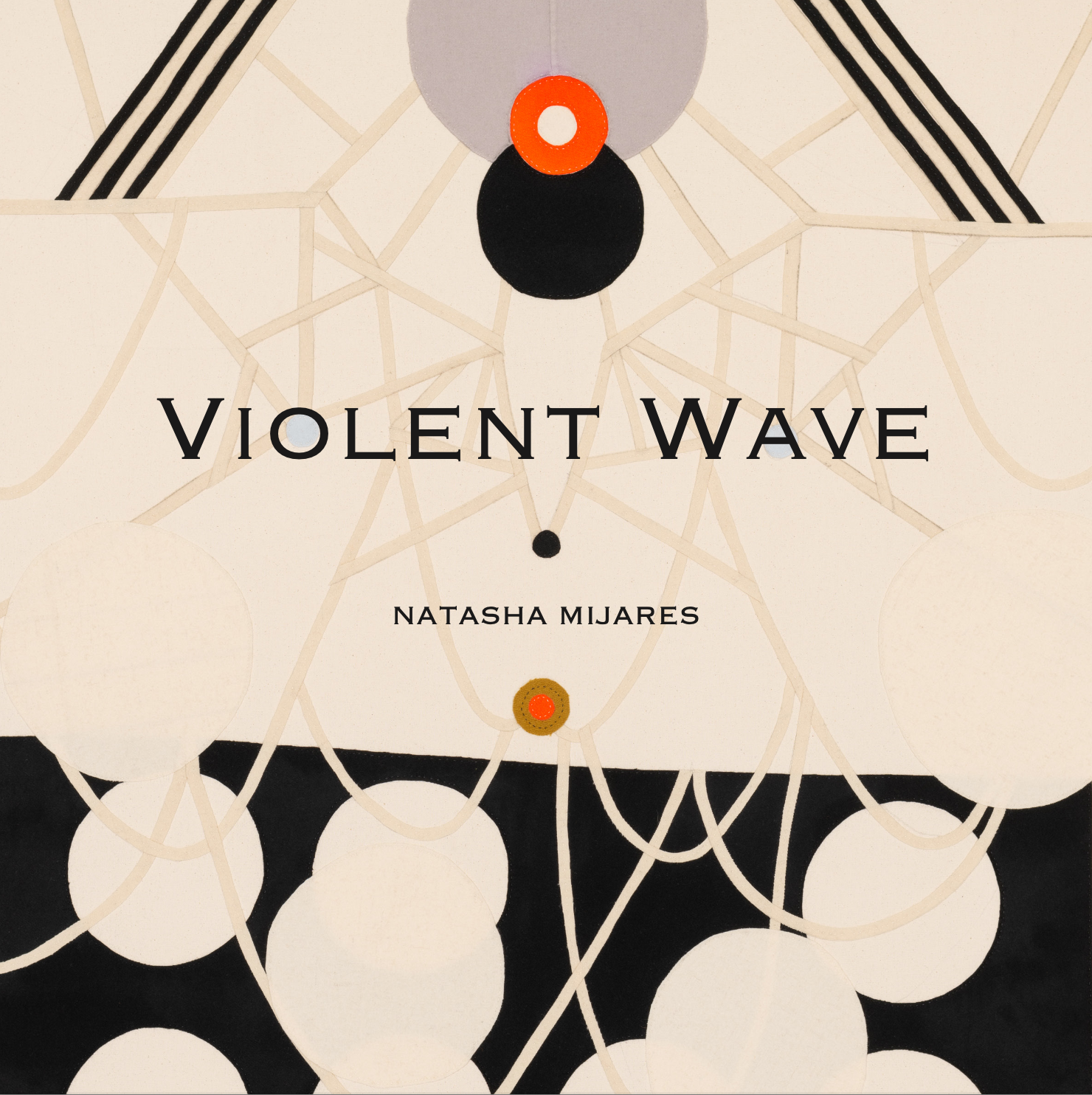
Natasha Mijares is a Chicago-based poet and visual artist. Her debut poetry collection, violent wave, merges the two disciplines in an effort to play with and complicate the reader’s understanding of space and how it fills the page. The book will be published later this month by Bridge’s recently launched poetry imprint, Allen Editions.
I spoke with Natasha about her process, each of us situated in our respective bedrooms—or a bedroom—me at my desk, my bed half-built in the background, fully encumbered by a recent move, and her on her bed, laying on her stomach, her legs bent at the knee and her feet swaying in the air. On a warm September afternoon, we were connected, briefly, by two computer screens. I asked her about the visual evolution of her poetry, what it meant for her to create from the body, and who inspired her to do so.
This interview has been edited for clarity.
Ruby Djuna Haack: Tell me about your writing process with violent wave. What informed your work?
Natasha Mijares: So, I have been, as a poet, working on ways of having a very expansive practice. I’m a poet and visual artist so I’ve always been challenging myself to mix worlds together or have a sense of a poem that isn’t just a poem, or a visual piece of art that is also written. Staying in the in-between spaces or the interstitial spaces is what my favorite kind of art is, so it’s always informing my work... I think those are the intentions and the things that inspire the formal qualities of the book. I feel like, as a poet as well, there’s this relationship to form that you develop that, for me, has always been positive. I feel like form is so interesting because it’s a set of rules, and how you manage them and break them, it’s something you have to learn. And I think that’s something I find interesting.
Obviously being a poet, I love language and how form is a type of coded language. And so those codes make me think about the forms and codes in our world and how we manage and intercept those. So I had a bunch of the language that was in the collection, and I was thinking about how to make it into a book and how I wanted it to connect to one another and become its own thing. Regarding the interstitial and the managing of different worlds, I was thinking a lot about language and humans and our connection to human and nonhuman beings. As well as our environment and our built environment, nature versus how our world is being shaped around us. Also a sense of the quotidian or the day to day banal and the supernatural or more fantastical, or just surreal experiences of life. So a lot of the language is teetering between these things. And so, because I felt this sense of dichotomy, or two, I feel like I’m mashing two things in one in a lot of it. That’s kind of what inspired the fact that the majority of the pages are two lines. It creates a horizon that the reader is engaging in. And so the purpose of having only two lines and the rest being so much blank space is because I was really thinking of how, in reading, what I love, or, a quality that I love is when poets and writers invite us to slow down and to really meditate. Having more of that meditative and associative type of lens on the work just really brought me a lot of joy. At the end of the day, I think that’s important for writing. Does it give you energy and excite you? And because all of the work had so many intersections that thematically went together for me, it was really just interrogating what is on the page, what kind of connections do I want to make if I pluck this line from over here and this line form over there… And I knew I wanted to play with the space and so, as you read the text, the lines start to go away from each other, and that eventually creates its own wave from itself. The spacing creates a sense of emphasis, a sense of drama. The narrative strips and threads and different lines of thought are being interrupted and not being as connected. I liked the formal qualities that that created and so by the end of it, we’re getting that sense of finality.
I’m glad you touched on the visual evolution of the poems. That was something I was particularly drawn to when engaging with your work from a production point of view. I’m wondering if you could talk a bit about your relationship with art and poetry as being parts of your identity. What came first for you? Did you find your attraction to poetry the same time you found your attraction to visual art, and how do they inform each other?
Both were very early on. I always loved to read, so I think books were first… I just feel like the act of reading was very generative for me. So often when I read, even now, I’ll have a notebook nearby because I’ll just want to start writing pretty soon … From a very young age, I’ve always wanted to understand how something works … It wasn’t until I had a teacher in high school that was like, ‘We’re going to do an entire poetry unit, and we’re really going to dive in,’ and we did meter and scansion and all of it, where I was like, ‘Oh, this is what I’ve been doing, and I didn’t really think that this was actually poetry…’ I was like, ‘Well, I feel like if I just continue to learn and continue to try it on, I will just do it…’
I would always have a journal. I’m a very journal-based type of person. And I was like, ‘Oh, what if I just painted in here? And started to draw? Or wanted to mix collaging and having different material qualities?’ I always liked doing things with my hands, so I wanted to put all of the pleasure centers together. I wanted to put everything I liked together.
From a young age, I always loved doing abstract painting. That was something, even today, that I could just do forever. And similar to my writing, it’s very associative. I wanted people and myself to not have a hard line or harsh prescription of like, ‘What is the meaning of this?’ I’ve always been more inspired by everyone having their own unique experience of an artwork… So yeah, I’ve always had the practices feel very side-by-side.
When I was in high school, I took all of the fancy art classes and did very well exhibiting my work. This gallery had this high school program and I was with all of the very artsy kids from all over—I’m originally from Miami—from all over the city… And even then I remember them telling me, ‘Oh, we really liked you because you also have writing integrated into your practice.’ They thought that was a way I stood out to them. So I always was kind of like, ‘Well, if these fancy gallery people like this—’ it felt very affirming. Like, well, I guess there is a place for me, and I could be accepted here. Because I think societally, they like to put people in boxes and act like you don’t exist within them.
In undergrad and grad I double majored in poetry and visual art. In grad school I went to the School of the Art Institute. I was in the writing program there, and it’s a very interdisciplinary program, so they’ve always been side-by-side. As my visual practice has evolved, I fell in love with a lot of book arts because it felt like a way you could encapsulate a lot of things in one. Also fiber arts, and I love installation art as well because it can integrate sculpture and using space in interesting ways, which I like doing both in physical space and on the page. I’m really connected to, ‘Ok, what does a work want to be?’ And I don’t really want to be like, ‘I’m only doing this.’ So I’ve done sound art and integrated it into my writing, I’ve made visuals and video poems and things like that. I’ve also done more socially engaged art, more social practice. I think for me, I’m just very open to what my work is: How can it evolve? How can it expand? And I’m just really open to learning. I think that’s a huge part of being an artist. Integrating practice and discipline and skill and also like, openness to failure and learning from like, ‘Oh, that was an experiment, that didn’t end up how I wanted it to, but I learned this part.’ So I just feel like my practice has allowed me to do that.
To zoom in specifically on violent wave, something I was moved by was the way ‘the body,’ whether it’s an abstract or concrete idea, takes precedence in your work, and I was wondering if you could speak to what it means to write from the body? What is your relationship to the body as you write?
I think as writers, creators, artists, we live so much in our heads, and so I feel like, for me, part of what I savor and cherish and nourish is how our practice can be embodied and bodily. Just because I feel like, for me, I think it’s just been a very integral element of being a woman—our relationships to our bodies are very important and they shape so much how we navigate the world, navigate our identity, navigate our relationship to others and all of these things, and so I feel like when I want to connect to human experience in any capacity, it starts in the body for me. It feels like something that is such a connector both through a personal lens but also a cultural lens. It just is homebase for me, in a way. As I’ve grown as an artist, I feel like a lot of my influences are others that are really interrogating the body, the body in space, the body against others and self, and how the body is very political as well...
You spoke to being influenced by people who write and explore concepts of the body, so if you'd like to provide the reader with some recommendations, I’d love to provide you the space to do that. Or in general, who are the people that get you excited about writing?
Obviously, like, so many people. In the text itself, you’ll notice that in the endnotes there are fragments and there are specific references. And the references are a mixture of scientific journals and abstracts and findings on different things having to do with time and space and electromagnetic waves…I remember being really young and in science class, and we’d have to read hypotheses and conclusions, and I was always like, ‘Wow, this has a formal quality to it that I like.’ It has a resonance that allows the language of it, which can feel very technical or very precise about something so granular, it allows it to have this clarity where you can see all the phases of this one thing. And I always connect to you know, how science and the sciences try to define our world. And I find that art and science are doing the same thing with different instruments. And so I’m always trying to mash those things together. But then there’s also Susan Howe, Eduardo C. Corral, [[RE-LISTEN 21:21]] people that I feel like are doing some of the work that I aim to do or that I aim to be in connection with. I’ll super shout out Eduardo Corral. His writing is extremely bodily. And considering so many different facets of identity, desire, the ways that we are traversing ourselves and the world. And so I always go back to him in some way. Also he just has an interesting story as a writer. Jenny Boully has The Body: An Essay. Thinking of the essay as a body itself.
(Grabs book from windowsill) I have that book right here.
Oh my gosh yes. Such a great experience reading that book. I think about just so many writers and so many poets that I feel like have really connected themselves to writing from the body… Semiautomatic is another great collection that thinks about the body politic in a way that is super crucial.
Like what you’re reading? Consider donating a few dollars to our writer’s fund and help us keep publishing every Monday.
