

REVIEW: Yudori, “Lovers of the Empire: Vol. 1”
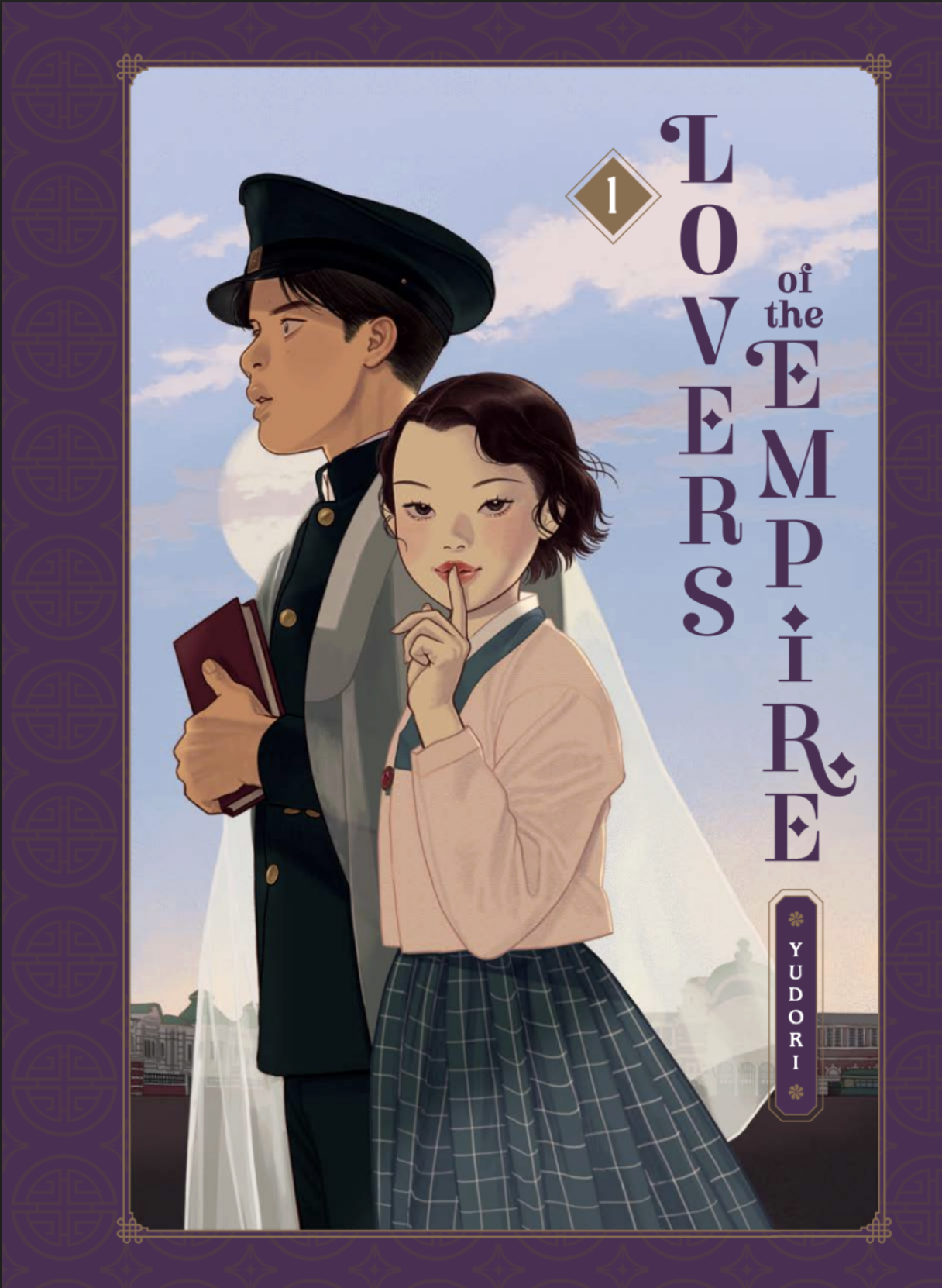
Cover, Lovers of the Empire by Yudori. Image Courtesy Fantagraphics.
REVIEW: Lovers of the Empire: Vol. 1
Written by Yudori
Fantagraphics, 2026 ($24.99), paperback
By Alexandra Azout
Jun Seomoon didn't fall for a girl. He fell for a life he'd never be allowed to have. Yudori’s novel, Lovers of the Empire, is set in the Japanese colonial capital of Joseon in northwestern Korea. The novel follows Arisa Jo, “the girl with the slimmest eyebrows” and daughter of a wealthy business man who owns a two-story, western-style fabric store, and Jun Seomoon, a young man Arisa’s father has taken in after an incident with the Japanese police resulted in the death of Jun’s father. Their relationship unfolds through this imbalance: Jun as the servant, Arisa as the girl whose family saved him. From the start of the graphic novel, as early as the cover of the book, Arisa and Jun are each other’s foils. Arisa carries herself as a woman of the modern age. She moves through Gyeongseong with confidence and attracts attention from everyone around her. Jun, on the other hand, is stuck in the ways of the countryside, holding onto the traditional forms of dress, speech, and life. His traditionalism not only leaves him stuck in the past, but alienates him from his current reality, leaving him constantly feeling like an outsider. However, Jun’s attraction to Arisa, a woman of the new world, pushes Jun to explore modernity first-hand, experiences otherwise unattainable to him. This tension makes Lovers of the Empire: Vol. 1 more than just a story about unrequited love. It's a metaphor about modernity being just out of reach and class being the reason it stays that way.
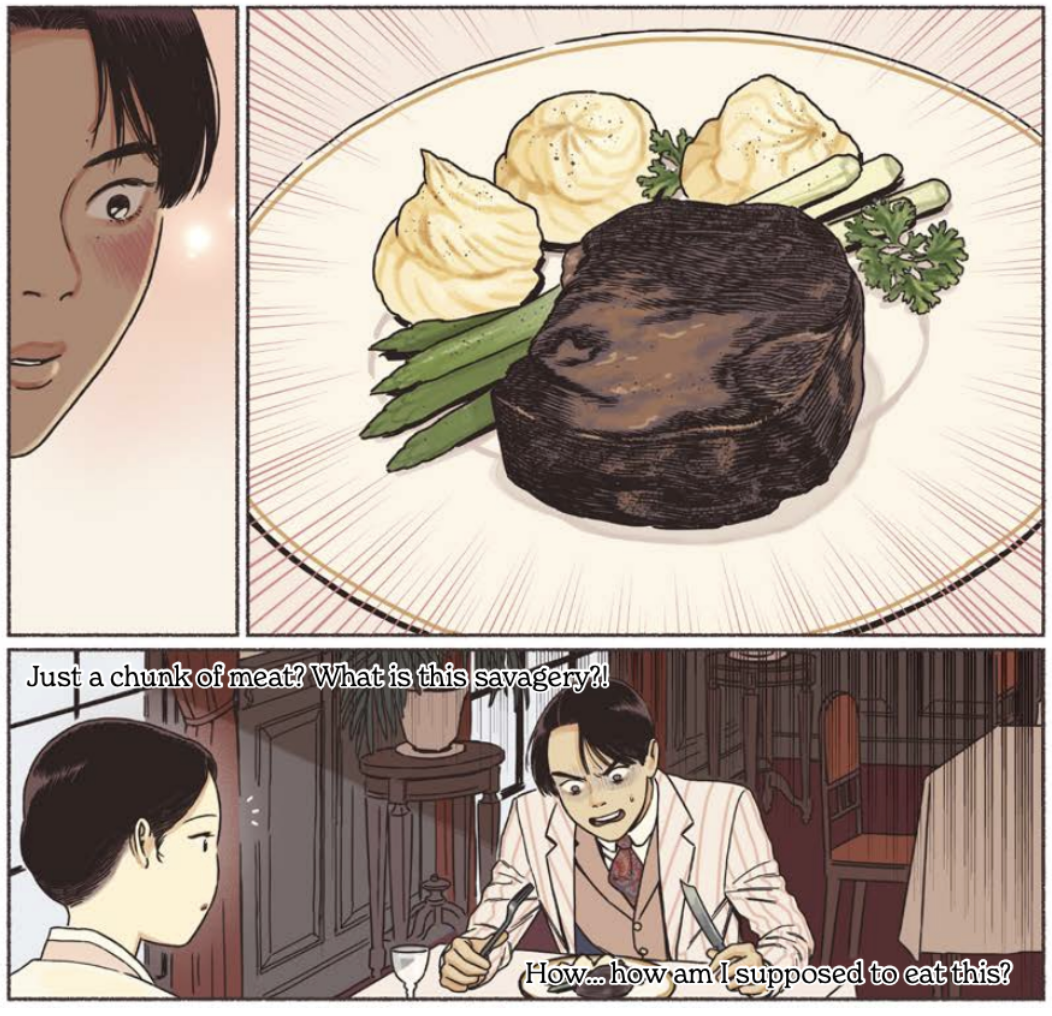
Image Courtesy of Fantagraphics
Through Jun's crush on Arisa, the graphic novel shows a man caught between wanting to modernize and being afraid to. In chapter five, Arisa takes Jun to a new restaurant in Gyeongseong station. Here, Jun’s crush on Arisa propels him to venture into modern acts but his fear keeps pulling him back to his traditional customs. Upon arriving at the station, Jun’s first obstacle is the escalator. He’s frazzled at the moving stairs while Arisa glides on and off naturally. At the restaurant, Arisa’s old American teacher startles Jun further with her perfect English, modern clothing, and the way she effortlessly initiates shaking his hand, while Arisa seamlessly wins her approval with her “western etiquette.” His dish, a beefsteak, further disorients him. He initially responds in outrage, but his first taste is “tender and delicious.” His disgust and his desire arrive in the same breath, but none of this is really about taste or nerve. Jun can eat the steak and ride the escalator but he can't actually buy his way into this world. His crush on Arisa isn't just unrequited, it's class-forbidden: his debt to Mr. Jo is the real thing standing between him and the modern life he's being seduced by. That's the tension this book keeps circling back to: it was never just about who's brave enough to modernize. It's about who can afford to. Jun's crush on the girl he can’t have is a metaphor for the life he wants but will never achieve. His shock and fear toward modernity are less a genuine reaction than a defense mechanism, a way of shielding himself from having to admit how unattainable it is.
Through these moments of confrontation, the novel complicates what "modernity" even means in colonial Gyeongseong. In the restaurant, modernity doesn't arrive as something simply Western, it arrives Japanese-mediated. The menu is written in English, but the room is Japanese: Jun notes that "everyone here is Japanese... and perhaps a few Modernized Joseonians," and when Arisa orders, she does so in Japanese, not English. Even the dish itself, a Western steak, comes back to the table filtered through Japanese pronunciation: "Beef-u steak-y desu." The one genuinely Western presence in the room, Miss Barrett, is treated as a novelty apart from all of this: "Western women even smell different," which makes clear that what's being performed at this restaurant isn't Western culture directly, it's Japanese colonial modernity borrowing Western signifiers. Jun doesn't just fail to fit into "the West." He can't even follow the version of modernity Joseon has already been handed. Arisa, meanwhile, moves seamlessly through all three layers: Japanese, English, Joseonian.
Alienated from his wealthy friends, Jun goes to great lengths to fit in as he accompanies Arisa on her "modern" excursions. In order to accompany Arisa to the movie theater, Jun must borrow a suit from a wealthy classmate. While the classmate agrees, he proposes a degrading trade: in exchange for the suit, Jun must satisfy the classmate’s crude curiosity about whether Arisa is “a real modern girl all the way inside” by stealing her sanitary pad. Wanting to look modern for one night costs Jun something that was never his to give away, and it costs Arisa a privacy she doesn't even know was taken from her. Jun's poverty doesn't just keep him out of Arisa's world, it puts him in a position where fitting into that world, even briefly, means bargaining with something that was never his to bargain with.
Colonial-era Korea provides a great backdrop for an in-depth discussion on what "tradition" actually costs, not just who’s brave enough to embrace it. While Yudori states at the end of the novel that this book is about women’s fashion, the true value of the book comes from an exploration into Arisa and Jun’s relationship. Fashion is and has always been tied directly to politics, and every generation battles over what styles are progressive or regressive. In Lovers of the Empire, Yudori brings class and money into the conversation. But this is only a small piece of the puzzle and, while it does contribute to the overarching theme, the value of the book comes from its narration about the transition away from old country traditions and toward the modernity the western and Japanese influence brings into the city. Money makes it easy to embrace change, but when you’re stuck in poverty, and when that which keeps you stuck is also that which introduces the changes of the modern world, it may not be that simple. By the time Yudori explores the significance of the characters’ dress, the reader already knows the novel is not just about western clothes, but about who can afford to wear them.
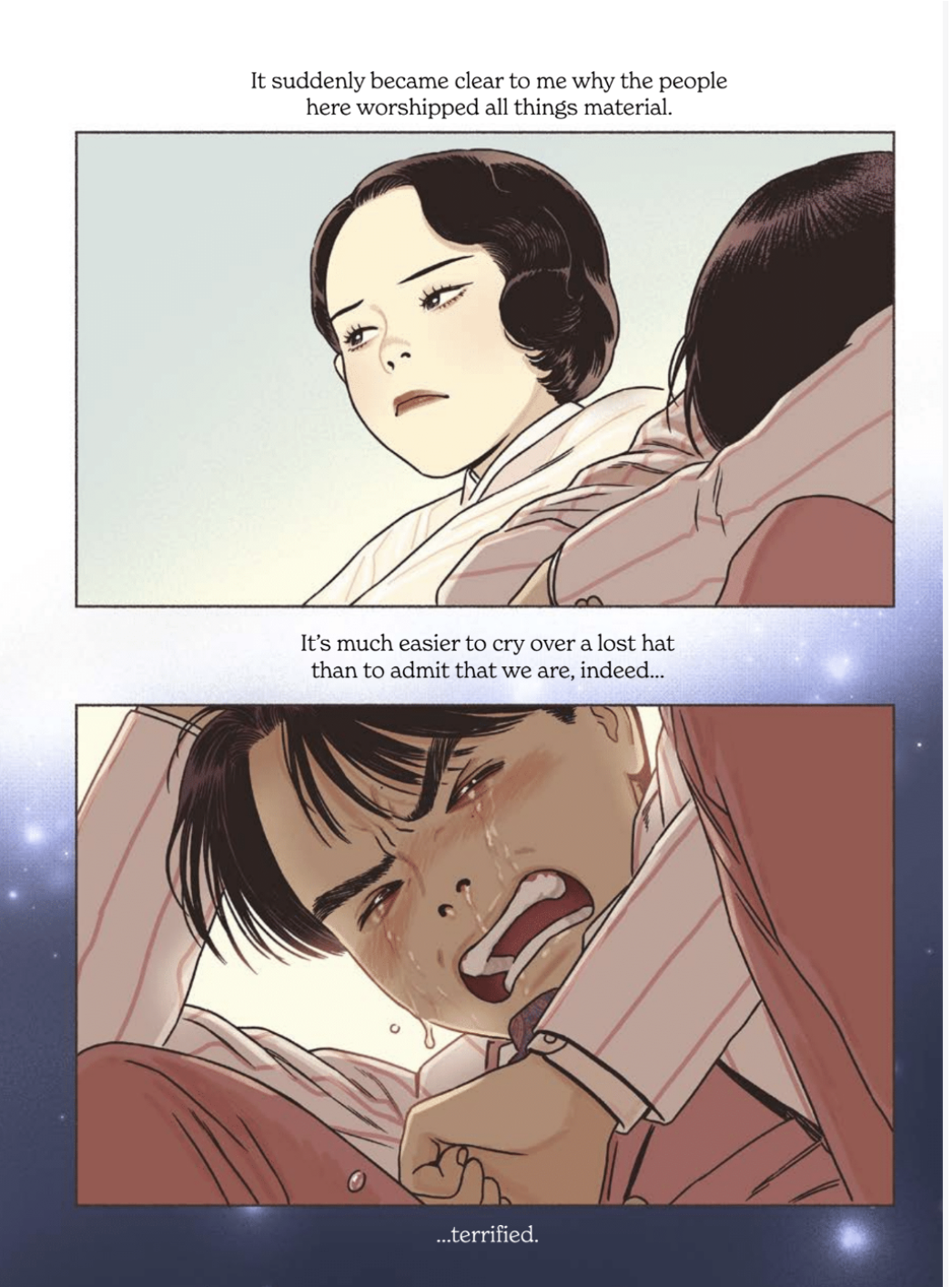
Image courtesy of Fantagraphics
The book's real argument about class comes into focus most clearly on page 195, in a line where it's not even clear who's speaking. After Jun loses his hat and cries, either Jun's internal narration or Arisa’s dialogue explains it isn't really about the hat at all: "It's much easier to cry over a lost hat than to admit that we are, indeed... terrified." The ambiguity of the speaker doesn't matter because it's true for both of them. Arisa, who spends the whole book looking like modernity comes easily to her, could be admitting she's scared of falling behind too. Jun, who spends the whole book feigning his distaste for modernity, could be admitting the same fear of being left behind from the other direction. Two characters positioned as opposites turn out to be hiding the exact same fear behind two different costumes; one dressed in Western fashion, one dressed in traditional Korean. It was never really about who's brave and who's afraid. The only real difference is who has enough money to cry about a hat instead of the truth.
Like what you’re reading? Consider donating a few dollars to our writer’s fund and help us keep publishing every Monday.