
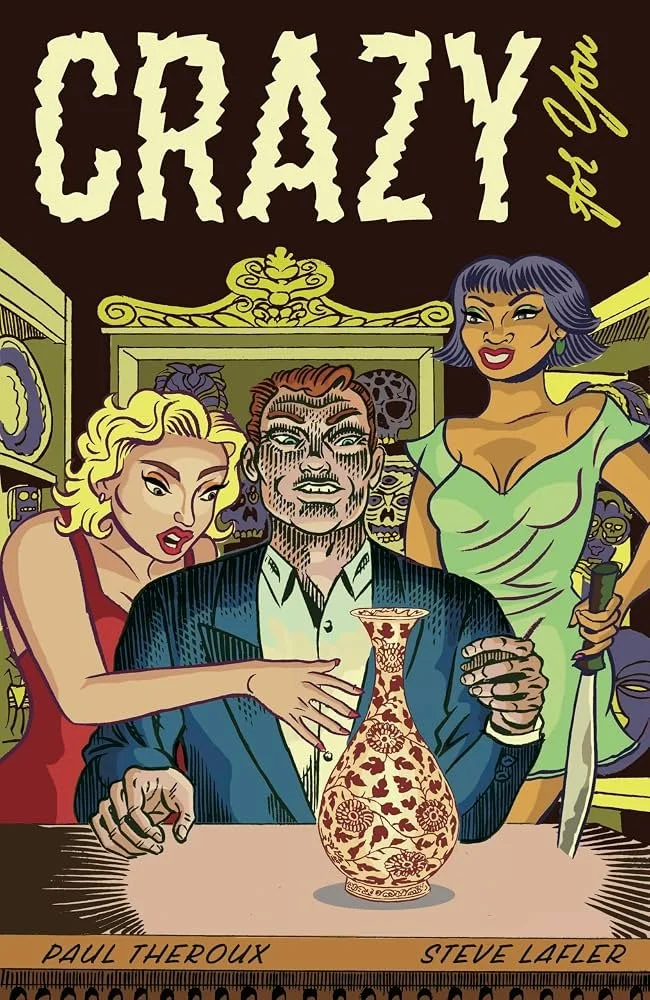
Cover, Crazy for You by Paul Theroux and Steve Lafler. Image Courtesy Fantagraphics.
REVIEW: Crazy for You
Written by Paul Theroux
Adapted and illustrated by Steve Lafler
Fantagraphics, 2026 ($24.99), hardcover
By Michael Workman
Drawn by Steve Lafler and written by Paul Theroux, the two stories collected here—“Siamese Nights” and “Minor Watt”—bleed sub-pop noir with an authenticity and seriousness that challenges the stark, black and white coolness of the book’s graphic style. Both follow men who have broken bad, tumbling into a darkness of narcissism and unchecked self-regard that leaves them blind to the wreckage they create—and to their own approaching ruin. In “Siamese Nights,” real human despair and longing for connection push against the surface pleasures of the genre, while “Minor Watt” takes us over the edge into a splendid portrait of narcissistic insanity. Both stories are rooted in a world of desperation and in the impossible ideals of creativity and freedom, ideals that boil over into a freedom from selfhood, replacing our ability to chart a course of conscience when blinded with the mean little passions of revenge, escape, and the seductive ignorances the sum of various minor evils can render.
Drawn cleanly with beautiful, ranging marker tones, Crazy for You adapts two stories that first appeared in Theroux’s 2014 collection Mr. Bones: Twenty Stories. The pairing is a fitting collision of sensibilities. Theroux, best known for a body of fiction and travel writing that includes The Mosquito Coast and decades of work tracing the desires, evasions, and moral compromises of people in motion, brings to these stories his familiar interest in drift, appetite, self-deception, and the places where freedom becomes another name for exile. Lafler, whose long career in alternative comics includes Dog Boy, BugHouse, 1956, and the Cat-Head Comics imprint, meets that material with a graphic language rooted in underground comics, jazz-age noir, grotesque comedy, and an evocative, almost sturm and drang aspect to his elastic figuration. The resulting pages go beyond illustrated literary adaptation, to a translation of Theroux’s moral unease into line, shadow, gesture, and a tensile anti-caricature that fits beautifully into the thoughtfully wrought, scenic pages.
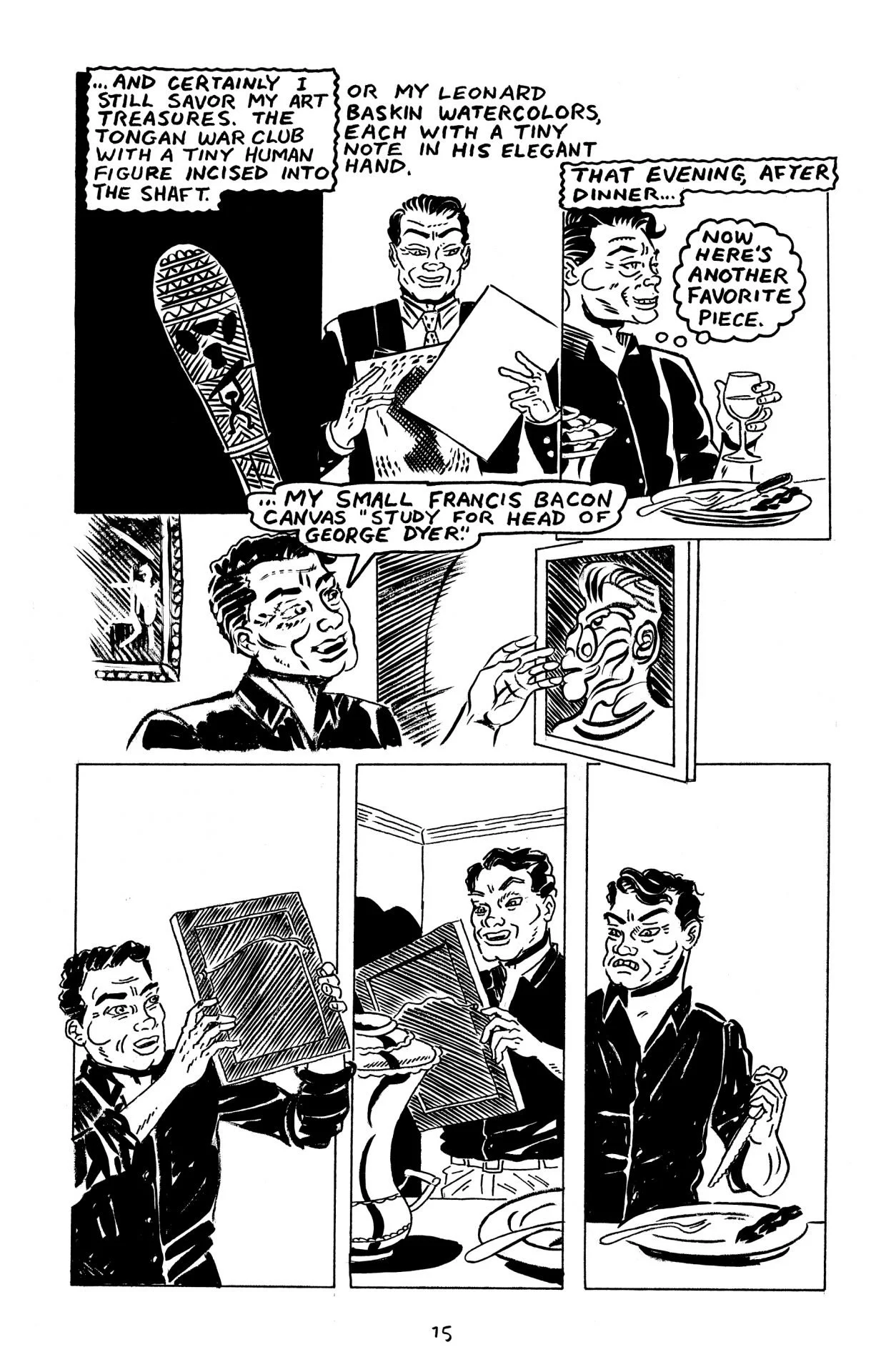
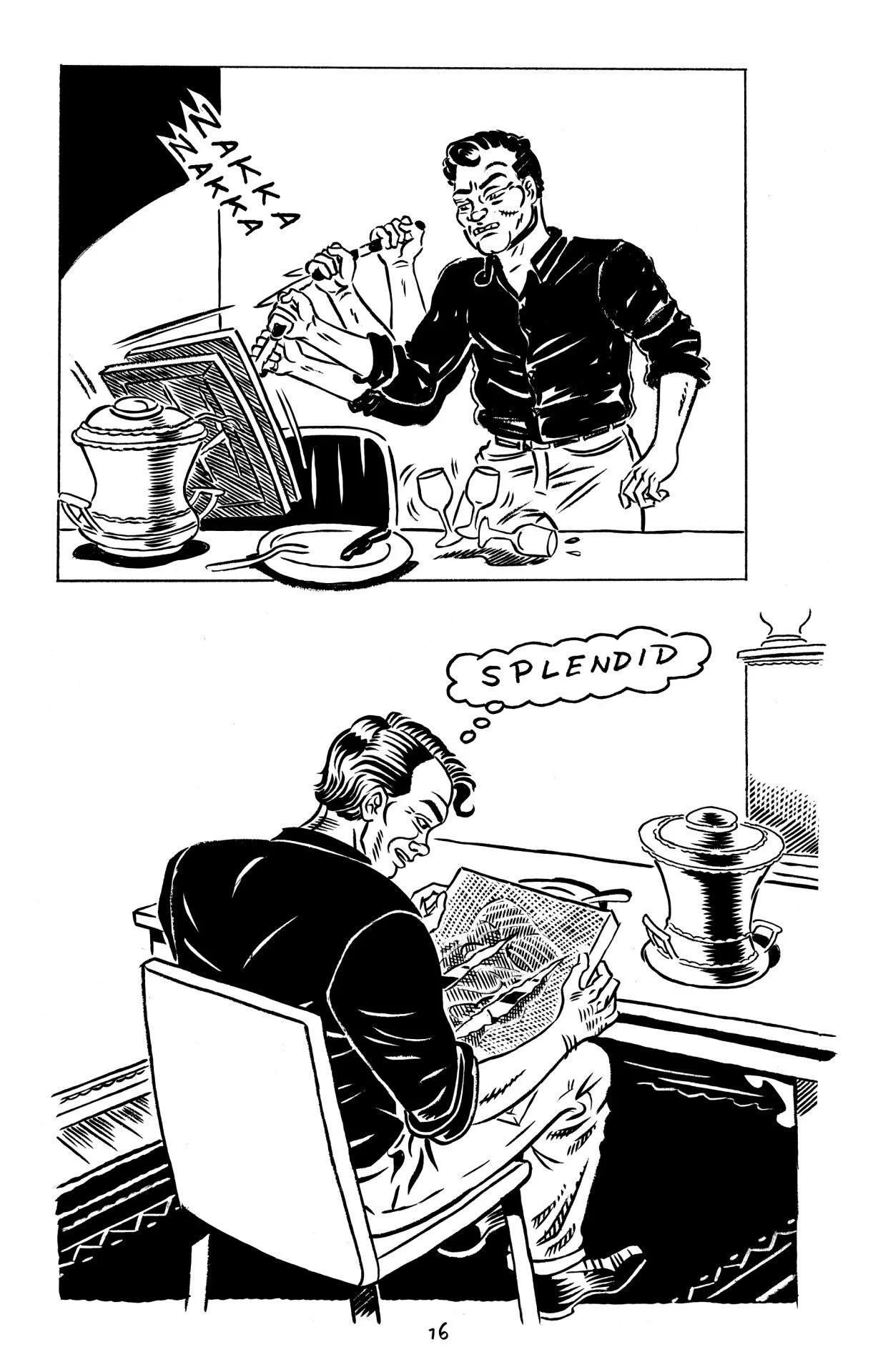
“Siamese Nights” is almost more a short novella than a conventional comics story, and in many ways it is the longer, more engrossing, and less bombastic of the two pieces, though “Minor Watt” has its own explosive charms. The inversion between them is part of the book’s charge: “Minor Watt,” with its engrossing, action-packed power trip tour through the art world, follows a wealthy collector whose divorce and appetite for control curdle into a mania for destroying the very objects he once coveted. “Siamese Nights,” by contrast, turns on a quieter story of infidelity, infatuation, and betrayal, following Boyd, an aging businessman and amateur artist in Bangkok, as his longing for escape and intimacy leads him toward a relationship that seems, at first, to offer renewal. But the story grows darker the more hopeful it seems to tilt, until its promise of connection becomes inseparable from delusion, exploitation, and loss.
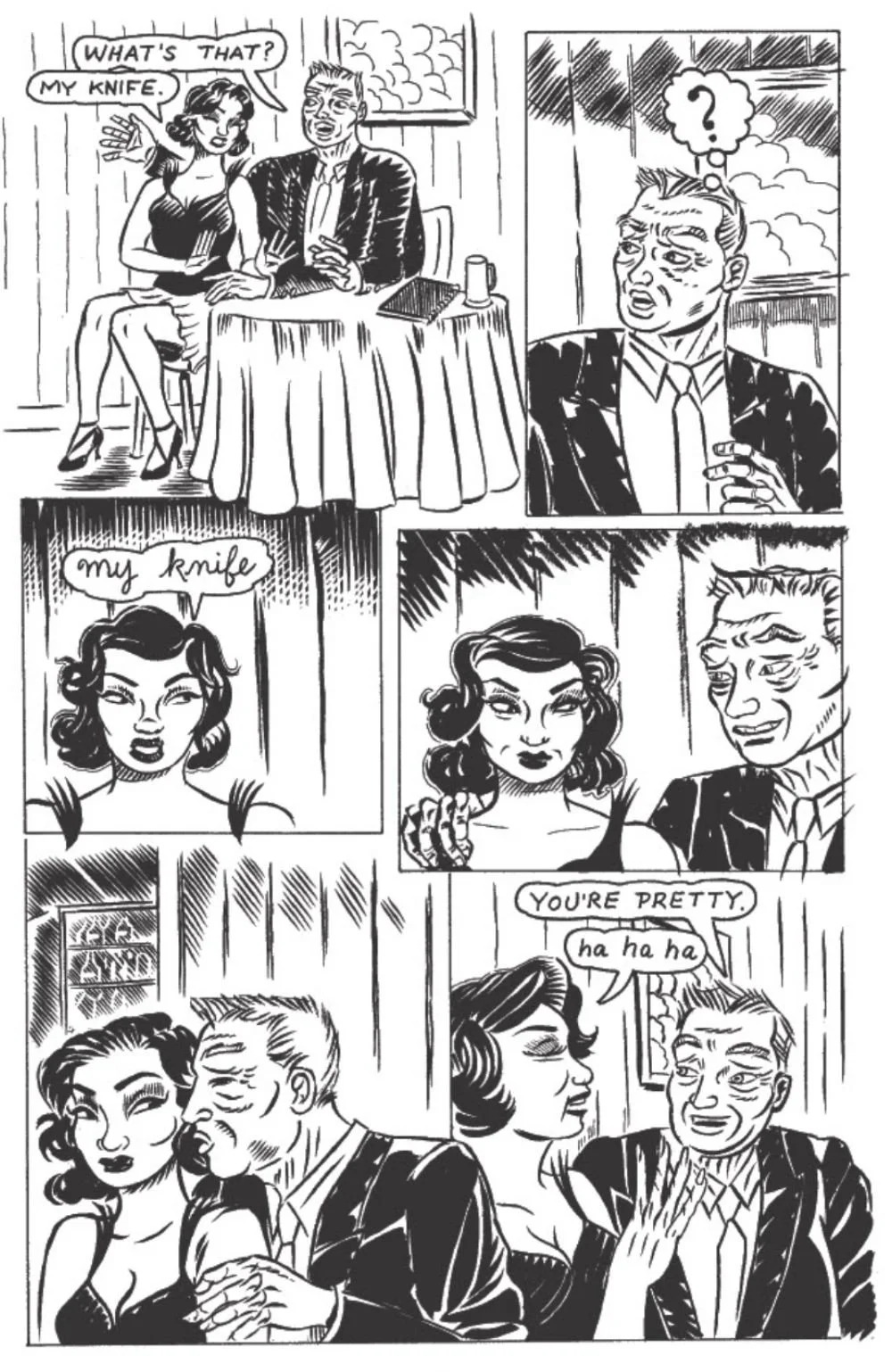
What makes the book work so well is the way Lafler refuses to flatten Theroux’s moral atmosphere into simple satire. “Minor Watt” could easily be played as a grotesque revenge fantasy about wealth, taste, and wounded male vanity, and in part it is exactly that. But Lafler’s drawings keep the story moving at the pitch of psychic collapse, where the architecture of privilege becomes ridiculous, then sinister, then strangely pathetic. The book wryly skewers the art world’s now-familiar avarice, particularly its habit of turning objects of individual creative imagination into trophies of wealth and taste. The joke turns on the presumed transfer of distinction: the buyer acquires the work, then takes its originality as evidence of their own. Minor’s rage against art is more than philistinism or a parody of collector culture. It is the tantrum of a man who mistakes possession for meaning, believing he can absorb a work’s creative force by owning it, as if devouring the flesh of his enemies. When he extends that claim of ownership to another person, he provokes a violent revolt that leaves him naked, bleeding, and publicly shamed.
“Siamese Nights,” though quieter, cuts deeper. Boyd’s fantasy of Thailand as escape, intimate renewal, and rebirth comes in the arms of a trans lover who has seen her share of deceit and disappointment, and wraps him around her little finger. Whereas the over-the-top sword assault of the first story results from an attempt to take possession to its next, absurd level, Theroux’s story is alert to the ugliness of projection, and Lafler gives that projection a visual grammar: interiors close in, faces harden, bodies become angular with suspicion and need. Boyd is not a monster in the manner of "Minor Watt,” but his delusions aren’t harmless either. His longing produces consequences, and the story’s power lies in how steadily, cut through with moments of seemingly real tenderness and awakening to joy, as it watches those consequences arrive.
Crazy for You succeeds because of how well Lafler finds the spark of Theroux's superbly written tales of comeuppance and despair and turns up their temperature—their heat, their sourness, their tragicomedy, their melancholy—and lets the drawings hold contradictions delivered with striking visual immediacy. The result is a strange, elegant, and unsettling book, its visual cool a foil for the messy, desperate, and grotesquely painful lives it depicts. In Crazy for You, freedom becomes another name for escape, sustained by the fantasy of having transcended ordinary life and its obligations. In the depths of that delusional fantasy, even the sincerest longings can leave everyone involved scarred for life.
Michael Workman is Editor-in-chief of Bridge.
Like what you’re reading? Consider donating a few dollars to our writer’s fund and help us keep publishing every Monday.