REVIEW: “Dancing the Revolution: From Dancehall to Reggaetón”
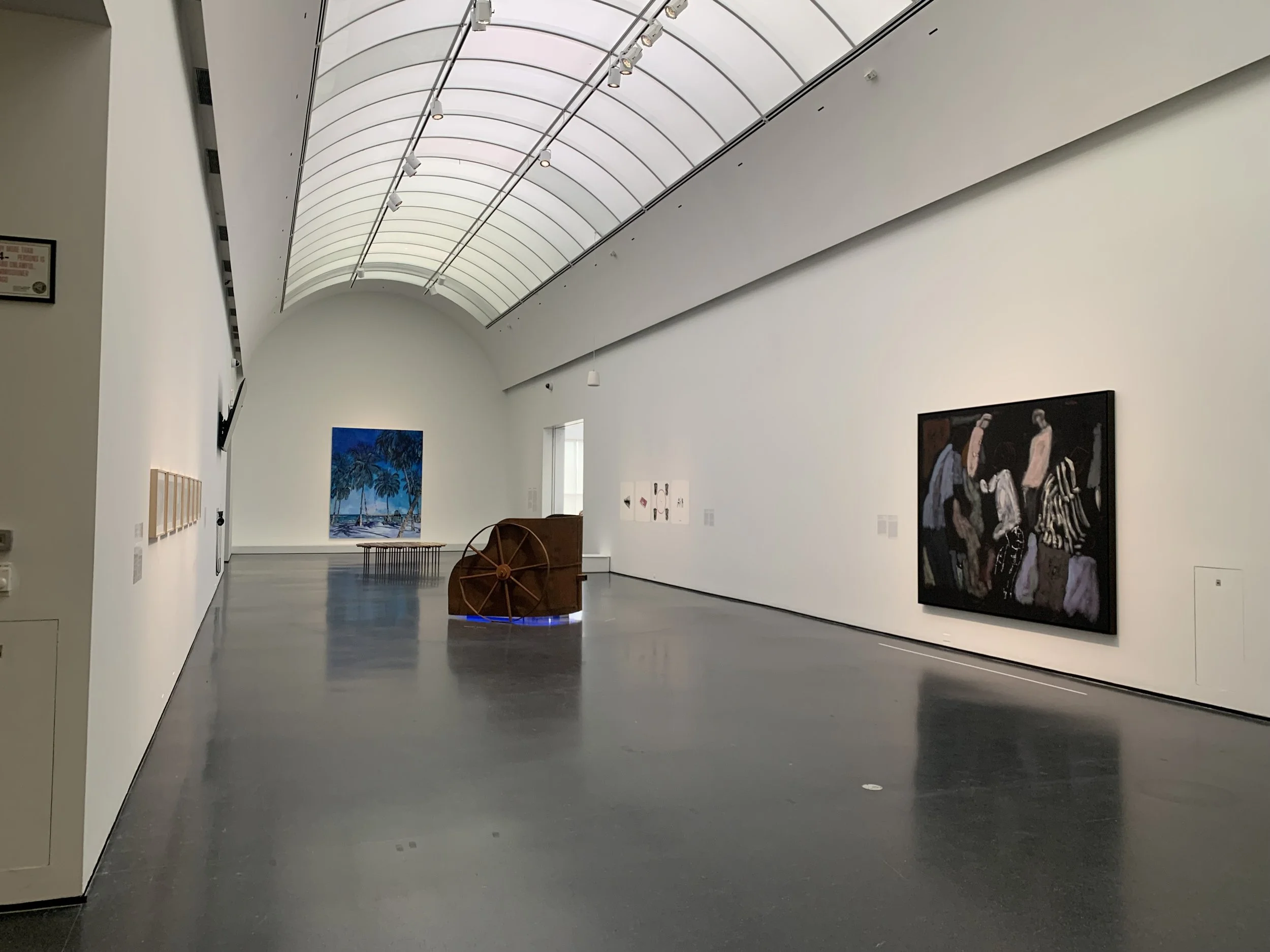
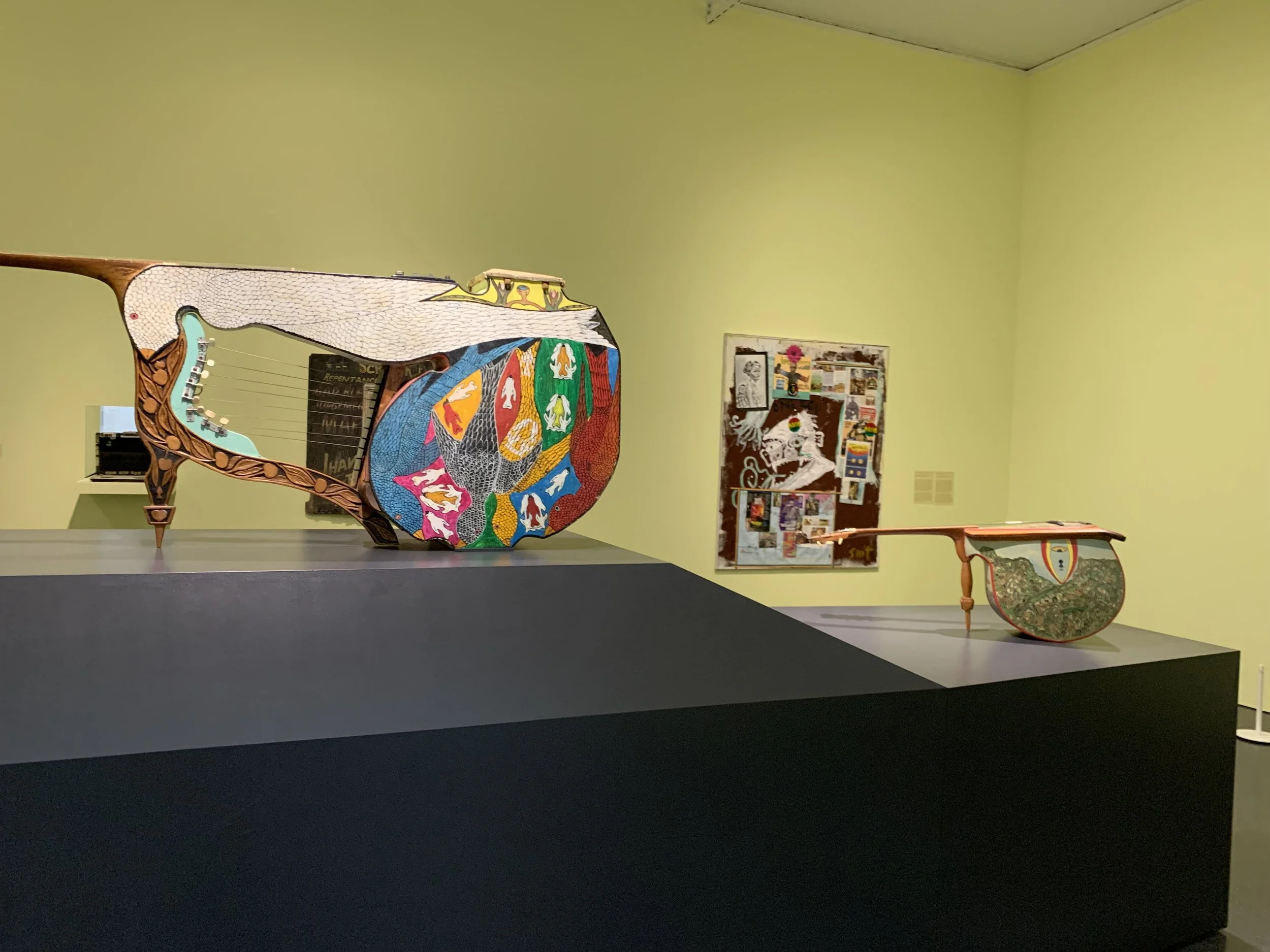
Installation view featuring: Everald Brown (Clarendon, Jamaica, 1917–2003), Starry Harp (Instrument for Four People), 1986. Oil paint on wood, 5 5/8 ft. (1.7 m). National Gallery of Jamaica Collection, L2024.151. Everald Brown (Clarendon, Jamaica, 1917–2003), Dove Harp, c. 1973. Oil paint on wood, 23 1/3 in. (64 cm). Lee “Scratch” Perry (Kendal, Jamaica–Lucea, Jamaica, 1936–2021), Untitled Painting (Super Ape), 2019–20. Collage and acrylic on canvas, 66 7/8 × 55 1/8 in. (170 × 140 cm). Courtesy of the Visual Estate of Lee Scratch Perry, L2025.315. Image courtesy of the Museum of Contemporary Art Chicago.
REVIEW
Carla Acevedo-Yates:
Dancing the Revolution: From Dancehall to Reggaetón
Museum of Contemporary Art, Chicago
220 E Chicago Ave,
Chicago, IL 60611
Apr 14–Sep 20, 2026
Review by Olivia Baczkowski
In 2019, the Puerto Rican people called for the resignation of the corrupt Governor Ricardo Rosselló after controversial messages between himself and colleagues were leaked, revealing homophobic and misogynistic hate speech, as well as statements made mocking victims of Hurricane Maria. While crowds ran to fill the streets playing diss tracks and the queer community invited people to dance to Reggaetón in front of an Old San Juan cathedral, Curator Carla Acevedo-Yates watched as a protest turned into a dance. This experience informed her new exhibition, Dancing the Revolution: From Dancehall to Reggaetón at the Museum of Contemporary Art Chicago. Standing outside the exhibit, one can hear the shouts of protest accentuated by the sweet beat of bass, beckoning them inside, and urging them to dance.
Dancing the Revolution: From Dancehall to Reggaetón is a Museum of Contemporary Art Chicago exhibit running from Apr. 14, 2026 - Sep. 20, 2026 that boasts 40 artists’ works across varying mediums. The enormous exhibit spans nine rooms of the Griffin Galleries of Contemporary Art, providing an overwhelmingly immersive exhibit. Curated by Carla Acevedo-Yates, Dancing the Revolution seeks to explore the cultural, political, and spiritual significance of dancehall and reggaetón music as it expands beyond its grassroots origins of revolution into pop culture and media.
By weaving between exhibits that invite viewers to sit and listen and others that encourage them to actively interact, Dancing the Revolution masterfully balances the relationship between music and silence, as well as dance and stillness, forcing us to confront the critical role music has historically played in leading political revolutions. Following the powerful Bad Bunny Superbowl Halftime Show in February of 2026, during a time of heightened ICE presence and intense turmoil in the United States under the Trump administration, this exhibit feels relevant now more than ever.
Dancing the Revolution: From Dancehall to Reggaetón is most effective because of its comprehensive and expansive curation.. Carla Acevedo-Yates is a Puerto Rican-American curator and art critic who has worked across Latin America, the Caribbean, and the United States. Moved by the 2019 diss-tracks and protests in Puerto Rico, Acevedo-Yates hoped to bring the tension of watching political turmoil on TV across the world meet the music and dance that followed to a Chicago exhibition. In a Block Club Chicago article, she explains, “It’s about the protest, but it’s about grief. The exhibit plays into these contradicting emotions that we hold together and that we’re able to not reconcile but acknowledge.”
Each of the nine rooms featured in this exhibit explore their own color story and cultural theme. The first room is all white and sparsely filled, allowing the noises from adjacent rooms to fill the space. The open space and sparse design almost invites the visitor to dance to the thumping bass from nearby speakers. Prominent works are two speaker sculptures, the first being Sole Imperial (For Patrick Johnson), a mobile speaker system built to evoke the image of a crescent wave. The other is Swing Lo’, a one-wheeled chariot outfitted like a lowrider car and featuring a speaker system actively playing 1990s Jamaican dancehall music. The speakers, both as a stationary sculptural piece and a chariot on wheels support the thesis that a sound system turns a physical space into something completely new. By placing speakers into a hall or wheeling them through town, the sound system turns a room into a dancehall, or a street into a protest.
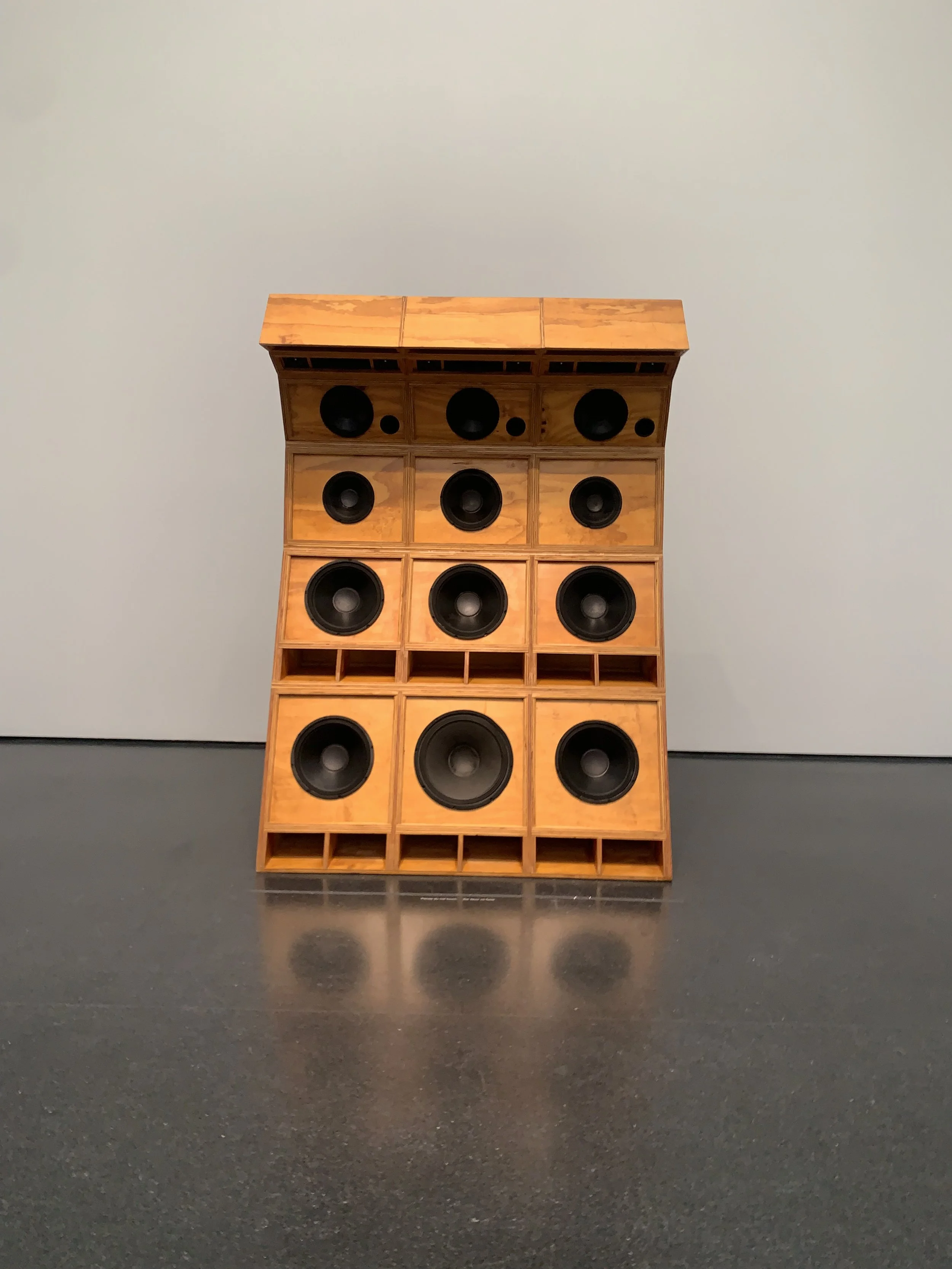
Cosmo Whyte (St. Andrew, Jamaica; lives in Los Angeles, CA, 1982), Sole Imperial (For Patrick Johnson), 2019–25. Plywood, 12 speakers, 3 horns, 15 tweeters, and sound composition; 31 minutes, 28 seconds. Image courtesy of the Museum of Contemporary Art Chicago.
The next room is doused in yellow and is the only silent room in the exhibit, creating a meditative atmosphere. The room explores the way Rastafari and revival practitioners use music in their spiritual practices. One prominent painting shows a Rastafari Nyabinghi groundation, a call-and-response drum style that worked to build spiritual energy. Another shows revival practitioners dancing and singing during a Church-like ritual. The tension in the silence despite the bright depictions of the culture forces the viewer to confront practices that are lost due to colonization. This room serves as an ode to and a reminder of the culturally embedded origins of the popular Caribbean music we hear today.
The following room, boldly colored in purple, features work exploring the racially-hostile club scenes of 1967 Britain. The key artefact is an experimental film Territories that documents the Notting Hill Carnival. Images jump between and layer police harassment, racial violence, a DJ spinning records, and riots. The tension between the images fighting for the viewer's attention mirrors the tension between race, class, and labor of the 1960s and 70s. This part of the exhibit is also the first to highlight the intersectional conflict that emerged from the racial turmoil, with the film showing migrant queer men dancing together while a British flag burns in the background. The jarring pairing of these rooms forces the viewer to go from reverent viewing to high alert, showing the clashing friction of colonial efforts against foundational spiritual and personal practice.
The next three rooms represent highlights in dancehall history, with the first room featuring four listening stations called “Amplified Panama,” inviting the viewer to sit and listen to mixtapes that explore key moments in the reggae genre. The listening stations face a gallery wall of photography documenting decommissioned U.S. buses that were turned into mobile DJ stations. By providing mixtapes to viewers to listen in, and by highlighting mobile DJs, Acevedo-Yates accentuates the importance of accessibility in regards to dancehall and reggae. The following room explores how this accessibility to dancehall and music transforms them from a local sanctuary to a cultural phenomenon. Across from a customized sound system shaped into a cross, a strong nod to the spiritual origins of Caribbean music, plays a projected video of Bom Bom’s Dream. The film follows a Japanese cartoonist who goes to Jamaica to compete in a dancehall dance-off. She’s seen “daggering,” a Jamaican dance that mimics the motions of thrusting during sex, and dancing “la iguana,” a traditional Mexican folklore dance. Bom Bom’s story and presentation shows the way dancehall music transitioned from a spiritual practice into an international cultural experience.
Installation view featuring: Michael Richards (Brooklyn, NY–New York, NY, 1963–2001), Swing Lo’, 1996. Steel, neon, wood, speakers with musical soundtrack, 50 × 52 × 64 in. (125 × 132.1 × 162.6 cm). Courtesy of the Michael Richards Estate, L2025.6. Radamés “Juni” Figueroa (San Juan, Puerto Rico; lives in San Juan, 1982), Untitled (Héctor’s Sound System at Escambrón Beach), 2026. Acrylic on canvas, 8 × 10 ft. (2.44 × 3 m). Courtesy of Proyectos Ultravioleta and Embajada, L2025.823. Reggie Burrows Hodges (Compton, CA; lives in California, 1965), The Offbeat: Bouncenstep, 2022. Acrylic and pastel on linen, 78 3/4 × 97 1/2 × 1 3/4 in. (200 × 247.7 × 4.5 cm). Image courtesy of the Museum of Contemporary Art Chicago.
The following room, decked out with bright green walls, features 1980s Dancehall Queens. A modern satirical TV show about dancehall plays on a TV, while the walls are lined with Phil Collins’s short films that explores queer issues in Caribbean culture in Berlin. Up to this point, dancehall is described as a community hub, a place to express themselves around the world, and to find like-minded people. However, this room highlights some of the misogynistic traits found in dancehall music, such as the promotion of hyper-masculinity and the use of homophobic lyrics. This room explores how femme and queer activists have worked to reclaim dancehall music as a space for sexual and personal liberation. The prominent work consists of TV screens playing 2026 satirical game shows called The Dutty Gyal Show that presents a fictional dancehall-themed morning show. The layered visuals and merging voices from speakers create an overwhelming environment where you need to pay close attention to hear what any individual is trying to say. The lighthearted game show paired with the looped visuals of queer art emphasize the joy that dancehall music brings to communities in times of political hardship.
In stark contrast, the next room shows only a documentary film titled, grief becomes gunpowder, but without the flame, it doesn’t become a fire. The film features footage shot during Puerto Rico’s Verano del 19 protests and follows a group of revolutionaries fighting back against the police. The film opens on an open ocean and ends with a close-up on flames, showing how the stereotypical tropical paradise quickly turns to fire and destruction through colonial efforts and violence. This room serves as a reminder that not all freedom songs are happy. Sitting in the dark room, the viewer is forced to sit and watch the violence of the protests and listen closely to the words the filmmaker wants you to hear. “I am queer, I am a slut, but I will never be corrupt.”
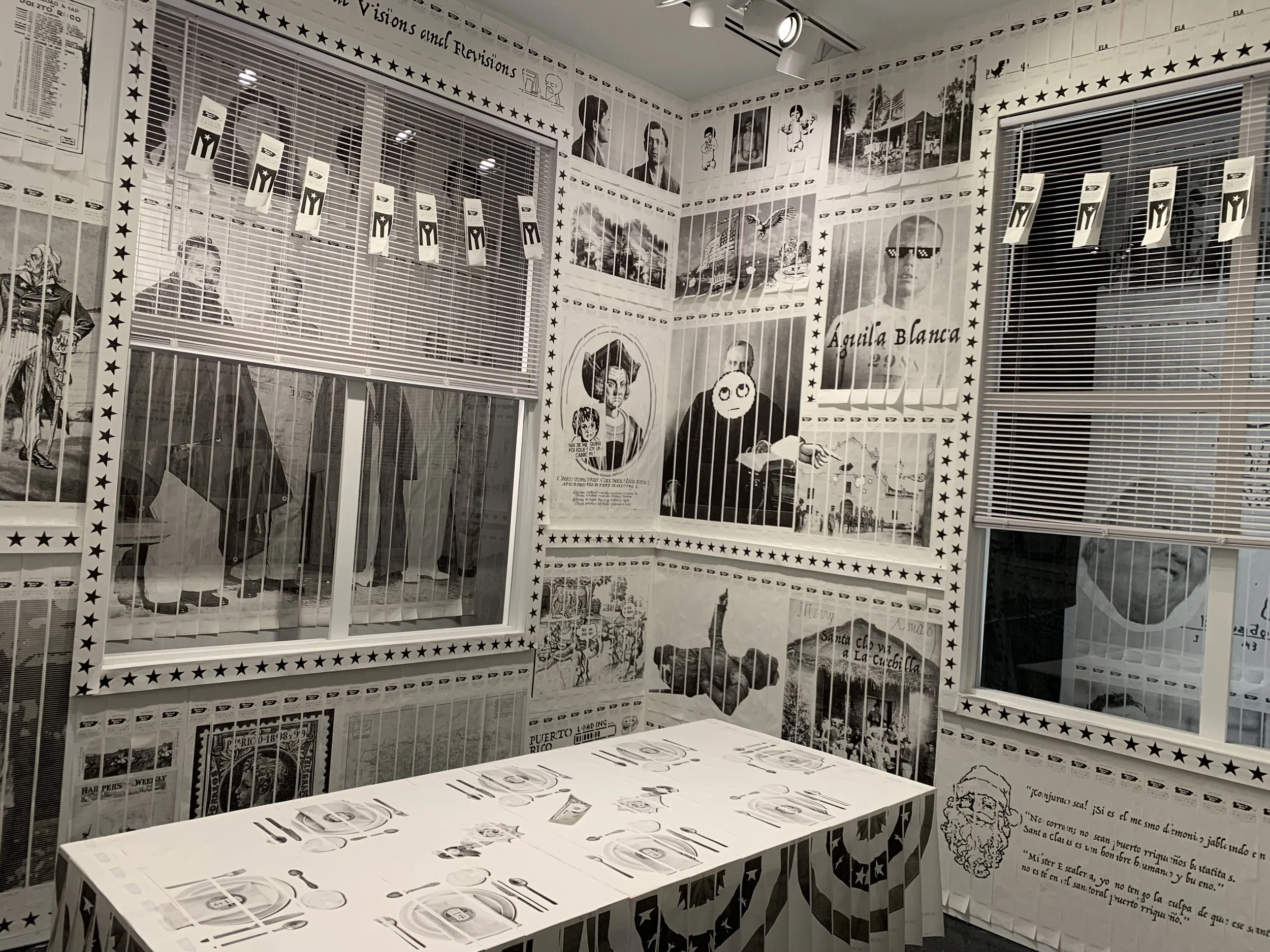
Garvin Sierra Vega (Ponce, Puerto Rico; lives in Puerto Rico, 1977), Retratos de una deuda, 2023. Receipt papers, 11 × 12 × 10 ft. (3.4 × 3.7 × 3 m). Artist collection, L2025.325. Image courtesy of the Museum of Contemporary Art Chicago.
The final two rooms bring dancehall and Puerto Rican culture to the present. One room, which is the size of a large closet, has the walls, ceiling, and floors entirely covered with black-and-white receipt papers issued from the “House of Debt.” The chronological collage of images and newsprints tells the story of Puerto Rico’s 74-billion dollar debt crisis and the institution of the Financial Oversight and Management Board for Puerto Rico by the U.S. Shaped to look like a Fourth of July dining room table, the papers and the room highlight the devastating colonial efforts of the U.S. in Puerto Rico.
The other features interactive elements that urge the viewer to become a part of the exhibit and forces them to recognize their place in history. After numerous rooms that invite the viewer to sit and listen via headphones in a solitary experience, or watch on a shared TV, the final room stands out as it invites the viewers to interact with the space in a way that changes the exhibit itself. The karaoke stage is functional and visitors are invited to come during open hours to perform. A tropically-painted bar that mimics a DJ station invites viewers to step behind and listen to music through headphones. Plastic chairs plastered with images of Bad Bunny have signs inviting viewers to sit, and a free jukebox lets you set the tone of the room through your choice of song. This final room is both a reminder of how much further we still have to go as a world and how much value music still has as a revolutionary tool, particularly in the United States. With rising danger in minority communities due to ICE raids and anti-trans legislation under the Trump administration, Dancing the Revolution: From Dancehall to Reggaetón reminds us the time to act is now. Dancing the Revolution: From Dancehall to Reggaetón is a reminder of hope in times of desperation – a call to action to dance and sing through the hardship. It is a reminder that finding joy through suffering is not a sign of weakness, but rather a byproduct of community strength.
Olivia Baczkowski is a Chicago-based writer and filmmaker.
Like what you’re reading? Consider donating a few dollars to our writer’s fund and help us keep publishing every Monday.