
REVIEW: Raqib Shaw’s “Paradise Lost” at the Art Institute of Chicago
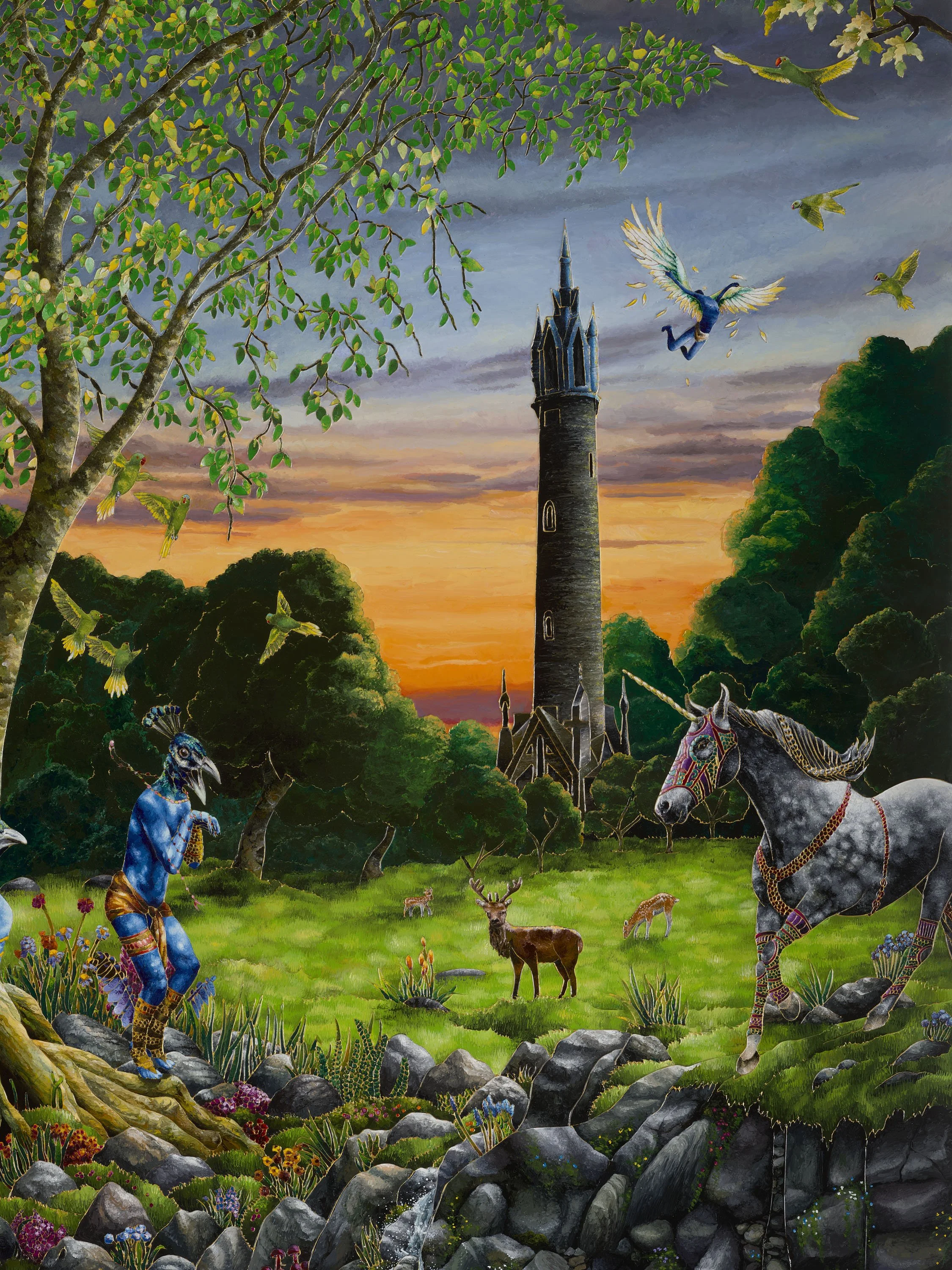
Raqib Shaw. Paradise Lost (detail), 2009–25. Collection of the artist. © Raqib Shaw. Photo by Prudence Cuming, London.
REVIEW
Raqib Shaw: Paradise Lost
Art Insitute of Chicago
111 South Michigan Avenue
Chicago, IL 60603
Review by Anna Wittenkeller
It is impossible to enter the first floor of the modern wing at the Art Institute of Chicago without staring in amazement at Raqib Shaw’s Paradise Lost. The painting measures over 100 feet long and comprises 21 panels portraying four chapters of Shaw’s life, filled with fairytale creatures and religious symbolic imagery.
Paradise Lost has been a work in progress for Shaw since 2009, but this exhibition marks the first time that the piece is being seen in its entirety. On one end, a human with a tiger’s head looks into the full moon from the edge of a cliff. On the other, a party of creatures with peacock heads and blue, human bodies laze about under a tree, holding parasols and playing chaupar. In between, there are deluges of water, cities crumbling, and bloodthirsty animals, fine-tuned with such precise detail that viewers can only see up close. At first, the scene appears to be vibrant, but serene—ocean waves crashing, cultural temples erected in the sun, and monkeys perched on tree branches. But upon closer inspection, darkness lurks in the details of these beautiful, grander scenes. The waves are violent, the temple is tumbling, the monkeys’ maws are bloody. These images serve as a symbolic reference to Shaw’s past.
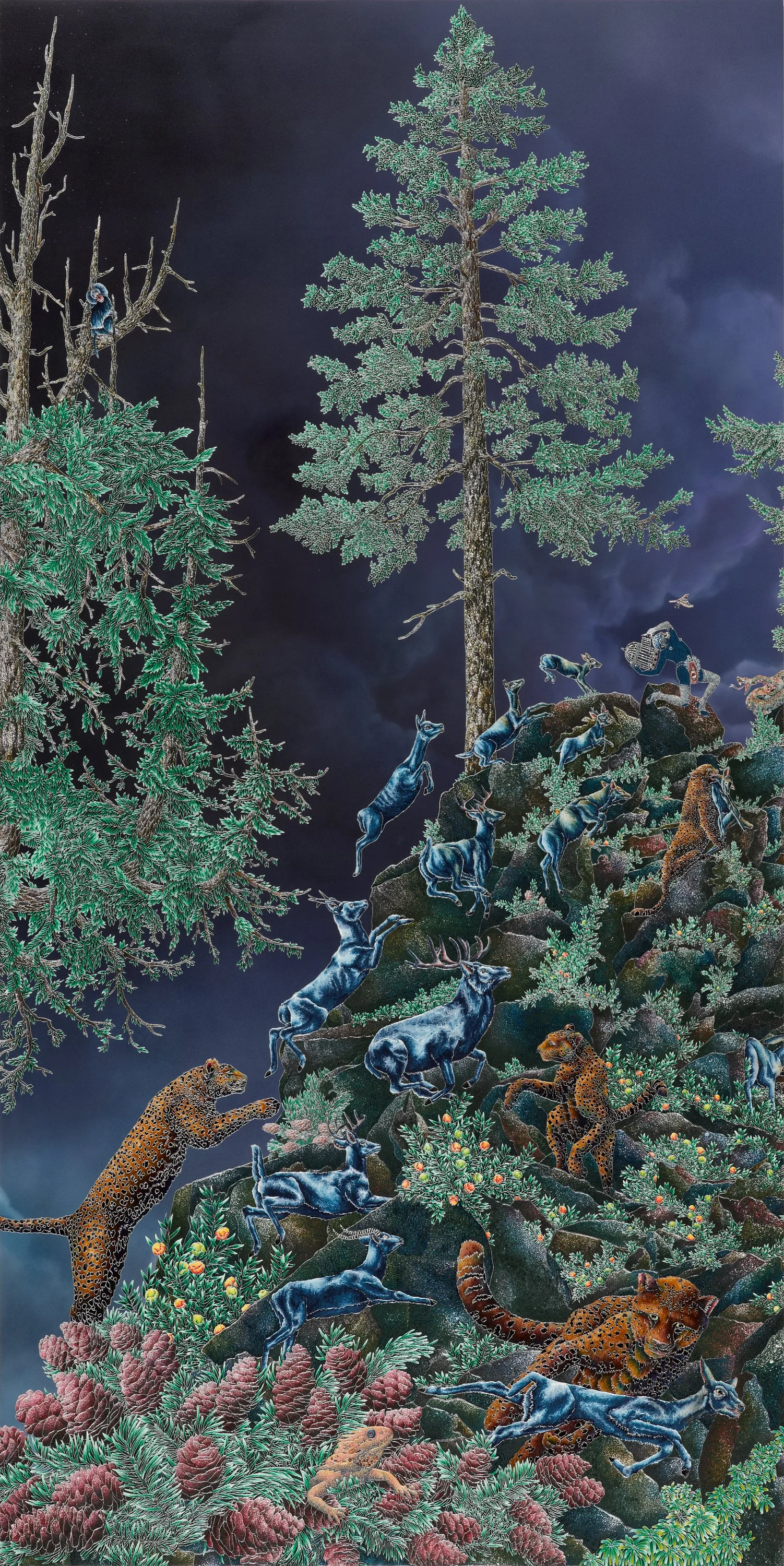
Raqib Shaw. Paradise Lost (detail), 2009–25. Collection of the artist. © Raqib Shaw. Photo by Prudence Cuming, London.
Shaw was born in Calcutta, India and raised in Kashmir, a valley tucked in the Himalayan mountains. At sixteen, Shaw fled with his family to New Delhi, escaping Kashmir’s political unrest due to longstanding territorial conflict between India and Pakistan. At 18 years old, Shaw moved to London and immersed himself in the city’s art scene. Though he never returned to Kashmir, his paintings of natural beauty of the forests and mountains depict the bittersweet memories he has of the land he grew up on. Kashmir itself is a “paradise lost” to Shaw, much like the Garden of Eden was to Adam and Eve in John Milton’s Paradise Lost, the name which lends itself to Shaw’s painting. By portraying both the pain that comes from loss, as well as the peace that can follow, Shaw explores the aftermath that comes from a communal loss and how that affects cultural memory.
Kashmir has long been the site of unrest, as both India and Pakistan seek control of this territory. Both countries were declared independent from the colonialist control of the British Empire in 1947, but Kashmir has been a conflict site since. As a result of human interference with the land, Kashmir has seen an increase in the effects of the climate crisis. The Kashmir valley is at a higher risk for destructive flooding and natural resources are receding, proving that the land is also paying the price for the conflict that Shaw’s family fled from. A community may have a symbiotic relationship with the land: if we are kind to the land, the land is kind to us. But if we are not kind to the land, then the land will return our cruelty. This is what audiences can see in Shaw’s Paradise Lost.
Shaw’s Paradise Lost is painted with automobile enamel paint on wooden panels. Glitter and small crystals are used to make the painting shimmer in the light. There is an acrylic liner, applied on gesso, that creates a gold outline, similar to the seams of stained glass windows. Because of the fantastical creatures and the way the paint glints in the light, the painting is dreamlike. Through this visual, the viewer enters a dreamlike world that Shaw has created; the lines between reality and fantasy become blurred. The loss of Shaw’s reality invades his fantastical images, showing that pain persists unless we address it. Shaw explores how various losses through one’s life shapes our memories and our lives, especially when those losses are not experienced by just one, but a community of others.
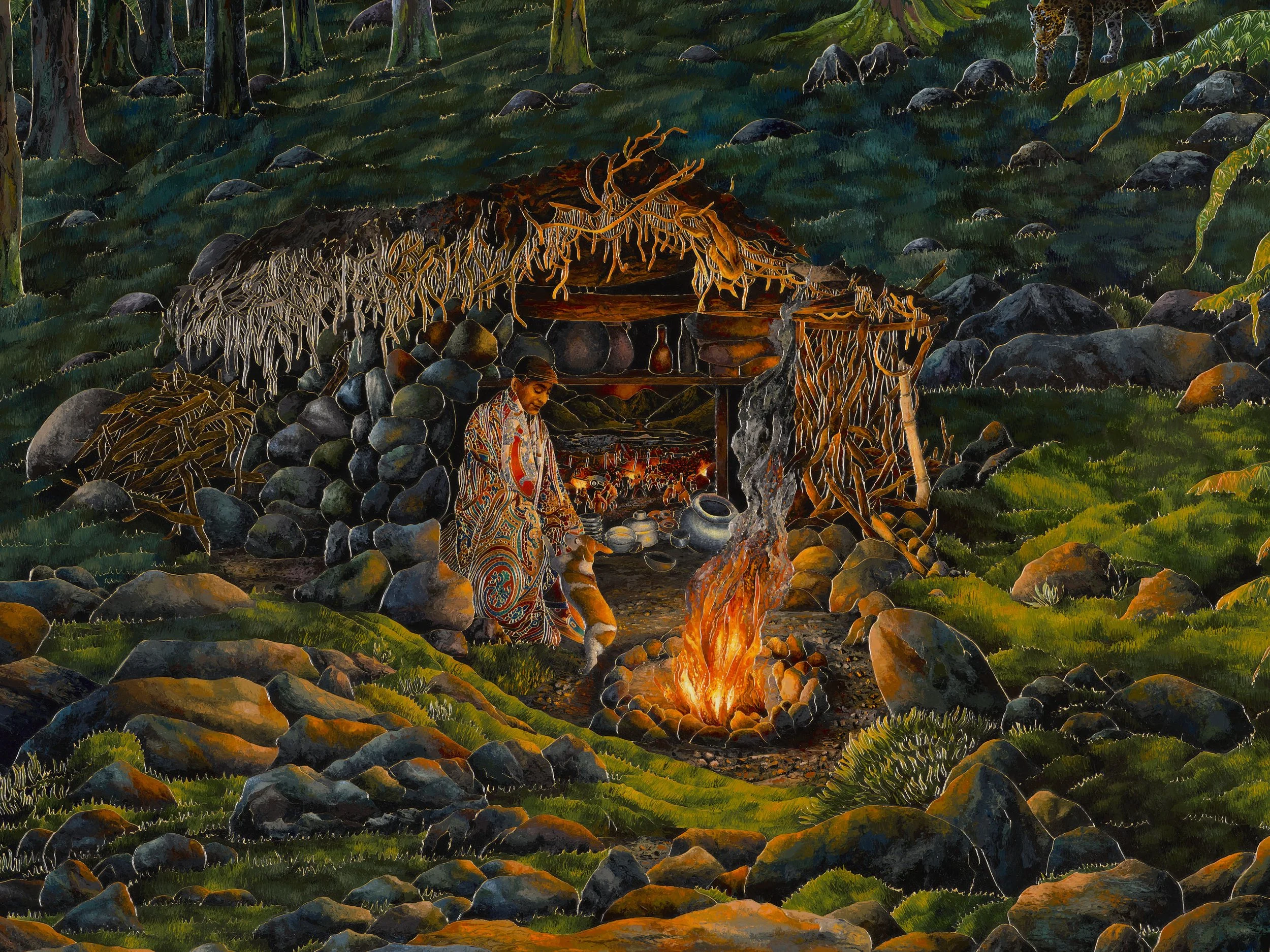
Raqib Shaw. Paradise Lost (detail), 2009–25. Collection of the artist. © Raqib Shaw. Photo by Prudence Cuming, London.
The man with the tiger’s head gazes into the sky, not with contentment, it seems, but with melancholy. The scene below the cliff is nothing if not violent—bloodied monkeys howl from the trees, deer run frantically in hoards, birds swarm in the sky. The perched figure’s homeland is in tatters, serving as a stand-in for Shaw and his relationship to his birth place. He is distanced from the land below and from his home, looking up at the moon wistfully. Perhaps the figure misses what his homeland once was before it succumbed to the violence that currently plagues it.
The painting then transitions to a landscape with flowers and plants in full bloom. But like the monkeys in the first panel, the baboons in the tree are brutal, killing innocent deer and bloodying themselves. This time, they hide behind a picturesque landscape. Again, Shaw draws parallels to the Biblical Garden of Eden, showcasing the hidden catch behind the apparent beauty of his world—the inescapable cruelty that dominates Kashmir’s political unrest, like the land decimation, the people harmed, and the families torn apart.
We then see Shaw’s substitution once again, this time as a centaurian monkey chained to a grand structure. He is unwillingly there, as signified by the shackles and the anguish spread across his features, forced to watch as buildings collapse and chaos ensues. Civilization crumbles and Shaw can do nothing but witness the destruction.
But it is not all pain and loss. Near the center of the painting, Shaw includes a powerful image where he depicts himself, fully human, sitting beneath a cherry blossom tree with his beloved dog in his lap. All around him are waves crashing, and Shaw’s own face is hidden within the crests, crying out. Orbs float through the waterscape, carrying memories from Shaw’s past. But Shaw pays no mind to his surroundings. In this image, Shaw has learned to live with letting go, releasing the many losses of his past and allowing himself to exist in the present.
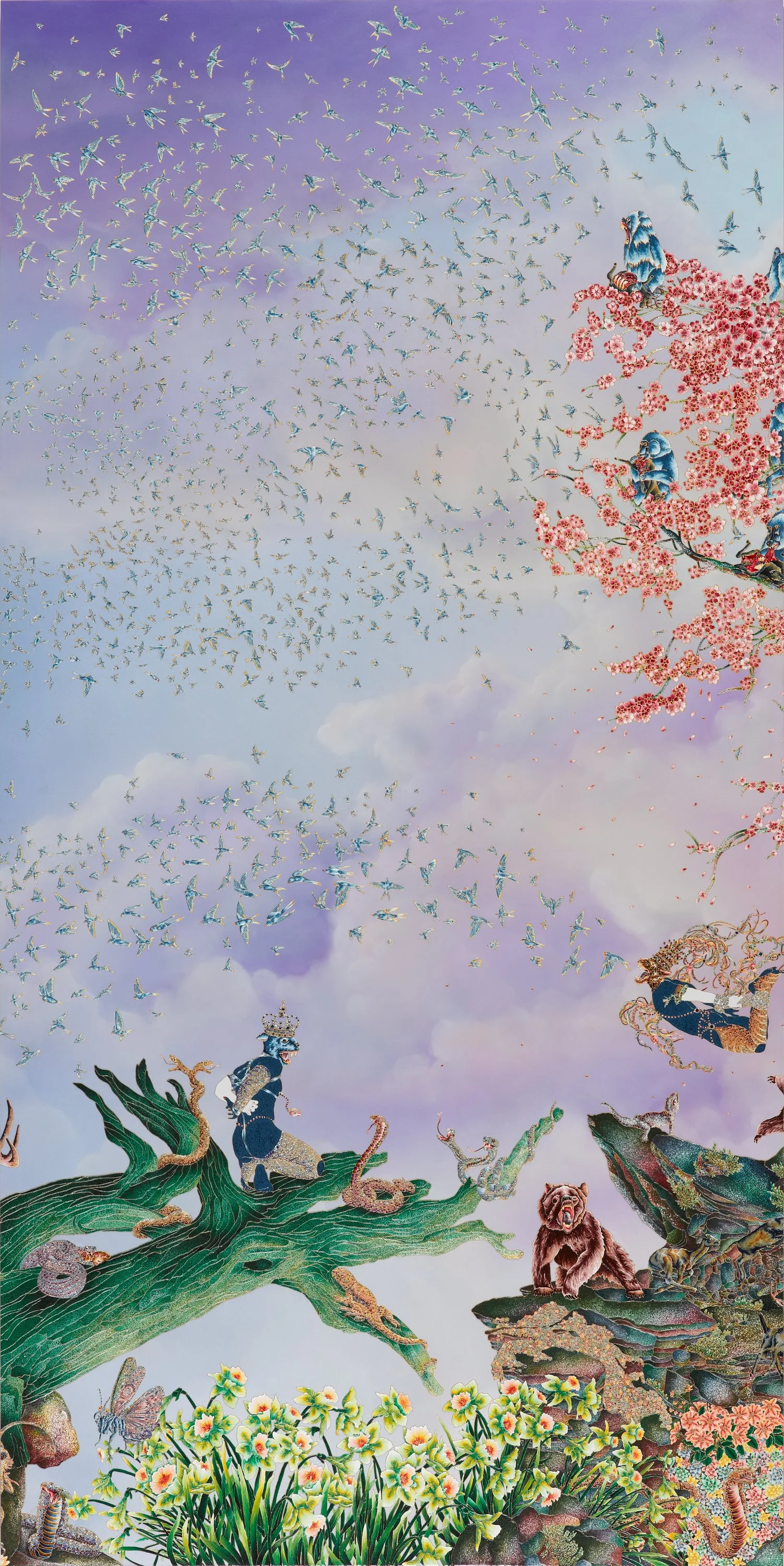
Raqib Shaw. Paradise Lost (detail), 2009–25. Collection of the artist. © Raqib Shaw. Photo by Prudence Cuming, London.
Standing in front of this massive painting, it’s easy to feel intimidated at the mere size of it. But so much detail exists in this 100-foot painting. One could spend all day attempting to look at each and every detail and still come away without having seen everything. .
This is a painting that begs to be seen time and time again—and it is still unfinished. What’s next for Shaw’s Paradise Lost? Will he delve into the future that making peace with the past can bring? Or does he leave that up to the individual viewer to decide for themselves?
Like what you’re reading? Consider donating a few dollars to our writer’s fund and help us keep publishing every Monday.