
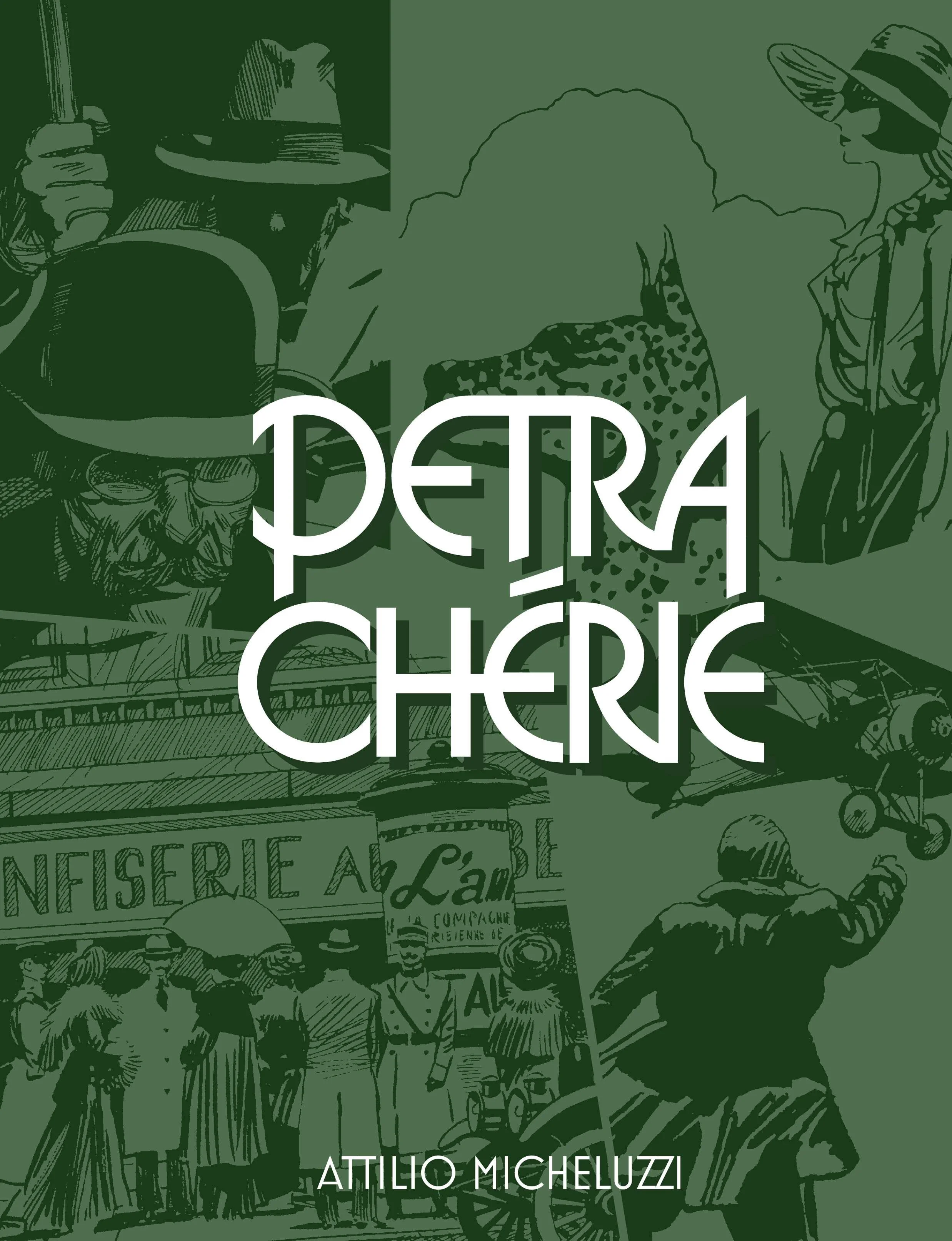
Cover, Petra Chérie by Attilio Micheluzzi | Image Courtesy Fantagraphics.
REVIEW
Petra Chérie
By Attilio Micheluzzi
Hardback ($49.99)
Fantagraphics
Review by Anna Wittenkeller
Through the fog, a lone plane emerges, absent of any national symbol or allegiance. Within minutes, the tide of the battle has been miraculously turned and the French forces have successfully thrust back the oncoming German foes for another day—thanks to this mysterious pilot. Entering the comics via commandeered plane, Petra de Karlowitz remains a woman of mystery and intrigue to the audience, to her friends, and especially to her foes.
The comic strip Petra Chérie, written and illustrated by Attilio Micheluzzi, tells the story of Petra de Karlowitz, a young adventurous woman in WWI Europe who inserts herself into historically precarious situations.
The first twenty-one episodes of Petra Chérie were published in the weekly Italian journal Il Giornalino starting in 1977. The last three episodes were published in the monthly Italian journal Alter Alter, before Micheluzzi’s Petra Chérie comics stopped suddenly in 1982. Since Micheluzzi’s death in 1990, the chronicles of Petra have been compiled in collections, and now, a full collection of the Petra Chérie is available in English for the first time, courtesy of Fantagraphics Books, Inc., translated by Jamie Richards.
Image Courtesy Fantagraphics.
Petra’s classic beauty is similar to that of an Old Hollywood star. But she’s more than just that: she’s also an independent, brilliant, corruption-fighting femme fatale. As Allied Europe’s unofficial undercover spy, Petra deceives and stops corrupt politicians, military officers, and anyone who threatens to harm the common good.
In the early twentieth century, women were supposed to stay home and raise children, not undertake paid work or fight in the war. Beauty was valued over brains, as a woman was not supposed to outshine her husband. But Petra is unique in spite of these ideals, not because of them. She values her beauty, clearly—it’s mentioned more than once in the 24 comics that are included—but she also values her intelligence and wit, using her beauty almost as a shield or disguise as she outsmarts men in high positions of power. Men typically underestimate her, which she uses to her advantage. Petra answers to no man, often mentioning her missions in an off-the-cusp manner to her assistant, Nung. Such is the case in “Gentle Flanders Fog,” where Nung asks Petra what the war bulletins will say the next morning after she intervened in a battle and she responds, matter-of-factly, “That someone burst through the fog, and by the time they disappeared back into it, two imperial Albatroses were left burning between the two army lines” (Micheluzzi 9).
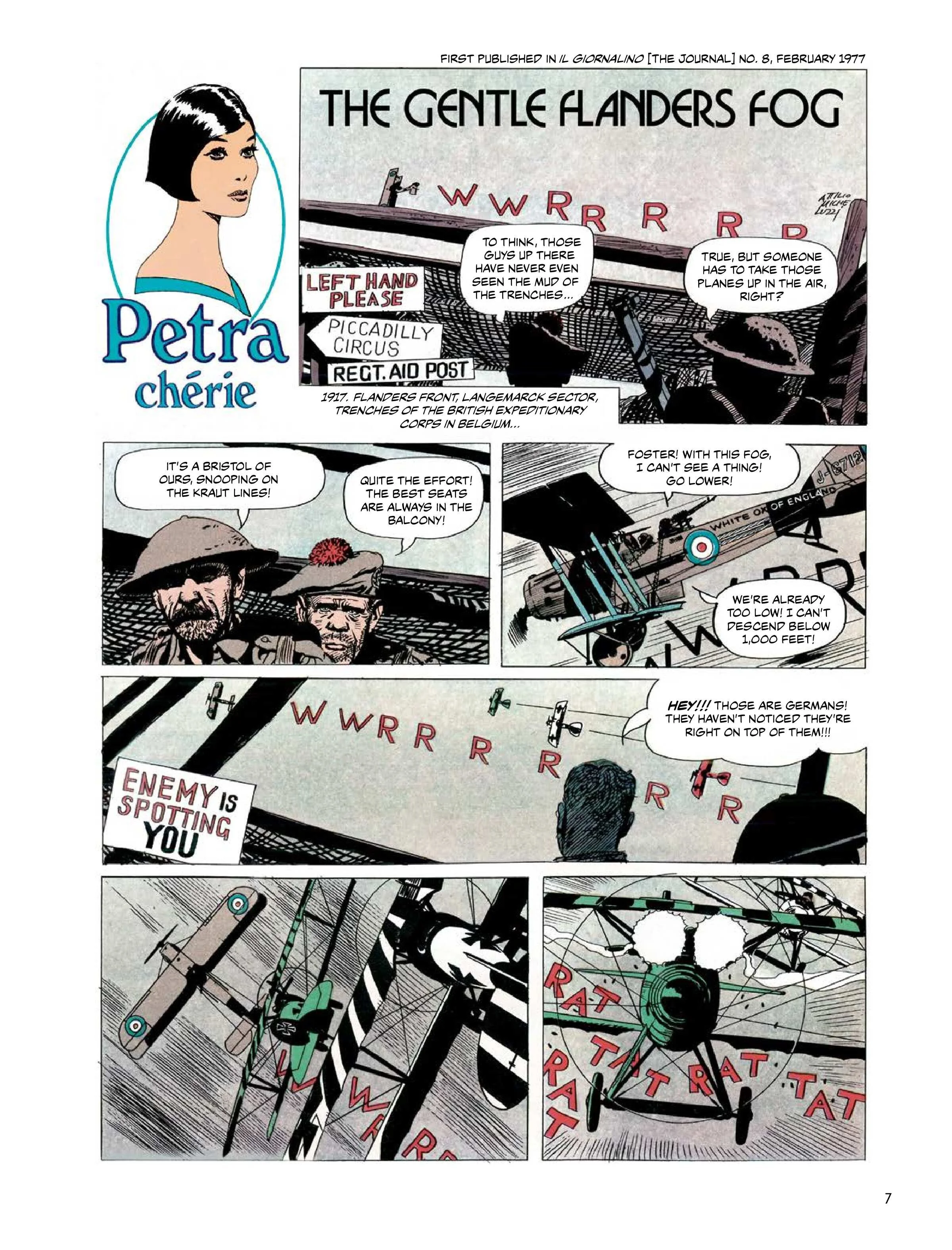
Image Courtesy Fantagraphics.
Petra’s subversion of gendered expectations leads her to situations where she uncovers spies, fights notorious war figures (like the Red Baron himself!), and stops robberies. She also has a pilot’s license (something very few women worldwide could say at the time), cuts her hair in a “boyish manner” (a pixie cut made popular after the war), and speaks multiple languages fluently. Throughout her adventures, she makes her male counterparts rethink what they know about women and their capabilities: “I’m afraid I’ll have to revisit my inexplicable bias against the so-called weaker sex…” says Colonel Montaldier after Petra discovers and unveils Sister Consolazione, a French nun, as a double agent. “She’s a great woman. A great woman indeed” (Micheluzzi 56).
At first, unassuming men can’t see Petra’s power, underestimating her because of her gender. When the colonel fails to see past Sister Consolazione’s disguise, Petra turns her hunch into initiative. She finds Sister Consolazione on the roof—where she keeps her doves that she uses to send messages to the enemy—and attempts to persuade Sister Consolazione to surrender. Refusing to be captured and presumably tried for treason, Sister Consolazione jumps from the roof, but her death is proof enough of her guilt, vindicating Petra’s hunch. Before Petra revealed the twist of the elderly nun’s betrayal, many of her male counterparts argued that her investigation into Sister Consolazione was misguided. Who would accuse an innocent-looking nun for treason? Petra would, and with good reason! Her actions prove herself as a stereotype-defying, independent woman. She needs no input nor approval of any man to take matters into her own hands and enact change.
Image Courtesy Fantagraphics.
As we watch the gutting of women’s rights—as seen in the overturning of Roe v. Wade, the recently proposed SAVE Act, and the reinstating of the “global gag rule”—Petra reminds us that women still have the power to resist the harmful institutions that attempt to control our bodies and repress our voices. In a world consumed with war, Petra was constantly underestimated, undervalued, and belittled by her male counterparts. And yet, she still managed to defy all gendered expectations, fight crime, and help innocent people along the way. If Petra could do it in the early twentieth century, who is to say that we can’t do as she did?
Given today’s political environment, Petra Chérie’s republication is timely. Petra de Karlowitz offers audiences a hopeful reprieve from the reality of a world so often consumed with fighting between and within different countries. What we all wish we had is a secret crusader, helping the world become a better place, one takedown at a time.
Like what you’re reading? Consider donating a few dollars to our writer’s fund and help us keep publishing every Monday.