
REVIEW: Dutch Afro Beginnings
Written by Charl Landvreugd
Punctum Books, 2026 ($22), paperback
Review by Imani Ford
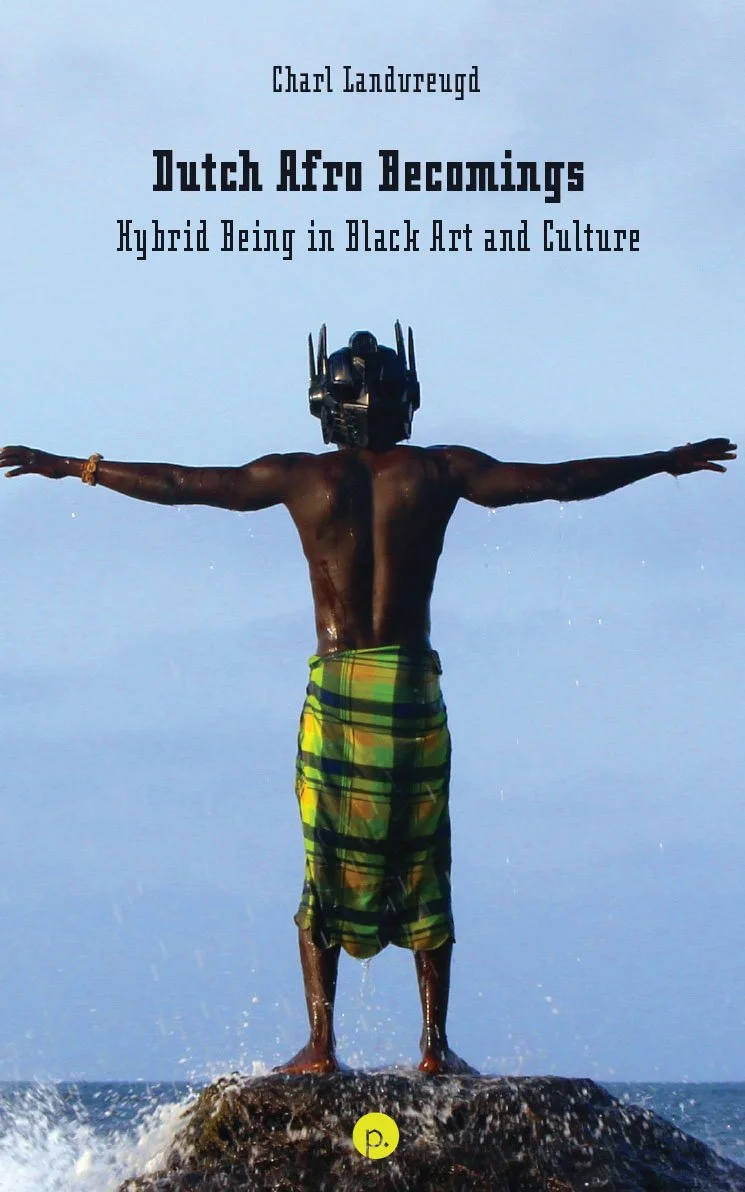
Charl Landvreugd’s Dutch Afro Becomings: Hybrid Being in Black Art and Culture uses (auto)ethnography and other historical methods to embed us in the history of his world as a Afro-Surinamese Dutch cisgender, queer, male, artist, curator, and researcher.
In Dutch Afro Becomings, Charl Landvreugd seeks to clarify and render the Dutch Afro subject by (re)defining Dutch Afro ontology. To do so, Landvreugd must wrestle with the vast shadow cast by Black American, Black British, and Caribbean discourses that provide important comparative studies for his goals to unburden, free Dutch Afro Art, but also leave Dutch Afro ontology and the Dutch Afro subject and artist under erasure.
Landvreugd asserts that the Dutch Afro subject is not yet Black, but is in a state nascent to Blackness. According to him, the Dutch Afro subject is, in fact, becoming Black. Due to distinct geopolitical, cultural, and historical constraints–and the potentialities in the Dutch Afro subject’s cultural, aesthetic, and political response to these constraints–the Dutch Afro subject is both becoming Black and refusing Blackness. Specifically, they are refusing Blackness as opposition to their cultural nativity to the Netherlands. Under the Netherlands’ specific cultural, linguistic, and legal frameworks, Landvreugd rewrites narratives, often normalized in the United States (US) racial state, that one’s refusal to become Black is, in fact, antiblack. This simultaneous nascence and self-awareness makes the Dutch Afro artists’ aesthetic production, intellectual processes, and need for resources most paramount. In the process of charting his, his forebearers’, and his contemporaries’ becoming, Landvreugd deftly showcases that this burgeoning, fertile ontological ground might both bear great fruit for the Dutch Afro subject, artist, and the Netherlands and provide a necessary structural-intellectual rearticulation within international discourses on Blackness, Black Art, and Black ontology.
To make his case, Landvreugd grounds himself in Dutch Afro, Afro-European, and European discourses as well as Caribbean Studies. He uses Edouard Glissant’s “spiral retelling: the movement from the One out to the multiple” and David Scott’s “the problem space” to name current challenges Dutch Afro artists experience and to create a “normal space” in which the Dutch Afro artists’ work “is native to the artistic landscape.” Landvreugd simultaneously theorizes and practices layered, hybrid methodologies—ethnography, autoethnography, cultural criticism, art criticism, sociocultural history, and more—to document emerging Dutch Afro epistemologies, aesthetic production, and aesthetic/cultural history against the backdrop of shifting local, domestic, and international art establishments. In short, he covers a lot of ground. He can because he was there as an artist, social agent, curator, and interviewer. He is there–he remains an interlocutor-participant-facilitator in the Dutch Afro subject’s emergence. And Dutch Afro Becomings is emblematic of this fact.
Although his undertaking is wildly successful, potentially shifting methodological, discursive, and linguistic engagement in the fields he engages, his emphasis on differentiation does recreate erasure in other contexts. Similar to the challenges faced in conversations amongst Black American, Black British, and Caribbean discourses, Landvreugd and his Dutch Afro subject must develop strategies that balance the limitations of cultural, historical, contextual, experiential, and linguistic translation, as well as the pressures of academic scope. The shortcomings of Dutch Afro Becomings, if we can call them that, are representations of a multi-hyphenate at the vanguard of his field smartly using the case studies in Black American art, for example, that most elucidated and served the argument he makes and the context he is in. He did what we are taught to do. However, field formation is complex and, without ongoing nuanced thinking and intellectual empathy and compassion, we often inherit and recreate the challenges others have created for us (and seek to surmount) for others. Here, this emerges in how he perceives Black American Art history because hegemonies that occurred in the past reverberate in our present day. In his reading and telling of that history, he unwittingly recreates the erasure of Black American abstract artists that he seeks to eradicate in the context of the Dutch Afro artist.
Regardless, because he lays the ground for Dutch Afro ontology and subjectivity, Dutch Afro Becomings serves similar roles for the Dutch Afro artist that the following texts do for the Black American, Black British, Caribbean, and African artists, cultural critics, and theorists: W.E.B DuBois’s The Souls of Black Folk, Toni Morrison’s Beloved and The Bluest Eye, Amiri Baraka’s Blues People, Stuart Hall’s oeuvre and work with the Birmingham School, Dennis Scott’s Uncle Time, Akwaeke Emezi’s Freshwater, Paul Gilroy’s The Black Atlantic: On Modernity & Double Consciousness, Frantz Fanon’s Black Skin, White Masks, Achille Mbembe’s Critique of Black Reason, Audre Lorde’s Zami and Sister Outsider, C. Riley Snorton’s Black on Both Sides: A Racial History of Trans Identity, and more. He evokes artists, writers, cultural makers, Cultural Studies pioneers, and Post-colonial theorists such as Édouard Glissant, Stuart Hall, David Scott, and Amiri Baraka. Landvreugd orchestrates and presents Dutch Afro discourses by layering Caribbean discourses alongside the following: French philosopher Étienne Balibar, German historian Fatima El-Tayed, Afro-French theorists Trica Danielle Keaton, T. Denean Sharpley-Whiting, and Tyler Stovall, British Historian Simon Schama, Afro artist Gerrit Schouten, cultural anthropologist Lizzy Van Leeuwen, Rihana Jamaludin, Annejet van der Zijl, Communist resistance fighter Anton de Kom, Astrid Roemer, Surinamese-Dutch writer and poet Edgar Cairo, and Frank Martinus Arion.
In naming his creative, cultural, ethnic, and intellectual standpoint and positionality, Landvreugd makes way for and lays the groundwork for an ontology, epistemology, field, and emerging set of practices and ways of being. The Dutch Afro artist has not yet become, but they are becoming, and is, therefore, pre-Black. The Dutch Afro subject's Blackness constitutes a sensibility that refuses Blackness as overdetermined opposition to the Dutch context’s cultural blankness—a normalized Dutchness, neither racialized nor white, in our sense of the term “whiteness”—while becoming Dutch Afro.
Landvreugd gives several examples, the most prominent being Remy Jungerman (b. 1959), Gillion Graatman (b. 1968), and Michael Tedja’s (b. 1971) the Wakaman Project (2005-09) which explored art by Dutch visual artists of a Surinamese background. “Wakaman” means “stroller, wanderer, traveller, drifter, loafer, or tramp. In Surinamese vernacular, it is ‘a man who goes from one woman to the next or a hustler, street philosopher, someone cool.’” The Wakaman were the dislocated, wallflower artists of the Dutch artworld, aligning themselves and their aesthetic sensibilities with their art’s positionality. They were people embracing their positionality as discursive objects whose ontology, meaning, value, worth, reception, consistently shifted in time-space, based on the art establishment and the Dutch state’s perception of them. Although the Wakaman project invited five women—Miek Hoekzema, Judith Heinsohn, Fabiola Veerman, Rose Manuel, and Juliette Tulkens—to be apart of the Wakaman project, due to Landvreugd’s perception that the Dutch art world more readily engaged the “gender issue” (“...speaking of the issue of gender in the arts is a very accepted and valued way of showing criticality.”), the question of Dutch Afro subjectivity, similar to questions of Africanity and racialization in other fields, is primarily–and problematically–indexed within the figure of the Afro-cisgender male body. Due to ideological and political differences, Wakaman split into two projects: Tedja’s Eat the Frame and Jungerman and Grantsaan’s Drawing Lines, Connecting Dots. Together, each Wakaman Project theorizes and employs what Langvreugd calls action curation. The former “comprises the self-initiated exhibitions that aim to establish Dutch Afro artists’ production beyond ideas of the quality argument and away from the existing frame-work—in other words, to eat the frame.” The latter “inhabit the institutional discourse that has developed over the years concerning the position of the Dutch Afro artist in the landscape and trying to change the position of the artists from the inside out.”
Landvreugd displays that the Wakaman Project’s establishment, regardless of external censure for the resources they garnered or the fragmentation of the group, the resulting projects both used a diasporic framework to create language, space, discourse and they did this in very different ways. The Wakaman Project communicated: Dutch Afro artists exist and they are not a monolith; all of these perspectives create intellectual richness, constitute action curation, and establish a specifically Dutch Afro discursive field.
While Dutch culture, colonial history, and racial taxonomies function such that a Dutch Afro subject cannot, as Sylvia Wynter theorizes in her unpublished, 935-page manuscript Black Metamorphosis: New Natives in a New World (circa 1970s), reindigenize themselves to the settler colonizer’s land, the Dutch Afro artist seeks to claim their rightful space as native to Dutch culture. In the US, UK, and Global South, reindigenization is a process of cultural and material survival. If we use Wynter’s lens, Afro-diasporic subjects in these parts of the world practice reindigenization and therefore become “native” to “new” lands by establishing a mutually constitutive relationship between self and the new environment. To showcase this, Wynter uses the concept of planting the yam—a symbol of Afro-descended people’s cultural root—which is replanted into the new environment. Yet, Landvreugd’s assessment of the discourse around Dutch Afro art versus discourses about art by Afro-diasporic folk in other parts of the world, and Dutch legal frameworks around citizenship showcases that the Dutch Afro subject’s relationship to space and worldmaking is slightly different.
In the Dutch context, water—blue—presupposes the blackening process ingratiated into “New World” racial taxonomies that require Wynter’s perception of transformation into new, implanted subjectivities that are both geopolitically rooted and culturally distinct. Cultural distinction, for us, emerges through the process of racialization (e.g. blackening). That is, according to Wynter the figure of the “New World Negro” transmutes and re-humanizes themselves through a symbiotic relationship with the land after having one’s humanity reduced to their corporality (e.g. made commodifiable as pieza). Black bodies “became” pieza through a monetary trade framework which the European colonial powers used to barter African flesh. The Dutch Afro subject–simultaneously contemporary and nascent–not only feels themselves to be culturally Dutch (native to the Netherlands), but is also geopolitically, biologically displaced vis-a-vis Dutch language—autochthonous versus allochthonous—a distinction made up until 2016 meaning “native” and “nonnative,” which after 2016 came to mean “with a Dutch background” and “with a migrant background.” There are also complex distinctions made between first and second generation “allochthones.” Dutch culture is such that those who grow up in the Netherlands feel themselves deeply tied to “the Dutch self-image;” indeed, there is a deep anxiety about the ways in which American racial capitalism deeply divides citizens amongst racial lines (e.g. American racial apartheid). In the Netherlands, cultural variation and layering is expected, yet at the expense of simultaneous nativeness and distinction. Further, Landvreugd makes clear that Dutch Afro subjects are in the infancy of their becoming akin to “the post-WWII Black British and the African Americans of the first great migration (1916–1930).” They are actively rejecting Blackness on conditions grounded in more developed contexts, while attempting to become Black on their own terms and through their specific geopolitical context, all while acknowledging the “Black becomings” [my phrasing] and Black socio-political movement(s) elsewhere have enticed and catalyzed their self-production.
In the US, we always start with black and shift to blue. Similar to Fats Waller and Andy Razaf’s “(What Did I Do to Be So) Black and Blue?,” first performed theatrically by Edith Wilson in 1929 and popularized by Louis Armstrong as a sort of protest song shortly after. Landvreugd, on the other hand, begins with blue and then goes black. And this is a distinction that makes his argument for the Dutch Afro artists’ distinction clearer.
Charl Landvreugd imparts this visual, somatic, and experiential transmutation as a mnemonic recollection to mark his emerging Dutch Afro subjectivity. Unlike Armstrong, Landvreugd explicates a different sense of blue in relation to the Atlantic.
In the first section titled “Turning the Gaze Black,” Landvreugd writes, “Blue…While migrating from Suriname to the Netherlands in 1974, at the tender age of three, Atlantic blues combined with the slightly different light blue that meets the ocean at the horizon and fills the sky. Shrouded in shades of blue, a conscious record of the environment reveals a classroom in Rotterdam with preschoolers, all acquiring skills that prepare them for elementary school.” Everything was blue before he experienced the process of “turning the gaze black.” When he went back, though, in memory, he saw blue, Atlantic blue, first.
In this blue, Landvreugd reveals, sits many shades of “Atlantic blue.” For Landvreugd, his “blue” is not the only one; and its potential towards Blackness is about a linguistic rupture slightly different from Frantz Fanon’s experience in Black Skin, White Masks–when the white child yells, “Look, a Negro!,” pulling Fanon into a being founded purely upon the child’s perception of his biology. Landvreugd’s embodiment is relegated to an “elsewhere,” across that body of water, that blue, from which he came: “Go back to your own country!” For him, and other Dutch Afro artists and subjects, Blackness is not (yet(?)) the default, blue is. For him, blue presupposes black and from there comes layers of meaning for artists of a multiplicity of Dutch subjectivities and backgrounds that are not blank.
Although Landvreugd’s horizon is set on more intellectual, aesthetic, institutional space, this potential for blue before black might push Afro-diasporic Studies et al. towards a curiosity that wanders at the root thought of, and beyond, two of DuBois’s most famous refrains in The Souls of Black Folk: “The problem of the twentieth century is the problem of the color-line” and “How does it feel to be a problem?” What, in the physical, somatic, and spiritual action and process of reindigenization–of world building–was overshadowed by the violence of linguistic rupture (e.g. how he (DuBois)/we label(ed) “the Veil/veil” (see DuBois) and/or the barrier settler colonial ideologies built between us (e.g. people, land, “self”), “the world” (their world), and the world(s) we ongoingly (seek to) build amid theirs?
While I believe that cultural hybridity does exist amongst Afro-diasporic subjects in the US, Landvreugd is right to acknowledge that US racial taxonomies disallow the elaboration, expansion, and emphasis of that hybridity. Further, through Landvreugd’s eyes, it becomes clear that the Dutch (Afro) subject is afraid of American racial apartheid, the sense that something more than culture, in our case, race, divides us. It is in the fear that undergirds the Dutch Afro artist’s refusal of Blackness as binary, polar opposite, or that which expands in opposition to, rather than immersion in and amidst, that set emergent Dutch Afro subjectivity apart.
While Landvreugd’s reading of the Black American Art history is strong, he glosses over quite a lot by focusing on the most visible in our aesthetic, social, and cultural history. Specifically, he does not name or interrogate the ways in which historically subjugated people can recreate hegemonies both within their broader communities and the same geopolitical context. Driven from within the Black Arts community established by Amiri Baraka himself, was the notion that art by Black (American) people was only authentic and “Black” if it reflected our social, political realities, interiorities, and liberation struggles through figurative art, murals, portraits with symbols and narratives. For Baraka, only this sort of representational visual vernacular could affect the Black racial, social, and cultural imaginary. For Baraka, that was the purpose of Black Art. The larger (predominantly white) art world seems to have legitimized this idea that only certain art made by Black people was authentically Black Art. This, of course, recreated, reified, and reflected mundane, cultural, and political discourses amongst stateside Afro-diasporic people that some folk who were both racialized as Black, but embodied perceivably "bourgeois" behaviors, tastes, interests, and beliefs, were/art not “Black enough.” Thus, Black people who made art that fell out of Baraka’s Black Art framework were sidelined. Howardina Pendell and Norman Lewis’s Black Abstract art was considered too Eurocentric and apolitical to be Black Art; artists such as Baraka, who made more realist art, did not believe Black Abstraction could raise Black people’s collective consciousness. While the Black Arts Movement and its relationship to culture, arts institutions, and its clarity of intent are similar to Dutch Afro artists’s Wakaman project, something is lost when Landvreugd’s does not acknowledge that there were Black artists within the US that are/were similarly misperceived, overlooked, and overdetermined by a hegemonic prescription of what Black Art and Black American art was. Second, engaging with these artists might have strengthened his argument. (However, as a Surinamase Dutch person and artist, Landvreugd and the cis men who make up Wakamanall fall highest on the Dutch Afro-hierarchy making them similar, in that regard, to Baraka and his camp.)While many Black Abstractionists have started to get their due, much might have been said about how Black American Abstractionists work(ed) to create a visual vernacular that both engaged and superseded the imposition of US racial taxonomies onto Black social life, as well as notions that there is a specific way that art by an Afro-diasporic artist must “sign” to be considered Black Art.
By flattening the Black American art world and its art history, Landvreugd misses an opportunity to elucidate the distinctions he wants to make about Dutch Afro art. I will share what I see: the Wakaman Project’s capacity for intellectual dispute and space for multiplicity vis-a-vis Landvreugd’s broad stroke at making public record a social history emerging in its infancy, showcases a discursive space where the existence of multiple realities creates a more expansive and less monolithic social identity, and therefore a more expansive aesthetic identity in the domestic and international art market, allowing everyone some good eatin’ off the art world’s proverbial plate. Further, intellectual disputes amongst Black artists existed far before “Black Art versus Black Abstraction” but not, I think, to such an extent that it affected those Black artists’ access to resources, recognition, belonging, etc. We see this in the 20th Century in Alain Locke’s beliefs that respectability in Black Art was essential because Black Art was about racial advancement and racial uplift. Zora Neale Hurston and Langston Hughes, however, started the independent magazine Fire!! To discuss more marginalized Black social realities such as queerness, sex work, and internalized antiblackness in the Black community. These “beefs” go on and on.
Still, Landvreugd’s honesty about the necessity, not friendship, that brought the Afro-Surinamese Dutch artists together for Wakaman elucidates that true intimacy amongst Afro-diasporic artists must be built adjacent to the institutional realities, disparities, and oppressions that often bring us together. I do, however, complexly, believe that the “falling apart” of the Wakaman Project created an intellectual richness we are lucky to have recorded access to. Falling under “The Wakaman Project,” we received a frame of multiplicity rather than severance. In some ways, the project might have started with the emphasis on individuation amongst wholeness (e.g. diaspora).
In terms of other aspects of Lanvreugd’s argument, the devil is, as we say, in the details. Landvreugd’s argument that the Dutch Afro artist is pre-Black (e.g. “becoming Black”) emerges in his methodology. He assures us that Dutch Afro Becomings is urgent while charting the complex, vexing minutia of mundane artist and museum life in the Netherlands and the Dutch art world. Through his use of detail about mundane social, cultural practices, and the daily politics of the Dutch art world, Landvreugd marks his presence as a witness to history in the making, the fly on the wall, participant-observer, and, now, documentarian to blatant systemic, cultural erasure and oversight.
To do this, Landvreugd flits between accounting for himself and his presence in the Netherlands, the history of state and museum practices, artistic methodologies, comings and goings, and thinking about themselves as their practices shifted in time, as well as the different ways in which the newly nascent and then everbecoming Dutch Afro artist interrogated and navigated being simultaneously overdetermined and erased both inside of and outside of the Dutch Art world. Some of this, which, in our context, would constitute “selling out,” and, in theirs, constitutes institution-facing strategy because there is more to lose in institution-speak than there is intra-communally (e.g., amongst other Dutch Afro artists). This is because there isn’t as much hinging on a potential social alienation in the artist community if one is perceived as racially “inauthentic” as there is here; everyone there is, to a certain extent, honest about their racial anxieties (i.e. taking on racial identities and labels). “Inauthentic” Blackness is not always about “bad politics,” (sometimes it's about someone's personality), but in the US the two are sometimes, problematically, conflated. From my perspective, though many would say otherwise or disagree, “authentic” Blackness is owned by no one racialized as Black in the US and its meaning depends on the person you ask/who is perceiving who, what, when, and where. It's my understanding that not being “Black enough,” is an intra-communal shaming device that marks all of us, yet many of us miss this fact about one another because friendship and true intimacy are neither emphasized or easily developed in these contexts; this shame-based belief, that there is a specific way to be Black, acts with such a force it is constitutive and foundational to creating the lines of belonging and nonbelonging in US-based Afro-diasporic social life. Here, there is social reward in acting, amongst our peers, as if we believe the game we play to the institutions, so much so that when one is honest and transparent in both contexts they are disbelieved. Thus, the assumption that everyone engages social reality in this way, creates more mistrust and less friendliness. In the Dutch context, there seems to be room for both because there is less intracommunal shame about openly being uncomfortable in/with becoming Black; it is not perceived as self-hate. This is because everyone is invested, first and foremost, in the Dutch self-image. For the Dutch Afro subject, this isn't about self-hate; it's about embracing all of what they are. And the Dutch language and legal state informs this too. But being Black and being blackened in a way that feels determined from the outside, and not the inside, is uncomfortable, disorienting, dislocating, shaming, and, sometimes, humiliating. We have all been saying that. Landvreugd’s Krutu–“a gathering where issues of governance and law are brought before the members of society”–action curation project showcased that Dutch folk are more uncomfortable discussing race in Dutch because their lexicon for race emerges primarily in English. The Krutu, a multi-round and sometimes anonymous interview process, elucidates the complexities of cultural mores, the lack of expansive social awareness beneath them, and the necessity of linguistic expansion and nuevo-translation practices.
In all of this we see a Surinamese-Dutch, queer, cis man accounting for the very hybridity and overlap between institutional intention and ignorance, and how the personal histories of agents of institutions occlude and reveal the shortcomings of the Dutch language as well as English-Dutch translation, and the English language to hold Dutch Afro ontology.
I turn now to the possibility born of these constraints–to blue.
A hue is often defined as a pure color family or a specific position on the color wheel; hues are often determined by its dominant wavelength of light. What I call “Afro-Blues,” what Landvreugd calls “Atlantic blues” when describing the horizon he saw upon immigrating to the Netherlands, is a metaphor for the discourses, methodologies, practices, intricacies, particularities, and ontologies, of Afro-diasporic aesthetic discourses.
It is clear that, for Dutch Afro artists, their specificity amongst our larger discourse is necessary for their ongoing becoming. This text seeks to render them present in the Netherlands, abroad, in between, and above. In that sense, we are all together and family in shared histories of erasure, exclusion, and the structural drive towards self-awakening, self-fashioning, and building a sense of self-regard.
If light, in the context of Afro-diasporic aesthetics has often meant visibility, recognition, and institutional access, then Black American Afro-Blue has occupied a hegemonic space in our sense of Afro-Blue. Yet, that visibility, recognition, and institutional access has often hinged upon systemic complexities and oppressions that also leave Black American artists unseen, vulnerable, exploited, and undervalued. Simultaneously, Afro-Surinamese Dutchness occupies the top of a hierarchy amongst the spectrum of Afro Dutch experiences. By looking at different hues of Afro-Blue–Afro-experience and how it aesthetically manifests–we might be able to understand “light” (e.g., sight vs “visibility”) differently. By accounting for the shadows that undergirds our ability to witness the materialization of Afro-diasporic aesthetics, we might learn to acknowledge that we might not be seeing the whole story. In the west, light often has hidden shadows. Now, we must use light to bring the shadows to the forefront. Through this, we humanize one another and build discursive empathy and compassion.
Dutch Afro ontology is not the same as Black American, Black British, and Caribbean ontologies, and, as such, Afro Dutch becoming exists as a desire for shared space, time, and acknowledgment of their different, yet multiplicitous lived experiences. While we share experiences of embodiment, Dutch Afro Becomings asks us to acknowledge that to speak, hear, engage, sense, and know our Dutch Afro siblings we might need to learn to speak, hear, engage, sense, and know not only their Dutch tongue, but also the languages they have fashioned in occlusion beneath our own fight for presence amid ongoing existential crisis.
Imani Noel Ford (they/he/she/we) is a Black, trans-masculine, nonbinary, cross-genre writer, interdisciplinary artist, arts educator, somatic practitioner, and mindfulness teacher from Chicago’s South Side, based in Brooklyn, New York. They hold a B.A. in African-American Studies and a minor in Visual Arts (Sculpture) from Princeton University (2018) and an M.A. in English & Comparative Literature from Columbia University (2020). Imani is pursuing an MSW in Community Organizing at Hunter College’s Silberman School of Social Work. Their writing has appeared in Aperture, The Sole Adventurer, and Black Minds Mag. Their visual art has been exhibited in New York and Princeton, NJ, and they have sold artwork domestically and internationally. They founded Black Body Productions in 2025 and are a 2026 Brooklyn Poets Fellow, May 2026 Brooklyn Poets Yawp Winner, and Sundress Publications’ 2027 SmokeLong Quarterly Trans Writers Fellow.
Like what you’re reading? Consider donating a few dollars to our writer’s fund and help us keep publishing every Monday.
