
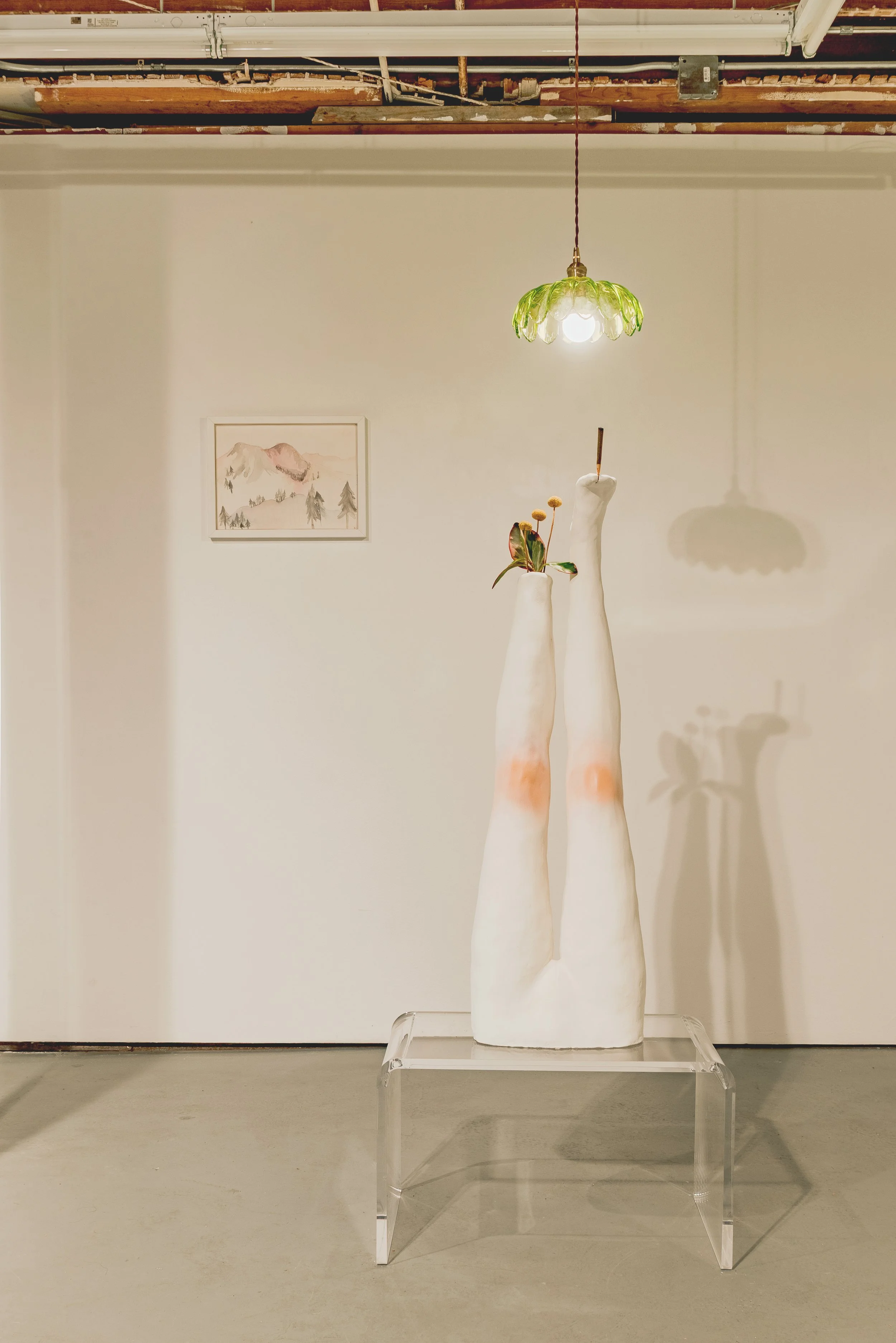
Iris Bernblum, Maintenance. Foam, apoxy, plaster, spray paint, joint, plant, acrylic table, 3.5’ x 1.5’ 2026. Photos by Robert Chase Heishman.
REVIEW
Iris Bernblum: Palliative Sedation
Oct. 25-Dec. 2
4th Ward Project Space
5338 S Kimbark Ave.
Chicago, Illinois 60615
Hours by appointment
Review by Annette LePique
When speaking with artist Iris Bernblum she noted her admiration for fellow artist Paul McCarthy’s mode of creating, a process in which McCarthy, usually on all fours, would allow one of his characters to wake up, to speak through him. Bernblum then told me she considered that state of making—where you make with your eyes proverbially half-closed, your self, that staid thing, slips through your grasp—of the greatest interest for her own practice. I couldn’t help thinking then of “letting go” both literally and figuratively when walking through the artist’s show Palliative Sedation, now up at 4th Ward Projects.
The phrase “palliative sedation” is taken from end of life care where a patient is given sedatives to lessen their pain as they prepare for death. This idea of escaping pain links to Bernblum’s own theory that the legalization of marjuana, along with other forms of escapism—sports betting, drugs, alcohol, gooning, shopping, the use of AI, etc.—are responsible for the rise of America’s reality-tv inflected conservatism, our home-grown, ready for prime time fascism. It’s a beguiling theory to be sure, that in a moment so bereft of material support and opportunity, the scraps we’re given to subsist upon are not enough (nor designed) to help us build or sustain a coherent progressive movement.
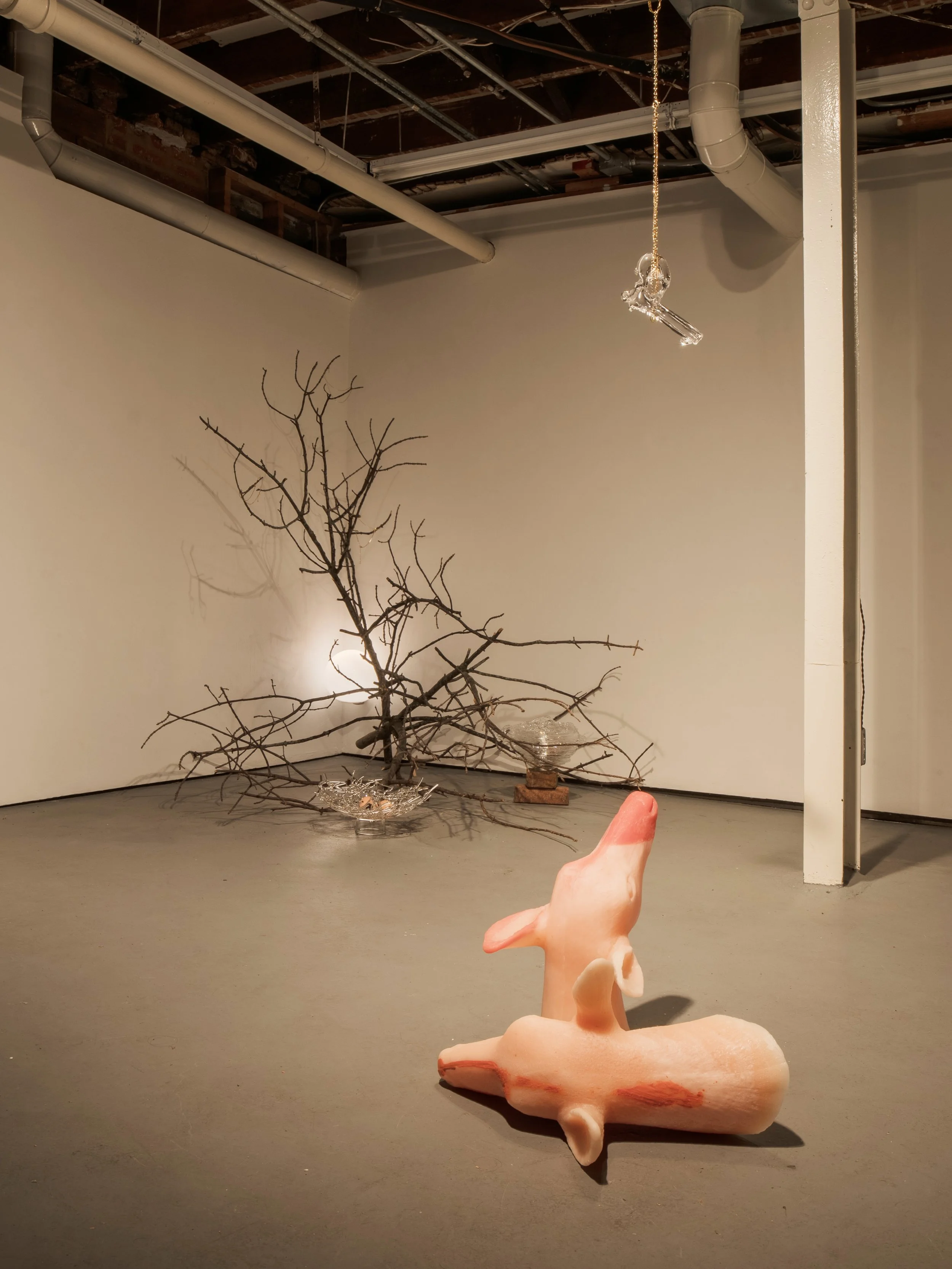
Iris Bernblum, Doe. Solid Paraffin Wax, 1’x8” Each 2026. Photos by Robert Chase Heishman.
I was ready then to just view Bernblum’s work through the lens of the political, of the material, yet instead I was so pleased to find Palliative Sedation works more as a dream-like reflection on the architecture of interiority and the nature of wanting; along with plenty of double entendres, allusions, and semantic slippages that labor to reveal something of the self. It is this self then we endeavor to escape, to slip from our own hands, in order to see what lies beyond our line of sight, if only just once.
Bernblum is a psychoanalytic artist to be sure, one that works within the nooks and crannies of dreams, sex, and the uncanny. Take her ongoing Submissions series which started in 2020 as a response to COVID-19 quarantine. For the series, Bernblum asked people to send her nudes, to submit to her, and the seventy-five “submissions” she received from around the globe then become the rough material of the series’ drawings. Here then is the crossroads from which Bernblum creates, the uneasy and ever-restless relationship between fantasy and the material, the knottiness of desire within systems designed to rein in the imagination.
Palliative Sedation is a mix of the artist’s more recent sculptural works and several of her earlier printed pieces (including an installment of the aforementioned Submissions series, the endearingly titled Italian in Kitchen). The sculptures are installed throughout the space, a pair of legs diagonal to two decapitated deer heads. The legs, Maintenance, petite and bone white, with fleshly bruised knees crafted from foam and epoxy, are installed upside-down, a curatorial choice that gives the impression the sculpture is doing a half-formed handstand, clowning around, making a joke. Maintenance is a funny piece to be sure as Bernblum adds a touch of humor in a joint hooked between two of the sculpture’s toes. The piece’s other leg ends in an ankle that births a sprig of daffodils. Yet, I can’t help but think of a joke as an outlet that allows for the expression of something hidden, some deeply buried urge or desire that must come to the surface. With the joint as a nod to the show’s title, I wonder if again escape is not just an attempt to exit our current political and economic system but to break free from the body itself; to be aloft and weightless, to marvel at a foot that’s become a flower.
The two deer heads, formed from a rosy colored paraffin wax with strips of crimson color, the contrast bringing to mind a hunt or other violent collision, are a single piece. They are installed on the floor, directly in line with the gallery door, and are the first work a visitor may see when entering 4th Ward. Bernblum has titled the heads Doe and positioned the work to sit under Saturday Night Special.
Suspended from a thin gold chain, Saturday Night Special is a handblown glass gun that also looks like a cock and balls. When we looked at the piece together, I smiled as Bernblum and I had been talking about the asymmetries and assumptions of desire in this country. I mentioned that I didn’t think the idea of the male gaze really held much water anymore for don’t we women also gaze and want, isn’t there pleasure to be found in performance? If I had the chance to remix thinker Laura Mulvey’s original theory, perhaps I’d call it the American gaze. For what’s more American than thinking a gun resembles a cock and feeling ever so curious about how its glass, its flesh, might feel against the hand? America, us Americans, it’s true, we love a phallus. Yet, Saturday Night Special does not sit with any outsized importance within the show, it is simply another pressure point of desire, of living, of being in the world, of navigating the flesh.
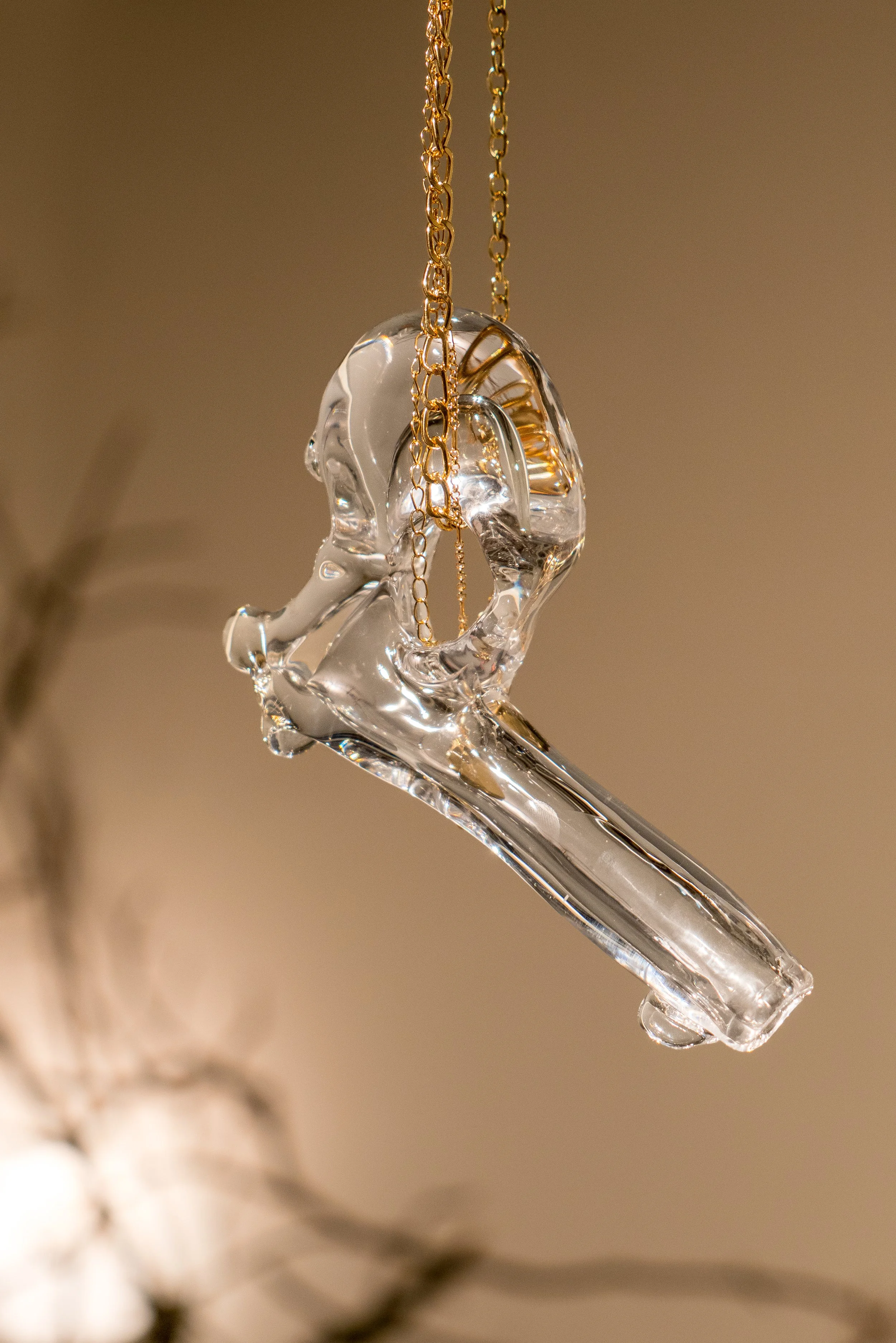
Iris Bernblum, Saturday Night Special. Handblown glass, gold chain, 9”x4” 2026. Photos by Robert Chase Heishman.
To the side of the gallery door hung a massive spider plant, beautiful and old, with tendrils of leggy green leaf blossoms almost reaching the floor. As the plant was not on the works list, I asked Bernblum where it had come from, she responded that it belonged to a female friend who had passed and she tried her best to include it in as many shows and galleries as she could. I couldn’t then help but notice that the braid of the spider plant’s leaves looked remarkably similar to the branches Bernblum sourced to frame two other pieces, both titled Nest, installed in a back corner directly diagonal to the plant’s position. Even the warp and weft of both Nests, formed with handcrafted glass, reassembled the natural patterns found in the branches and leaves of the spider plant.
I’m still unsure what to make of this coincidence, the seemingly accidental similarities found between these pieces of nature and Bernblum’s Nests, both pieces even filled with cast wax eggs packed with soil, blushed and warm like the artist’s deer heads. I slipped once in conversation with Bernblum and referred to the eggs as “soiled”, for I think there’s a porous line between how we understand things like an egg—often shorthand for an ur-feminine—in relation to cleanliness, to order, to that imagined place far away from the abjection of nature and our own capacities for cruelty, kindness, selflessness and selfishness, desire and abstention. This idea of understanding in context, of allowing desire to dance with its relations, acknowledging the circumstances of its birth, is what I think lies at the heart of Palliative Sedation. Bernblum asks us to look, to really look, so that you may understand what you see when your eyes close and your mind slips under.
Like what you’re reading? Consider donating a few dollars to our writer’s fund and help us keep publishing every Monday.