
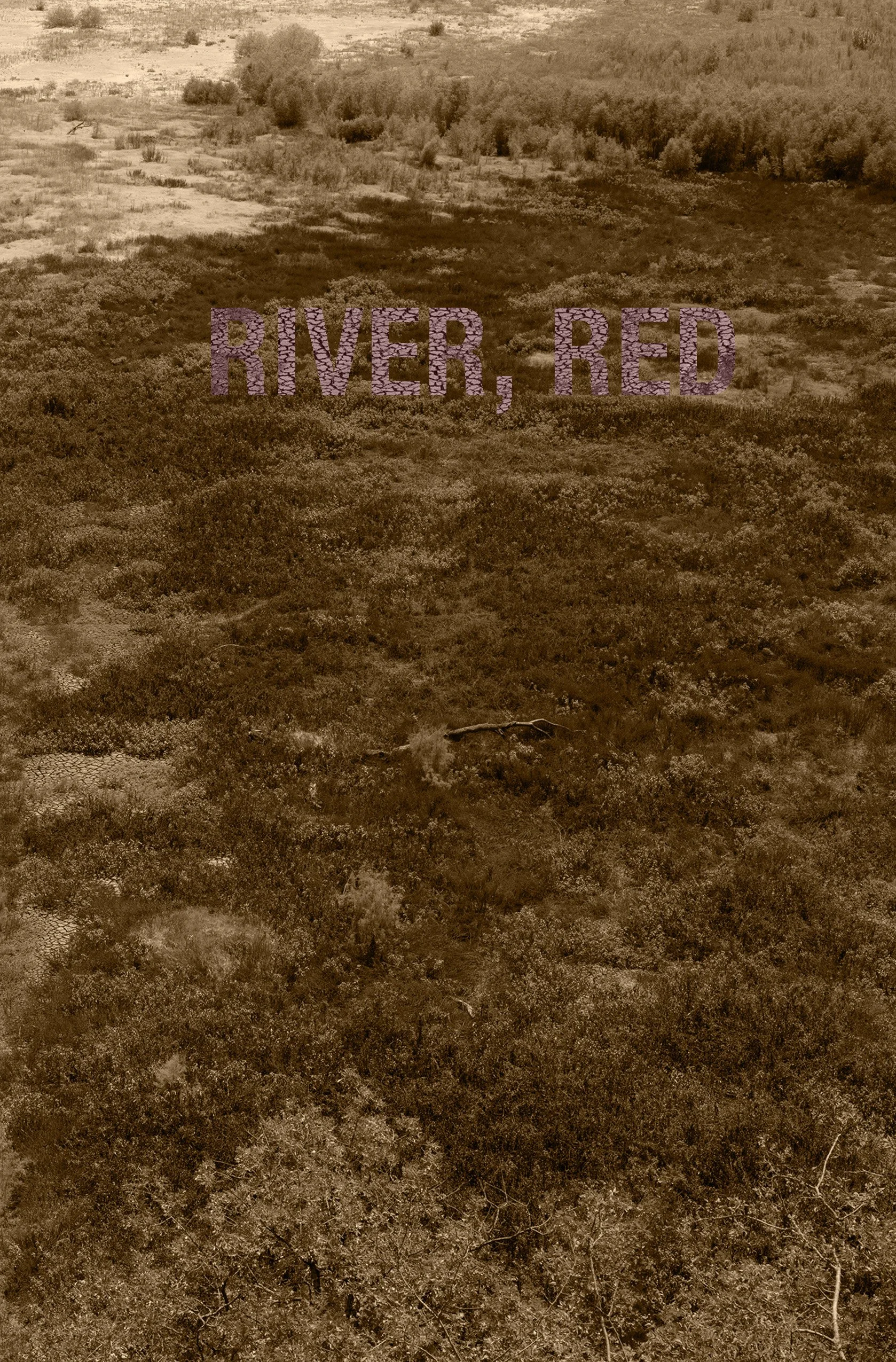
BRIDGE BOOKS: Ahmed Ozsever: “River, Red”
AVAILABLE SOON — CLICK HERE TO PREORDER
Ahmed Ozsever’s River, Red is an artist book and research project examining the shifting landscape of the Red River along the Texas–Oklahoma border. The project begins with a deceptively simple fact: rivers move. Yet when a river has also been made to function as a legal boundary, that movement unsettles ideas of property, jurisdiction, ownership, and historical permanence.
In 1923, the river’s southern bank was legally established as the border between Texas and Oklahoma. Over the century since, erosion and accretion have altered the river’s course by as much as a mile in some areas, creating a widening gap between the border as it exists in legal and archival records and the river as it exists on the ground. These changes have contributed to disputes involving private property, state boundaries, and Indigenous land, revealing the instability of systems that attempt to fix a dynamic landscape in place.
Ozsever approaches this terrain through photography, writing, archival research, mapping, poetry, and collage. Traveling through the space between the river’s present course and its recorded historical location, he documents remnants of human-made structures, stains left by receding water, changing vegetation, eroded banks, and aerial views that register the passage of time in the landscape itself. These images are placed in conversation with manipulated archival documents and textual fragments that once attempted to define and contain the river.
At the center of River, Red is a concern with time and the difficulty of perceiving it directly. Ozsever looks instead for its traces: in land, infrastructure, abandoned or altered spaces, ecological processes, and the records through which people attempt to organize territory and history. The project moves between geological time and human time, between the gradual transformation of a river and the comparatively rigid temporalities of law, property, commerce, and political borders.
The book itself becomes another form of infrastructure—a space in which photographs, historical records, reflections, plans, and fragments accumulate to make environmental change legible. Rather than presenting the landscape as fixed or resolved, River, Red attends to its continual transformation and to the tensions produced when natural processes exceed the systems designed to contain them.
Through this collision of landscape and archive, Ozsever asks what happens when the physical world refuses to remain where history has placed it. River, Red offers a meditation on environmental change, memory, territoriality, and the fragile human desire to impose permanence on a landscape that is always moving.
