

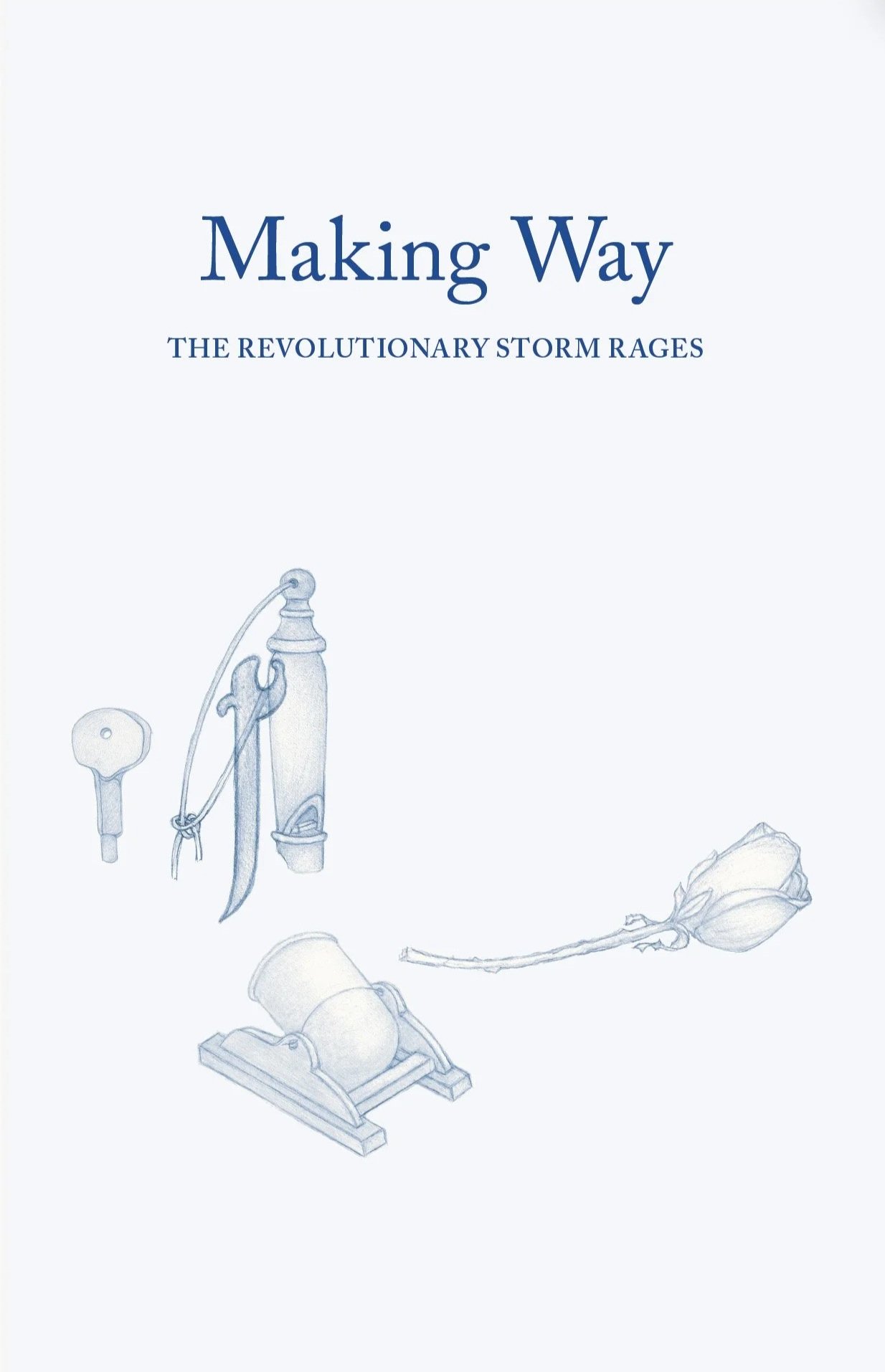
STEPSISTER PRESS: “Making Way Volume 2: The Revolutionary Storm Rages” by Dick Farkas with drawings by M.A. Papanek-Miller and designed by Jessica Larva
AVAILABLE SOON — CLICK HERE TO PRE`ORDER
Click here for Making Way Volume 1
In the first volume, the crew takes shape by accident and serendipity. They are seeking a way to navigate-both literally and figuratively-the challenges of making their way through the rapidly changing political, social, and cultural realities of the 1770s in British Colonial America. Their success is neither planned nor consistent. In fact, that lack of awareness of what is happening around them leads to their entrapment in the conflict itself. They find that they have no choice but to enlist their energies into the rebellion as privateers.
The story continues as the "revolutionary storm rages." Change swirls around them like a gyre. They must prepare for their new role in the war, but they need crew, direction, new skills, sanctuary, and leadership. They bring very little to the rebellion at the outset and face a dizzying array of choices and challenges.
In some important ways, these realities parallel the choices faced by contemporary young adults. The characters in the story encounter questions of purpose, tolerance, comfort with violence, justice, and collective decision-making. They begin to refine their awareness of the world around them, drawn by experience to consider the important issues that thoughtful people recognize-whether consciously or not-as matters that shape their lives. Some readers may see the trajectory of the story tilting toward a deeper concern for the role of women and other marginalized groups in Colonial society. This is important, because history as it has often been told has neglected these perspectives.
Understanding these young adults as they try to make their way through the unknown and into the future is a challenge-for us and for each of them. Choices, often very limited ones, steer them toward consequences and outcomes altogether unforeseen.
If one stands on the deck of a ship, the wake off the stern reveals that the sea has been churned. It heaves with bubbles and foam as a consequence of the ship's passage through the water. It sends ripples outward beyond the dimensions of the ship, changing the appearance of the sea's surface. One can only speculate how far the impact reaches and whether, below the surface, unseen change is taking place. Most remarkably, with the passage of time and distance, the sea seems to erase the impact-the wake disappears. To a casual observer, it may seem that the consequences of the ship's passage have been swallowed up by the sea's natural form.
Did something important happen? Or did something trivial happen? Should we expect the sea-or history-to tell us?
The crew of the PYGG is about to face and journey into a raging storm, as dark, violent, erratic, and uncertain as any that nature can conjure. For them, it is a rebellion whose creation, conduct, and purpose are unclear. Yet they are already in its midst. Like the wake that seems inevitably to vanish, will their lives, their energy, and their sacrifices disappear without a trace?
Their experience is transformed by necessity. They confront the realities faced by women trying to manage their colonial roles while also meeting the challenges brought about by rebellion.
