
NEWS: WBEZ Chicago Reports About 60% of Chicago Arts Workers Report Earning Less Than $40,000 Annually
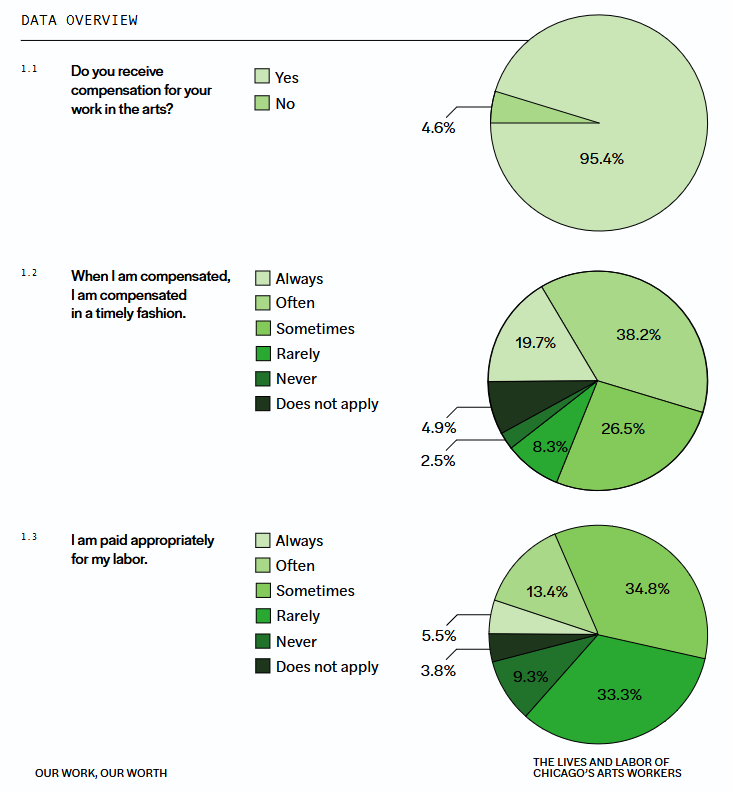
Photo Chicago Arts Census Report
NEWS
Chicago Arts Census surveyed more than 1,200 art workers to give policy makers hard numbers that reflect Chicago artist experiences.
Early May 11, 2026, WBEZ Chicago published a report highlighting key data points received from The Chicago Arts Census survey that was made up of more than 1,200 artists across disciplines who completed a 120-question survey. The survey provides insight into issues ranging from education and healthcare to housing and labor conditions.
Created during the COVID-19 pandemic, The Chicago Arts Census is an organized coalition of artists dedicated to collecting real-world data that reflects the lived experiences of Chicago art workers. While personal testimony is important when advocating with policymakers, concrete data can help drive meaningful structural change.
In 2023, Bridge had previously collaborated with The Chicago Arts Census to highlight and examine findings from an earlier report compiled from more than 2,500 intimate and detailed responses to 210 questions created by and for Chicago art workers. The survey combined practical financial questions with broader reflections on sustainability and collective futures.
Read that report here.
Among the most recent survey’s findings, WBEZ Chicago reports artists were shown to be significantly less likely to become homeowners, despite 44% of respondents having started or completed a master’s degree program. These numbers are perhaps less surprising considering that nearly two-thirds of surveyed artists reported earning less than $40,000 annually — below the average income for Chicago residents.
Although the survey was completed prior to Donald Trump’s reelection in 2024, the findings point to longstanding trends of declining arts support that predate the administration’s cuts to national arts funding. The Chicago Arts Census argues that shifts in both government priorities and private foundation funding have increasingly marginalized arts workers and cultural labor.
Coverage by WBEZ Chicago has also highlighted how broader economic crises, including the loss of SNAP benefits and other forms of public assistance, have taken precedence over conversations about arts funding. In moments when basic needs are under threat, art can be framed as a luxury rather than a necessity. The Chicago Arts Census contends, however, that artist labor rights are deeply connected to wider labor struggles, and that artists should be included in broader conversations around economic justice and worker protections.
The survey further documented the financial instability common within artistic careers. While 88% of respondents considered their work important and roughly 95% reported receiving compensation for their labor, only 57% said they were paid promptly, while 37% reported rarely or never being paid on time. As WBEZ Chicago noted, many artists work on contract-based projects that require them to front production costs themselves before payment is received, placing additional financial strain on already precarious careers.
The Census findings provide critical data supporting the lived realities of artists working across Chicago. Beyond documenting hardship, the research offers a framework for advocacy, policy development, and future structural change.
While the WBEZ Chicago report highlights specific identity and education metrics ranging from education to project funding, the Bridge report highlights the jarring statistics about welfare. Together, the reporting and Census surveys provide data-driven evidence of the challenges facing artists and cultural workers across Chicago. By developing solutions for artist workers, the city also creates pathways for supporting specialized and contingent workers more broadly.
Olivia Baczkowski is a Chicago-based writer and filmmaker.