

REVIEW: Paul Kingsnorth, “Against the Machine: On the Unmaking of Humanity”
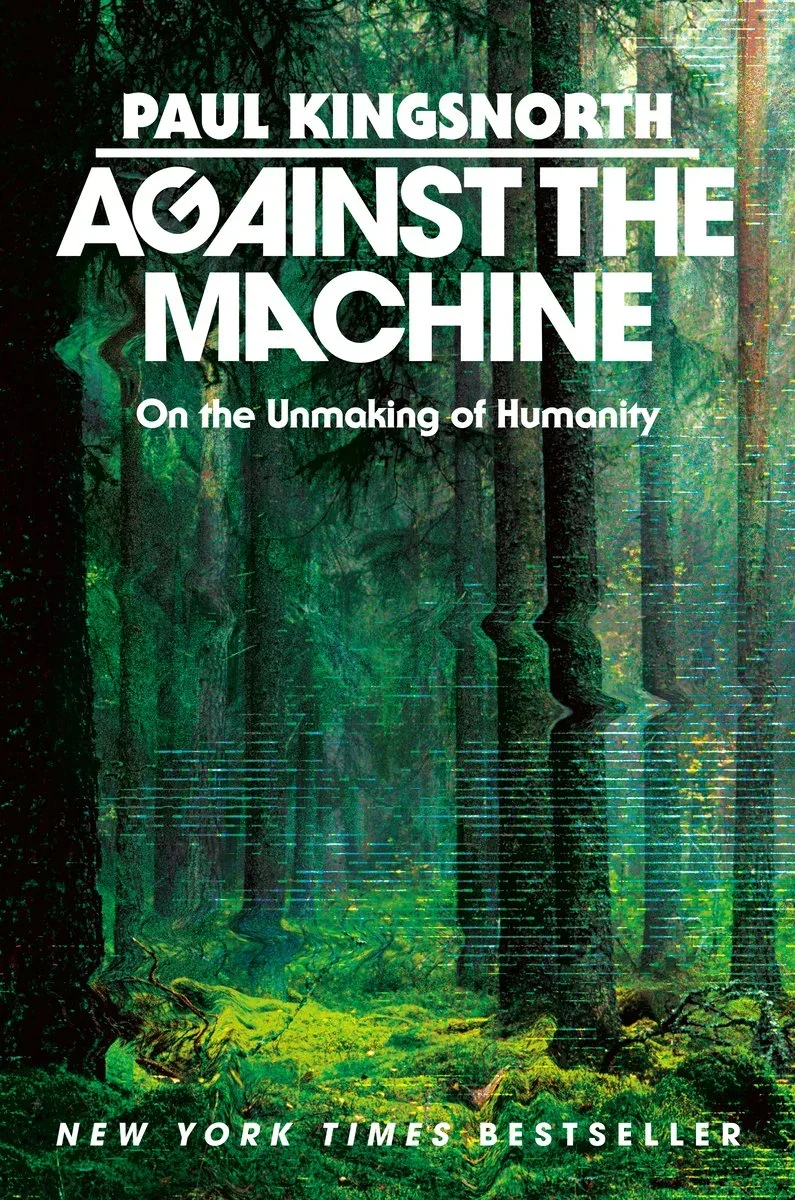
Cover, Against the Machine: On the Unmaking of Humanity by Paul Kingsnorth, Courtesy of paulkingsnorth.net
REVIEW
Against the Machine: On the Unmaking of Humanity
By Paul Kingsnorth
Penguin Random House, Hardback ($32.00)
By Ryan Fazio
As I write this, Artemis II has just returned from the dark side of the moon. It is a milestone in the exploration of space, yet any uncomplicated sense of celebration feels misplaced. While NASA might have won this one, the contemporary space race is mainly driven by billionaires' private interests and their specious designs for the future of humanity. Elon Musk and Jeff Bezos have made no secret of their conviction that the boundaries of the earth and the limits of mortal bodies are problems to be solved, confines that can be escaped.
In 1957, Hannah Arendt was already troubled by a version of this dream. Writing in the prologue to The Human Condition, just after the launch of Sputnik, she noted that the event was greeted less as a triumph of human achievement than as a first step toward liberation from the earth itself. Her injunction was simple: think what we are doing. Paul Kingsnorth's new book, Against the Machine: On the Unmaking of Humanity, takes up similar concerns with limitless growth and a tech-fueled desire to become unbounded.
The book moves through four stages: an account of how modern life has left us unrooted and adrift, a historical excavation of the machine's origins, a return to its effects on contemporary values, and, finally, a set of proposed remedies. The name he assigns to his misgivings is the Machine, and while there is much to agree with in his analysis of what it is and what it does, the overall result reads more like a series of blog posts than a sustained argument with clear causal analysis.
Educated in an interdisciplinary style myself, I was curious to see how all of the enumerated problems and their corresponding sources would work together. Ultimately, I was disappointed. In a generous reading, the book offers readers a chance to think alongside Kingsnorth as he grapples with his intuitions. Less generously, it reads like a mind map in which Kingsnorth has written THE MACHINE at the center and drawn arrows inward from every direction — capitalism, Progress, liberalism, the Enlightenment, the religious wars, colonialism, the rise of instrumental reason. The arrows are suggestive, but a larger picture of how all these things fit together is largely missing. We are given ample signposting and reminders, but it begins to feel more like a pile of problems than a set of interlocking causal conditions.
He enlists an idiosyncratic cast of thinkers to make his case, ranging from Simone Weil, Jacques Ellul, and James C. Scott to Oswald Spengler, René Guénon, and Jeremy Naydler — figures that come with considerable baggage, and whose presence raises quiet questions about what kind of anti-modernism we are ultimately dealing with. Guénon, in particular, the founding voice of Traditionalism, has been enthusiastically adopted by some of the darker currents of contemporary politics. Kingsnorth does not address this. His thinkers appear as witnesses rather than interlocutors, summoned to confirm what he already suspects and then released, their backgrounds and receptions never systematically addressed.
Because the book resists building to a singular argument, its positions can be accepted or dismissed piecemeal rather than weighing on the reader as a whole. For example, I could agree with the diagnosis of capitalist uprootedness, I could even play along with the idea that we are literally only using one side of our brains ( see ????), and still easily set aside Kingsnorth's more provocative claims. Specifically, his conviction that AI amounts to the birth of the Antichrist or that transgender identity taken to its logical extreme represents a desire to escape the human body entirely. A more sharply argued book would demand full engagement. Here, the central critique’s lack of focus reduces its impact.
The proposed solutions are where the tension becomes impossible to ignore. Kingsnorth calls for roots, limits, spiritual grounding — a recovery of people, place, prayer, and the past. As he puts it, "the first step to its dismantling is neither monkey-wrenching nor revolution — it is to stop believing the story. The second step is to stop telling it to others, and the third is to begin the search for a better one." It is a genuinely stirring formulation. But a better story, to take hold, requires storytellers who share a world — institutions, solidarities, a collective life. What Kingsnorth offers instead is closer to a set of individual retreats: denounce technology, live on the margins, tend your spiritual life. His battle is one for hearts and minds, but his weapons are essentially private.
It should also be noted that Kingsnorth is an explicit Orthodox Christian, and his proposed solutions carry a specific theological content that the book's tone sometimes obscures. The better story he is searching for, and the we he imagines telling it, may be more particular than the diagnosis suggests.
Arendt's injunction was to think what we are doing, emphasis on we. Kingsnorth’s solutions, retreat, forgoing technology on an individual basis, living in the margins, begin to resemble the very liberal individualism and uprooting the challenges. In the end, the Machine may prevail.
Like what you’re reading? Consider donating a few dollars to our writer’s fund and help us keep publishing every Monday.
