
FICTION: “FALSE DAWN” by Eugene Stein
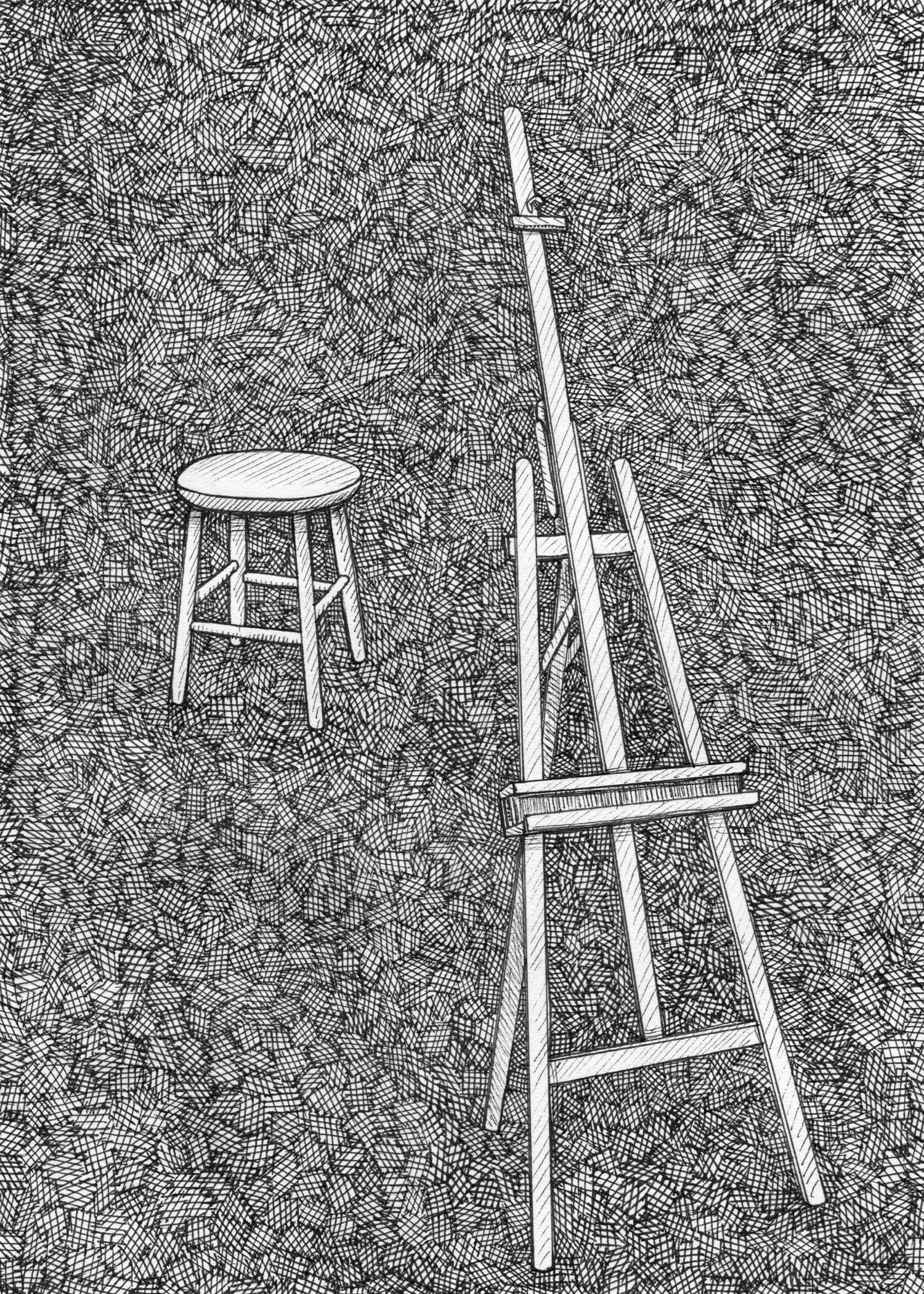
Illustration by Maura Walsh / Black Nail Studio.
FICTION
FALSE DAWN
By Eugene Stein
Ezra Safdie was twenty-nine. Dark eyes, dark Mediterranean skin, a long neck and large Adam’s apple, pursed mouth. The eyes were intelligent and searching, the mouth sardonic, often derisive; mostly he mocked himself. He saw couples holding hands at the Centennial Exposition and felt intense longing: a longing to be a different person and to have a different life. He had odd jobs at the Exposition. He washed dishes in the Turkish café, unloaded silk embroideries and carpets at the Turkish Bazaar next door, and sold olivewood trinkets at the Syrian Bazaar for four brothers, Orthodox Christians, whom he had met on board when the steamship brought him to Philadelphia six months earlier.
He shared a room with Irish day laborers in a tenement on Fitzwater Street in Southwark. He couldn’t always understand their accent and they couldn’t always understand his. He spoke Arabic, Turkish, Ladino, a little Greek, a few words of French; he thought his English was still poor.
Ten million people, a fifth of the entire country, had attended the Exposition in Fairmount Park. Safdie had looked for young men who resembled Marios, his Cypriot friend in Alexandretta; he had looked for older men like his former employer, David Forbes; but he was still alone. He met bruised dockworkers in the dark alleys near the coal wharves at the foot of Packer Street, merchants in the changing rooms of the public baths, affluent sportsmen in the woods on Smith’s Island in the Delaware River; but these were hurried, nearly silent encounters. What he was looking for might not exist. And yet his memories of Marios were not imagined.
During the summer months, at the end of his shifts in the early evening, Safdie would cool himself standing in the mist thrown off by the Centennial Fountain, whose granite base was in the shape of a Maltese cross. One Friday he sipped water thirstily from one of the drinking fountains that surrounded the structure and when he looked up a man was staring at him. They locked eyes.
It was still light out. At this hour, in Aleppo, his family would be readying for the sabbath. The man moved toward him and began making conversation, speaking in a high, boyish register. He was dark-haired, like the Syrian, and perhaps a few years older, with a strong brow jutting over intense, pained dark eyes. Handsome, broad-chested, healthy-looking. He had a dark moustache and a thin black beard along his jawline. His manner puzzled the immigrant: the man held himself somewhat regally and his accent sounded polished to Safdie’s ears, but he wore rough clothing. He offered Safdie penny candy from a small brown bag he kept in the pocket of his smock.
“You work here?” Safdie asked.
“No. I’m a painter.”
A house painter? Safdie was confused again.
“Let me show you,” the man said. He put an arm briefly around Safdie’s waist, guiding him toward the Avenue of the Republic. They walked slowly past the lake and the Machinery Building, continuing their desultory conversation. Where the man had touched him on his hip, Safdie felt a pleasing burning sensation. They passed through the Main Exhibition Hall and into an art gallery. Then Safdie felt foolish for misunderstanding the man’s profession.
They stopped in front of one of the paintings. “This is mine,” the artist announced.
Two seated men were playing chess, watched by a third, who was standing. A decanter of port and wine glasses glowed on a side-table, the men’s faces and the white chess pieces were lit up as well, and a black cat groomed itself on a red carpet.
Safdie looked closer at the standing man. “He looks like you.”
“My father,” the painter said. “I want to show you something else.” He led Safdie out of the art gallery and walked at a clipped pace to the U.S. Government Exhibition Building. “I have a painting here.”
“Why here?”
“That’s a good question.”
An ersatz Army Post Hospital wing had been built in the Government Building, and at the end of the ward, behind metal beds filled with papier-mâché patients, a large painting was hanging on the wall. Safdie had never seen anything like it, first its immense size, two meters wide and two-and-a-half meters high, and then its subject matter, a surgery in process. The painting felt alive: the elderly chief surgeon with unkempt gray hair and thick gray sideburns whose bloody hand held a scalpel, a team of junior surgeons operating on a patient, a woman, probably the patient’s mother, looking away in terrified disgust, a recorder taking notes, and a crowd of people watching in the surgical amphitheater. The blood, the pale thigh, the mother’s revulsion, the surgical instruments—they all looked real. Safdie was transfixed.
“Hello Mr. Eakins. Hello.” A soldier assigned to the ward greeted them.
“Another big crowd today, eh, corporal?”
The soldier was embarrassed which seemed to delight the painter.
Safdie waited till the corporal had moved off. He indicated one of the onlookers, a figure on the right, watching intently, holding a notebook and pencil. “You.”
“Yes.”
“It’s wonderful,” Safdie said.
“Thank you. But as you can see, I’ve been banished.”
Safdie didn’t understand that word, “banished.” But he understood the man’s disappointment. “Wonderful,” Safdie said again, to cheer the painter up.
“I want to paint you.”
Safdie was confused. “Why?”
“Why not?”
He didn’t know the word for chess in English. “I don’t know how to play échecs.” Somehow he remembered the French; his father had traded with French businessmen in the Levant. “I am not a smart person, not a doctor.”
“I think you’re intelligent. Anyway, I paint many people who aren’t.” He handed Safdie his card. “Can you come tomorrow?”
“No. I work.”
“Sunday? I paint at home on Sundays. I can pay you.”
The man seemed eager, and the restaurant and bazaars at the Exposition were closed on Sundays. And the way he had looked at Safdie… Perhaps this was how he met men, how he befriended them, asking to paint them. “Yes.”
Eakins lived in a rowhouse in Spring Garden, a middle-class neighborhood. His studio was on the fourth floor of the family house, a wood-framed attic space that had been added to the original brick structure. It had a skylight and three tall windows fronting the street. Watercolors and perspective drawings, mostly studies of scullers along a river, were pinned around the room and framed canvases leaned against the walls.
Safdie had wondered if—had hoped that—they would be alone in the house. But Eakins lived there with his father, his three sisters, and his brother-in-law. “It’s my father’s house,” Eakins explained.
This was not going to be an intimate meeting, then. “You are married?” He hadn’t seen a wedding ring.
Eakins was positioning Safdie opposite his easel and under the skylight. “No. Engaged.”
“Do you have a painting of her?”
“No. Take off your clothes.” The artist saw his reluctance and showed him his sketchbook with drawings of nude men and women. “People pose for me all the time.”
Safdie still hesitated.
“No one will bother us here,” Eakins said. He locked the door of the studio. “It’s quite safe.”
Safdie knew that artists painted nude models—nude women, he had always imagined. Nervous, he stepped slowly out of his clothing until he was in his drawers and undershirt.
“Everything,” Eakins said.
Safdie removed his underwear and added these to the pile on a chair next to him.
“I like old-fashioned underwear,” Eakins said. “It’s prettier.” The painter considered him, kneeling on the slats of the wooden floor and looking up at Safdie. “Turn around slowly.”
Safdie turned around until he was facing Eakins again. He was embarrassed by what was apparently a purely professional examination.
“Your skin is exquisite,” Eakins said. “I love the color.” But he was looking intently at Safdie’s penis. The painter scooted closer to him. “You’re circumcised.”
Safdie thought he knew what this word meant. “Yes.”
“Are you a Jew or a Moslem?”
“A Jew,” Safdie said.
Eakins got up from the floor and moved over to his easel. Safdie didn’t think he was imagining that the painter was cooler to him now. “Don’t move,” Eakins commanded and began to sketch him.
“You sell your paintings?”
“Not many. Don’t talk.”
Safdie hated this: standing naked, not moving, not talking. “I want to go.”
“No. I’m paying you.”
Safdie looked at one of the framed canvases: Eakins poling a boat through reeds in the early morning while his father held a shotgun. “I like this one.” He liked it because Eakins looked like a laborer, and the brown marsh and the streaks of golden sky at dawn were beautiful.
Eakins, mostly indifferent, turned briefly to see what Safdie was pointing at. “Oh. We were hunting rail. I don’t go there anymore because I caught malaria.”
“Malaria.” Safdie pronounced it mal-ahh-ria. “I too.”
The painter looked up at him, his dark eyes flickering with momentary sympathy. “Beastly disease. I thought I was going to die.” He drank from a quart bottle of milk on a side table, returned to his work, and sketched quietly. “Were you sick long?”
“Yes. The fever comes back and comes back.”
“And the ague. Awful.”
“I took kine – kine –” He couldn’t pronounce the word.
“Quinine. No more talking.”
A British tar had given Safdie the drug, back in Alexandretta, the fluid golden brown, like Eakins’s painting. Bitter tasting stuff in small brown bottles.
At the end of the session the painter handed him a silver dollar: excellent pay for two hours work. “Get dressed,” Eakins ordered.
Safdie had wondered if they might talk after the modeling session—if, perhaps, the painter desired him after all.
“Maybe I’ll draw you again,” Eakins said.
“When?” asked Safdie, appalled by his own foolish, desperate hope.
“I’ll find you at the Exposition.”
That seemed unlikely, with the throngs of visitors and tradesmen. “I work at the Turkish café.” He realized Eakins didn’t know his name. “I am called Ezra. They know me there.”
Eakins had little interest. “Yes, yes, thank you.”
Safdie had caught malaria in Alexandretta; the harbor was built near marshland. He had left Aleppo to escape his father and because the local economy was deteriorating. His father was a slender, hardworking, headstrong Sephardic Jew; pious and assiduous; sometimes cruel. In many ways he lived as his ancestors had lived for generations. But new ideas were percolating, the Haskalah or Jewish Enlightenment reaching Aleppo through the Alliance Israélite Universelle school that had just been established in the city by French philanthropists and the Ladino newspapers from Constantinople, Smyrna, and Sofia that Safdie’s father cursed and subscribed to.
Fertile farms surrounded Aleppo, and behind and above the farms were the mulberry and olive orchards of the hill country. Safdie loved the city, but he needed to leave. He didn’t want to be observant; he didn’t want to fight with his father any longer; and most of all, he didn’t want to marry.
Alexandretta, only 150 kilometers from Aleppo, was on the Mediterranean, at the foot of the Amonos Mountains. Below the hills, between the swampy fields and the dilapidated jetties of the harbor, was the town, with its Alawites and Armenians, Turks and Greeks, merchants and thieves; and here he found work at MacAndrews & Forbes, a company that manufactured licorice extract. The sweet roots of the bitter licorice plant were boiled until a thick black resin was left. The paste was then poured into crates lined with paper where it would cool, dry, and harden.
David Forbes, who ran the Nazilli plant and opened the Alexandretta facility, had hired him. Safdie was strong and could lift the heavy crates, and he had a facility for numbers if they needed help in the office. There was an understanding between the two men. Forbes, a confirmed bachelor, would nod to him, occasionally put a hand on his shoulder, but never really engaged in conversation, except about the business. A few months later the Scotsman left the Ottoman Empire for the United States, where he opened a processing plant in Newark, New Jersey.
A Cypriot boy, Marios, twenty years old, befriended Safdie, who was then twenty-four. For months they shared a room and a bed in a derelict boarding house near the quay. The elderly landlord assumed they were saving rent, and since he was deaf, he didn’t hear their noises at night. Marios worked for a cotton merchant in town. Safdie learned English in the office, Greek in the bedroom, Turkish in town. He was happy. Oh, it was sweet to share a bed with Marios. To punish him for his happiness, God sent pestilential winds through the marshes that gave Safdie malaria. The fever and chills came in cycles. The Cypriot moved out, afraid of catching the sickness. By the time Safdie recovered, Marios had made a new and wealthier friend.
Safdie wanted to get away, far away. He moved to Smyrna, a thousand kilometers northwest, a large harbor city on the Aegean in Western Anatolia. The bay was beautiful and spacious, the pier long, the town chaotic and crowded. In the alleys near the wharves, in the backrooms of inns and taverns, in cramped lodgings on the slopes of Mount Pagos, Safdie, trying to forget Marios, had sex with sailors, stevedores, stokers, coal trimmers: some who couldn’t afford whores, some who preferred men. The stokers had thick calluses, the stevedores had thick muscles, the coal trimmers coughed, the sailors were sunburned.
He read about America in the Ladino newspapers, America with its liberty. Spartali & Company, the export company where he worked as a dragoman, had offices in London and Liverpool; he made himself indispensable and was sent there. And then he followed David Forbes to the United States: not because he hoped to find and sleep with his former employer, but because Forbes was free.
They met again four months later, in early November, and again at the fountain, in the late afternoon, when it was already growing dark. Today Safdie had been stationed at the Syrian Bazaar, packing up the olivewood crucifixes, rosaries, and brooches for shipment back to Jerusalem, where the four brothers lived; the Exposition would close down soon. He had been working since sunrise and the eldest brother, Nachly, had told him he could leave early.
“I was hoping to see you,” Eakins said.
Safdie had not forgotten the painter but had forgotten about his high-pitched voice. He nodded hello.
“Are you done for the day? Yes? Come back to the studio with me.”
“It’s too dark.” He meant it was too dark for painting.
“I have lamps. We’ll be alone, my family’s out of town. You’ll be more comfortable this time.”
Safdie demurred. “I don’t want to be naked.”
“Then, good sir, you shall wear your clothing.” Eakins spoke grandly. Safdie sensed he was being made fun of.
They took a horse-drawn streetcar over the iron truss Callowhill Street Bridge, Eakins paying for Safdie’s ticket. In Spring Garden they walked along Mount Vernon Street, which was peaceful and dark in the early evening, to Eakins’s house. Once again Safdie walked up the three flights of stairs to the studio. The house was quiet, the creaking steps making the only noise. Eakins lit paraffin lamps in the studio, the smell of kerosene mixing with the odors of linseed and turpentine.
“You like to paint at night?” Safdie asked.
“I love lamps and candlelight, and morning and evening, and beautiful women and men, their heads and hands and skin and most everything I see.”
What would that be like, Safdie wondered, to like everything you view? To not hate yourself and therefore the world around you?
“And I want to paint them as I see them,” Eakins said. “You’re a beautiful man.”
“No.”
“I think so. Your skin is extraordinary. Are you hungry?”
“Yes.”
Eakins offered a tray of food: cheese, bread, milk. Eakins poured him a glass of milk, and drank the rest of the quart, emptying the bottle.
Safdie drank the milk. “It’s sweet.”
Eakins informed him that it was preserved with formaldehyde. “Safer that way. Now, won’t you take off your clothes? I will. I’ll show you.” Eakins removed his clothing and stood naked in front of the Syrian. He had wide hips and not much hair on his chest, which had a faint indentation at its center. “See? It doesn’t hurt.” Safdie slowly removed his own clothing. “That’s better,” Eakins said. “And more comfortable.” He adjusted Safdie, positioning him sideways with his arms clasped at the wrists behind his back, so that his weight was on one foot, his groin was concealed, and his head swiveled to the left. “Can you hold that?”
“I will try.”
“This way no one will know you’re circumcised. Beastly practice. I would not mutilate Nature for double the money.” He started to sketch. “When an artist paints a naked woman, he gives her less than Nature did. A naked woman is the most beautiful thing there is, except for a naked man.”
He drew for an hour and a half. Sometimes Eakins studied Safdie with what the Syrian felt was frank desire, sometimes he gazed at Safdie as if he was simply an available subject, like a vase of flowers or a ceramic bowl in a still life. “Does it get easier for you, posing?” the painter asked.
“No.”
Eakins laughed. “All right. We can stop.”
Safdie turned around. He didn’t put on his clothes. Instead he walked slowly up to Eakins and put his hand on the artist’s bare chest.
“No. No touching,” Eakins said. “I like to look. You can get dressed.” He paid Safdie another dollar.
Safdie enjoyed living in the thriving metropolis, admiring the streetcars crisscrossing Philadelphia, the ice skaters in the winter on the smooth frozen ponds, the new gleaming railroad terminals with their turnstiles, elevators, post offices, and restaurants—all the modern American appurtenances; and then, too, the beautiful hills and orchards around the city that reminded him of Aleppo.
Ten years had passed. He was working in Philip Lutz’s German restaurant on Fifth and Chestnut Streets. Safdie bussed and poured drinks, bartended in the tavern on Tuesdays and Thursdays, cut off the säufers, politely, when they’d imbibed too much, waited tables at the restaurant when the waitstaff was short, even helped the assistant manager with his accounts. On Saturday mornings he brought the ledgers to Lutz’s home in West Poplar, not far from Spring Garden, for review. Once again, he had made himself indispensable. Safdie’s English had improved and now he was learning German as well, pleasing his boss. Lutz, stout and frenetic, apt to turn red in his rages, was himself a bit of a säufer, a little too fond of his Bavarian beer, but in his calmer and more sober moments, appreciative of his staff.
Safdie recognized Eakins at once, although the painter had gained weight and his eyes had lost much of their quickness. He doubted Eakins would remember him, but maybe, he thought, his dreadful hope stabbing him again, an artist always remembered his subjects, the way Safdie’s father could recall each customer he’d served in the souk. Eakins, sitting with friends, paid him no attention as he brought over the drinks, looking up only briefly when Safdie placed a bottle of milk before him without being asked. He barely looked up again when Safdie set down his plate of hamburger steak, Lutz’s specialty. But when Eakins rose to use the toilet room, still a rarity in restaurants, and found Safdie in the narrow passageway outside the kitchen, he grasped the Syrian’s arm. “My friend, remind me, what’s your name?”
“Ezra. Safdie.”
“Yes, of course. I teach at the Art Students’ League. You must come to my class to pose.”
“No.”
“My pupils need to paint you. I’ll pay.”
The Syrian acquiesced. He was sending bank drafts to his now indigent father in Aleppo. Safdie could use the extra money, and he could come on Tuesday morning, before the tavern opened.
Outside the school on Market Street, Eakins, dressed in his painter’s smock, was throwing breadcrumbs to house finches. He greeted Safdie and took him upstairs to the studio. “We’re just about to start.” By and large the boys in the studio were young, perhaps twenty or twenty-one years old, joking with one another as they set up the classroom. One stood naked in front while the others sketched him. The room was spare, with a few plaster casts on the floor, animal skeletons on tables, folded easels against the wall under a horizontal stove pipe, and two pairs of boxing gloves hanging from a shelf. The spring day was warm, the stove was turned off, and a calico cat was lounging on the piping. Safdie gathered, from the excited buzzing of the students, that the school was new. And more: that Eakins had left his previous school in a hurry. Banished again. One student, Samuel Murray, a favorite of Eakins and younger than the others, was barely nineteen, an athletic-looking Irish boy with thick brown hair and eyebrows and green eyes. The impishness, the youth, the dark hair framing the handsome face, the desire to please and to be pleased—all brought Marios to Safdie’s mind.
Eakins told him to remove his clothing and then gathered the students around. The painter crouched on the ground, looking up at him. “Mr. Safdie is a nice Jewish gentleman. Notice his penis and the missing foreskin. Michelangelo made a mistake when he sculpted his David.”
He should have realized it was going to be like this, Safdie thought. The students began to draw. “Always include in your sketch the strongest light and the deepest shadow,” Eakins instructed. “Then work between them. Draw by the longest lines you see, then you can put in the little knobs and swellings later. You want to go at a thing as simply as possible.”
After an hour he asked Safdie to don the boxing gloves. “You don’t mind, do you? You see that Sam is willing.”
Safdie and Samuel Murray posed naked with their knees bent and elbows splayed, raising their gloves at each other. Safdie and Marios had played naked games like this, minus the boxing gloves—silly wrestling matches in their small room in the boardinghouse in Alexandretta; it didn’t matter who won or lost because the games ended, inevitably, in lovemaking. But Safdie was twenty years older than Sam, he must look silly sparring with him. Eakins had taken out a four-by-five inch dry plate box camera and was taking photographs of them.
“Notice how the composition of the gluteal muscles begins to change with age,” Eakins said with his high voice. “These changes are slight in Mr. Safdie, and slightly more pronounced in me.” The painter had taken off his clothing by this point, and he turned around to demonstrate. “The gluteus maximus, medius, and minimus and the quadratus femoris all continue to atrophy as we advance in years. Or, as my Grandmother Cowperthwait, a proper Quaker woman, used to advise me: whatever you do, don’t get old.”
Eakins drank a quart bottle of milk and then he sketched too. He seemed to prefer to draw in the nude. His lower lip sagged as he worked, and he drooled a little. He wiped his mouth with his handkerchief. Mid-morning they took a break and Safdie went downstairs for some air. Market Street was noisy with the passengers pouring out from the trolley terminals, the construction workers heaving joists and bolting girders as they built City Hall, the crowds of customers heading to Wanamaker’s Grand Depot clothing and dry goods store. The finches, no doubt frightened of the hubbub, had flown away. Safdie watched the passers-by, then, steeling himself, went upstairs.
“Good, you’re back.” Eakins presented the Syrian with a costume and asked him to wear it. Safdie looked at the clothing. There was a traditional taqiya for his head, a festive shirt decorated with blue, red, and black embroidery around the neck, a kaftan made of silk that would reach his ankles and cover the wide cotton shirwal pantaloons, and a thick leather cross belt, all to be topped by a black cloak stitched with golden thread at its edges. Safdie was also presented with a ceremonial sword to wear.
“No,” Safdie said. He was an American now, a citizen, not a Bedouin.
“I think it will fit. Please. Two dollars and twenty-five cents for the morning.”
But this was good money, more than a coal miner or millwright would make in an entire day. Safdie, seething, put on the clothing.
“Wonderful,” Eakins said. “Look at his eyes. That’s what anger looks like. Our Jewish gentleman is not so peaceable now.”
Eakins took photographs of him while the class sketched. At noon Safdie took the costume off.
“I can’t persuade you to stay longer?”
“No. My money please.”
“Can you come back?”
“No.”
“I’ll have to paint you from the photographs then. I shan’t forget you.”
Safdie saw Eakins one last time, eight years later, in 1894. Lutz’s businesses had closed, and Lutz had died of circulatory disease, barely in his fifties. Safdie was now the general manager of The Squire, a large restaurant and banquet hall on Ninth Street, next to the Walnut Street Theatre. He oversaw the firm’s crew of cooks, waiters, dishwashers, cloak room attendants, linen pressers, and porters—the industrious Germans, Irish, Black Philadelphians, Russian Jews, and Italians they employed.
Tonight, he was supervising a fundraising gala at the Charity Ball at the Academy of Music. He didn’t attend every event they catered, but the Charity Ball was important to Mr. Donovan, the owner of The Squire, and thus it was important to Safdie. He loved the Academy, with its beautiful horseshoe-shaped auditorium. He had attended the premiere of The Flying Dutchman here, and more recently Gounod’s Faust, accompanied both times by Miss Murphy, Mr. Donovan’s secretary, a pleasant woman in her forties and Safdie’s friend.
While surveying the ladies in their gowns and the gentlemen in black tie as they entered the vestibule, he caught sight of Eakins. He was surprised to see him at the gala. Eakins, he gathered—from time to time he had made inquiries—was still under a cloud from various personal scandals. The painter was now a slow, glassy-eyed, rather coarse figure, who walked with a slight shuffle and whose lower lip permanently drooped.
Safdie avoided Eakins, but as the Syrian made his rounds under the flickering lights of the yellow gas lamps, checking on his employees, patrolling the halls, examining the bouquets of pale blue hyacinths and white jasmine flowers, Eakins grabbed hold of him outside the toilet stalls. “I thought that was you. Your skin. I’ve always remembered it.”
“Hello, Mr. Eakins.” He tried to pull away.
“I want to paint you again.” Eakins was still clutching Safdie’s suit jacket. “Won’t you pose for me? I want to paint you naked. Don’t worry, it will just be the two of us, no one else needs to know, I promise.” His voice climbed even higher with his desperation. “Please? Won’t you do that? It will be so easy for you, but it would mean so much to me. I can pay you.”
Safdie stalked off. Finally, now, he understood. Eakins was sick. And he, Safdie, must be just the same, just as sick. His disease sent him at night to the dark saloons and dank molly houses at the waterfront. Philadelphia was a city of a million people and in the brothels there were new faces all the time, new customers in the shadows, new whores and rent boys, tired faces, hungry faces, faces streaked with coal from the anthracite shipped through the Port Richmond Terminal or streaked with dust from the dirt floors of steel mills. In the saloons there were sailors from the naval base and army engineers who dredged the harbor; they might be treated to drinks or meals, or they might be paid. He had been deluded in thinking that there would ever be anything more for him; he looked forward only to more chaste opera dates with Miss Murphy. After all this time, at the age of forty-seven, he had still held out hope for a companion, someone to share his life with. No longer. That foolish, desperate, vain hope was gone. Marios had been a brief and bright interlude, but a false dawn. Safdie would pay to be serviced and if need be, when he was older, he would pay to serve. Sometimes, alone at night, he imagined a world where he could live as he wanted: a shimmering, unreal world, full of light, like a painting.
Thomas Eakins died at seventy-two of heart failure, possibly exacerbated by lead poisoning from the paints he used or formaldehyde poisoning from the milk he drank. Safdie died of pneumonia two years later during the influenza pandemic, which first struck hundreds of sailors at the Philadelphia Naval Yard in September 1918. Not much is known of Safdie’s last years, although in the 1910 Census he is listed as a single man living in Haddington, in West Philadelphia, near the Market Street El.
The painting Portrait of Syrian Man in Traditional Garb, c.1887, whose subject seems to glare at the viewer, remains in the permanent collection of the Hirshhorn Museum and Sculpture Garden in Washington, D.C.
Eugene Stein is a writer residing in Santa Monica, California.
Like what you’re reading? Consider donating a few dollars to our writer’s fund and help us keep publishing every Monday.
