

PERSPECTIVES: “On Loss and Absence: Textiles of Mourning and Survival” at the Art Institute of Chicago
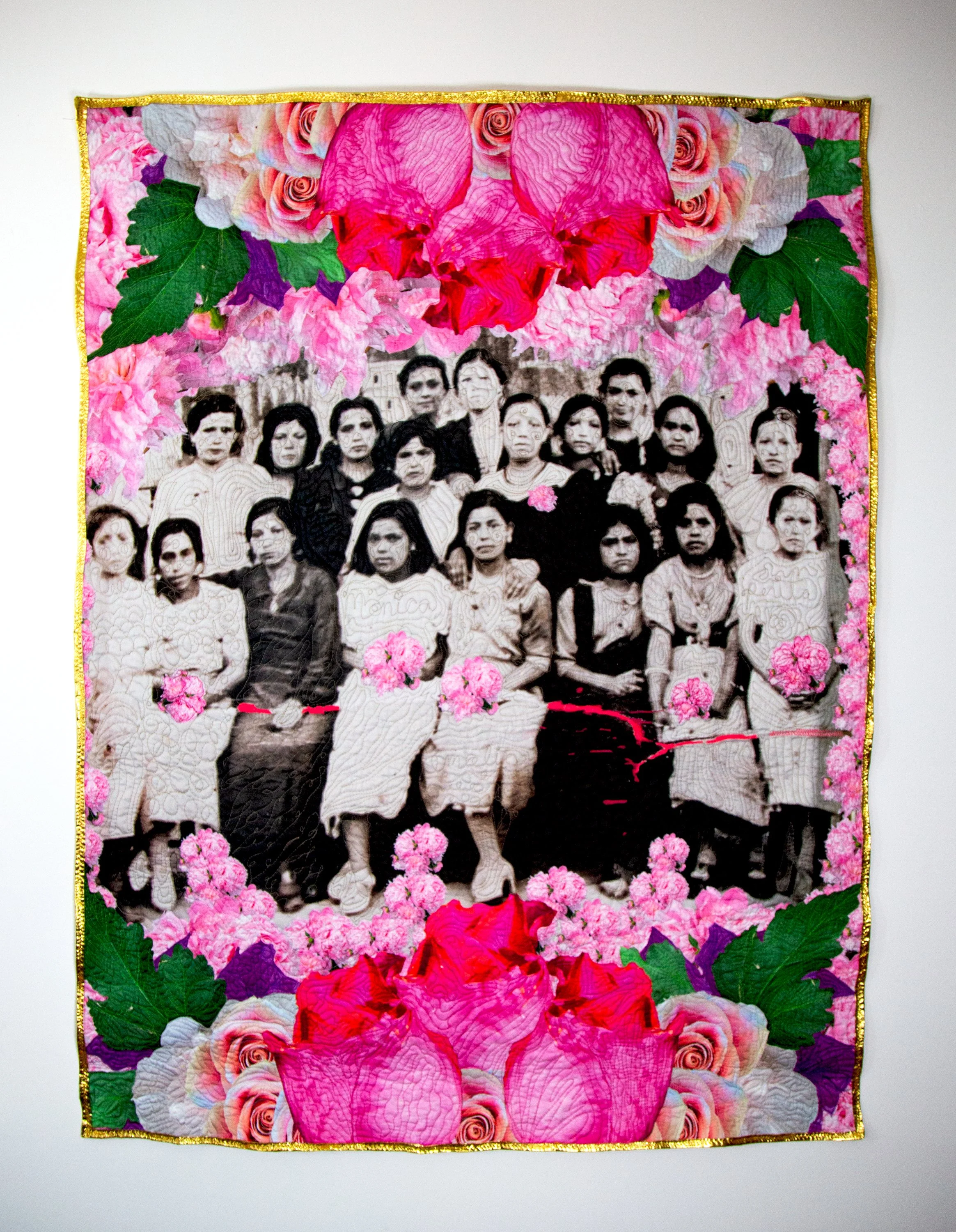
Carina Yepez. Made in collaboration with Maricela Herrera (auntie) and Lula Yepez (mom) and in gratitude to Amalia Martínez from La Haciendita, Guanajuato, Mexico. Mujeres (Women), 2023. Collection of the artist.
PERSPECTIVES
On Loss and Absence: Textiles of Mourning and Survival
Art Institute of Chicago
111 S. Michigan Ave.
Chicago, Illinois 60603
By Kristin Mariani
In the fall of 2022 I visited Anne Wilson's Drawing Room, an archive project from the artists’ textile collection informing her prolific creative practice. Opening the doors of her home and studio at a time when the world was just emerging from the threat of Covid 19, Wilson was also in the early research phases for On Loss and Absence: Textiles of Mourning and Survival, digging deep into the archive of the Art Institute of Chicago's Textile Department with fellow curators Isaac Facio, Nneka Kai, L Vinebaum, and Melinda Watt serving as senior museum advisor. On Loss and Absence: Textiles of Mourning and Survival spans four millennia, with artifacts dating from the 2nd century BCE to contemporary works made as recently as 2024. These textiles, which originate from all areas of our inhabited globe, speak to us in the present moment, the time and place from which we live. This editorial, rather than providing a review of On Loss and Absence: Textiles of Mourning and Survival, shares the perspectives and writings of three individuals who practiced slow, close observation to the textiles they encountered, featuring responses from Mariela Acuña, Vaidehi Gohil, and Caroline Bellios.

L. Vinebaum, WE ARE STILL HERE, 2025, Gold ink on paper, edition of 1000, 11 x17 in. Image courtesy of the artist.
On Presence
By Mariela Acuña
“WE are STILL HERE,” affirms a print hung on the wall near the entrance of the exhibition. The poster, with printed gold letters on yellow paper, is an editioned print by artist and exhibition’s co-curator L Vinebaum, who generously made it available for visitors to take home during the first few weeks of the exhibition. For the artist this poster is a celebration of “resilience, resistance, and survival.” Hung in the exhibition, it also serves to assert our presence. In the gallery, yes, but most importantly, in our city, country, and world, as we witness heightened, overlapping injustices and profound loss. We ARE still here. How best to use our presence, our knowledge, our voice, our hands?
The exhibition contains powerful examples past and present of artists who have used their hands and minds to honor those who are gone and to resist erasure through textile traditions and practices. The Diné artist and weaver, Barbara Teller Ornelas, contributed Contemporary Chief Set (Three Miniatures) (2024) to the exhibition. This body of work, which includes 75 individual weavings, honors 75 Navajo weavers whose names have been forgotten by institutions that often exhibit their work without their names. Highlighting this practice and resisting her own erasure, the artist affirms, “when you see my work, you will know my name and where I come from.”
Also using textiles to resist erasure and call out injustice, artist and activist Dorothy Burge has dedicated her artistic practice to making sure that young Black Americans know their history. Using a medium familiar to her as a third-generation quilter, Burge makes portrait quilts to amplify the voices of people whose stories are not often told and at times, intentionally silenced. Burge’s larger-than-life portraits in the exhibition are of Michelle Clopton and LaTanya Jenifor-Sublett, two Black women who were tortured by Chicago police, forced to confess to crimes that they did not commit, and forced to serve more than 20 years in prison. Through her quilts, Burge honors the stories of these two women and many others, demanding we don’t forget.
At this moment, when the federal government is actively working to erase past injustice and silence those protesting injustice today, these artists remind us of the power of art and in particular, textile traditions, as tools of resistance. May this exhibition remind us all of the responsibility behind the assertion that we are still here.
Mariela Acuña is a curator and art administrator in Chicago, where she is Director of Exhibitions and Residency at Hyde Park Art Center and Board President at Comfort Station.
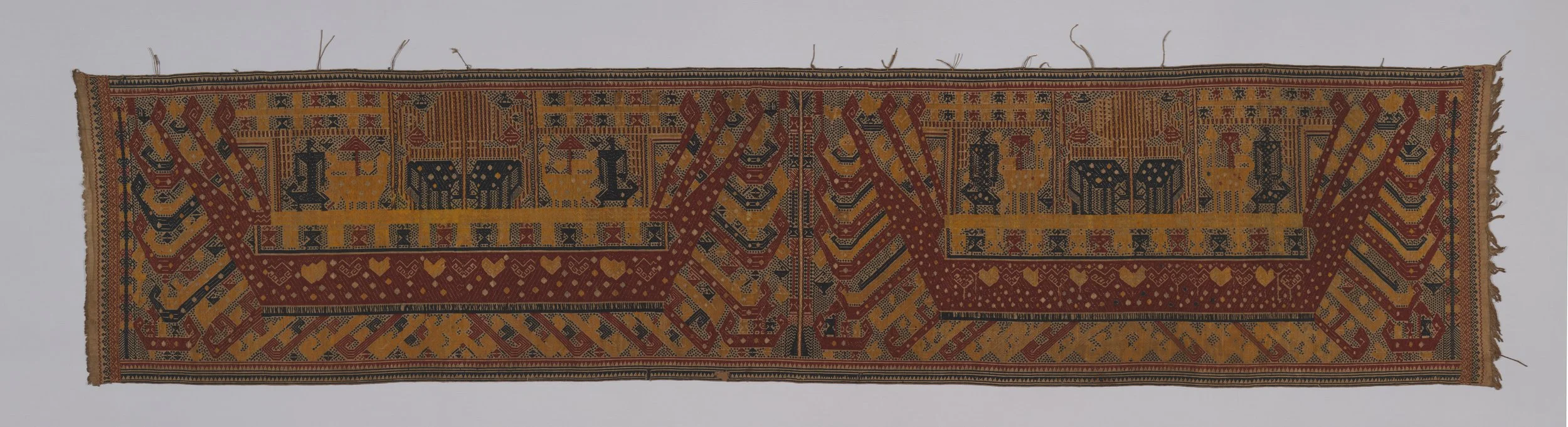
Paminggir people; Kalianda, Lampung area, South Sumatra, Indonesia. Ceremonial Hanging (Palepai), 19th century. The Art Institute of Chicago, gift of E. M. Bakwin Indonesian Textile Collection.
Crossing Oceans
By Vaidehi Gohil
As I entered the gallery with the intention of exploring and learning, my eyes were drawn involuntarily to the fabrics displayed on the right. They seemed different yet familiar, so I asked myself why they called for my attention. Upon further inspection, the realization dawned on me that their origins were the same as mine. Patola are double ikat woven silk fabrics which take about a year to be completed. These prestigious fabrics are worn in celebration, mentioned in many folk songs, classical literature, and even in modern music. Seeing this tickled a distant memory of a school trip to Patan, a small city of Gujarat in India where the textiles are made.
My classmates and I were taken through the journey of making the fabric. Never had I thought I would encounter the textiles here, and experience their association with death. Across the ocean to Indonesia, the meaning as I had known it had been transformed. In Indonesia patola are heirlooms, used in funerary contexts, placed atop burial mounds of rulers. No longer defined simply by their craftsmanship or materials used, these textiles mark the passage to another realm accompanying the dead, telling me that death is not just the end but a transition to another state of existence. As I ventured along, another piece carried this feeling. Hailing from Indonesia, Ceremonial Hanging (Palepai), a high status cloth displayed in special occasions, is also called ship cloth, to represent ‘ship of the dead.’ This boat transports the deceased to another world, aiding one through life's transition, a promise of safe passage when life becomes unstable, echoing the sense of vulnerability. Just as the patola had, the palepai convey a movement rather than an end in a place where we mortals deem the ending of one's being, exhibiting that cloth moves where mere bodies cannot, crossing oceans and even realms holding what mere words cannot.
Vaidehi Gohil is a senior at the School of the Art Institute of Chicago, working across painting, fashion design, and visual communication. Their practice bridges fine art and design with a focus on visual storytelling and material exploration.
Looking Through Loss
By Caroline Bellios
A good deal of my research and practice centers death and mourning and our connections with loved ones, so I entered this exhibition expecting I was going to meet old friends and stories and hopefully a few new ones, too. And indeed within the first space of exhibition, labeled Death and Mourning, I greeted early 19th century hair jewelry floating like spirits in a transparent enclosure.
Hair jewelry presents a piece of a loved one as a rare jewel or precious metal, an adornment of everlasting connection. Our hairs are threads of human lives, a record of time lived. Like the rings inside a tree, strands of hair are marked by periods of health and stress, a diary our own body writes, our body’s witness of our existence. Once snipped from the head of a loved one, their hair was brushed and stroked one final time and arranged into a plait to be preserved beneath glass, a human attempt at the permanence of amber, these final gestures a woven story of humanity in the tradition of Arachne, immortalized to be pinned next to a heart or encircle a finger.
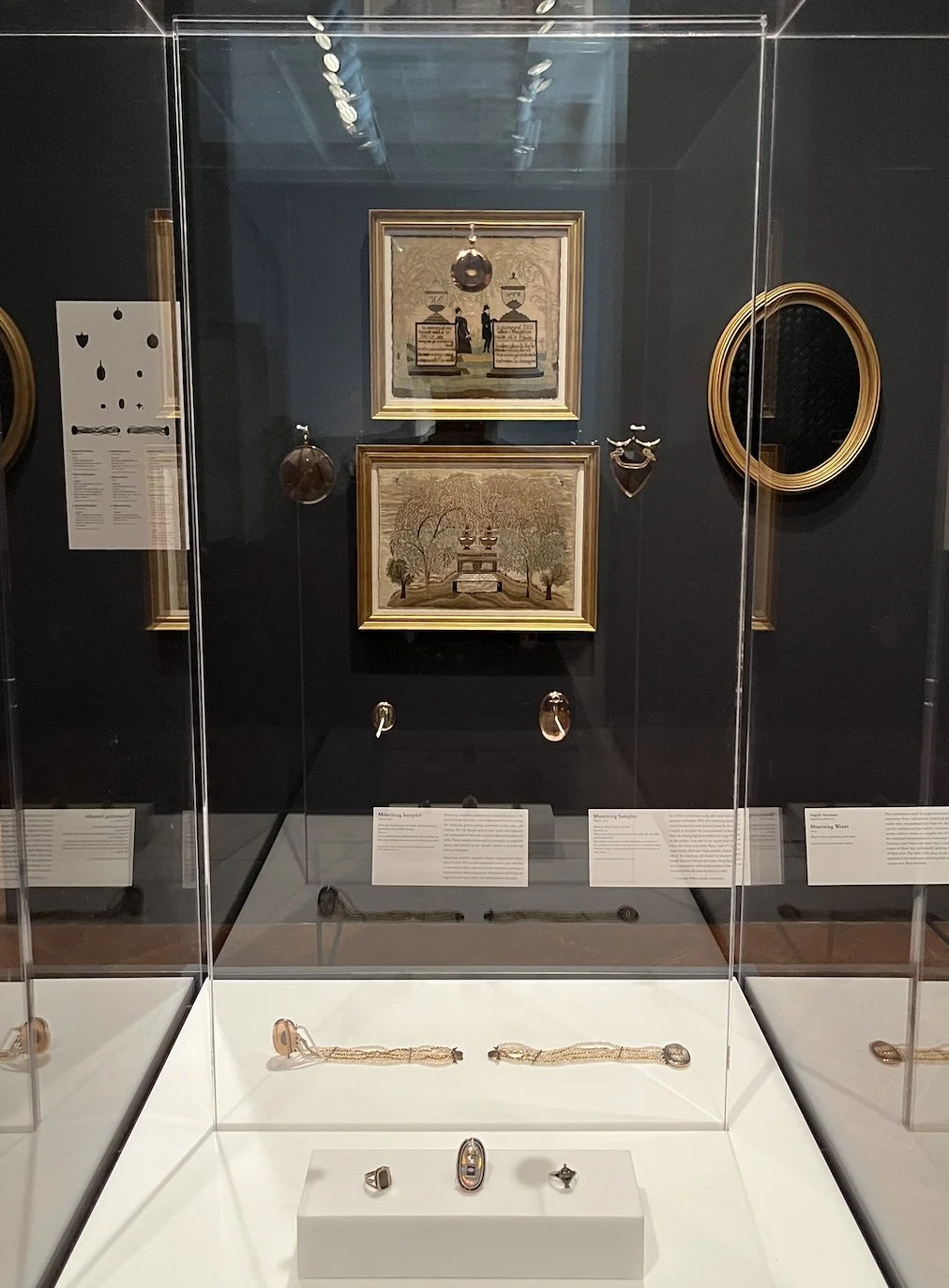
Through their case the pendants and brooches, shining with locks of loved ones long buried, layered fascinatingly in conversation with nearby sewing samplers, words and images stitched with colored silks and strands of hair, memorializing others also lost. Image Caroline Bellios.
While catching up with the braids and stitches I heard a familiar but unexpected tonality - chanting from an Eastern Orthodox liturgy. Having been raised in the Greek Orthodox Church, it was the sound of community on Sundays, welcoming baptisms, joyful weddings, and also the sound of lachrymose funerals and memorial services bitter and sweet. This chanting ties together all of the rituals of life and death. In the music I could smell incense and feel people standing next to me. My phantom physical sensations reminded me how bodily grief is, something you feel yet cannot touch.
The chanting originates from a room designated Care, where the physical space of the exhibition turns, and the object focus transitions from mourning to repair. This room, gently bridging the abyss of loss, is a moment of reflection in between death and remembrance. Perhaps textiles help us process our grief, repetitive motions creating an offering imbued with our attention and affection, and with music we fill the empty spaces between - between us and the lost, between us and others who grieve, between us and those who never knew them, and in this exhibition between us and the textiles we cannot touch.
Standing in Care, embraced by the soft chanting, I could look back through one doorway upon artworks associated with Death and Morning, turn to an arched window covered in scrim veiling the brilliant but damaging sunlight from the vulnerable dyes and fibers inside, and turning yet further I could see textiles in various states of Repair suspended in clarity pulling me through to a final room filled with pieces embodying the Transition of Realms - a journey through grief and loss, life and death, here and there, with you and without you - a journey of survival, survival of the living, survival of their memory.
May their memories be eternal.
Caroline Bellios (she/her) is a professor of fashion design and history. Her current research encompasses 19th century hair jewelry, embodiment, touch, fashion in museums and memory and as inclusivity. Caroline is a founder of the Chicago Fashion Lyceum, a collaborative body for fashion discourse. She would also like to hear stories about your grandmother.
On Loss and Absence: Textiles of Mourning and Survival is on exhibit at the Art Institute of Chicago, (111 South Michigan Avenue, Chicago, Illinois) through March 15.
Like what you’re reading? Consider donating a few dollars to our writer’s fund and help us keep publishing every Monday.
