
INTERVIEW/REVIEW: Jamillah James, Co-Curator: Yoko Ono, “Music of the Mind” at the MCA Chicago
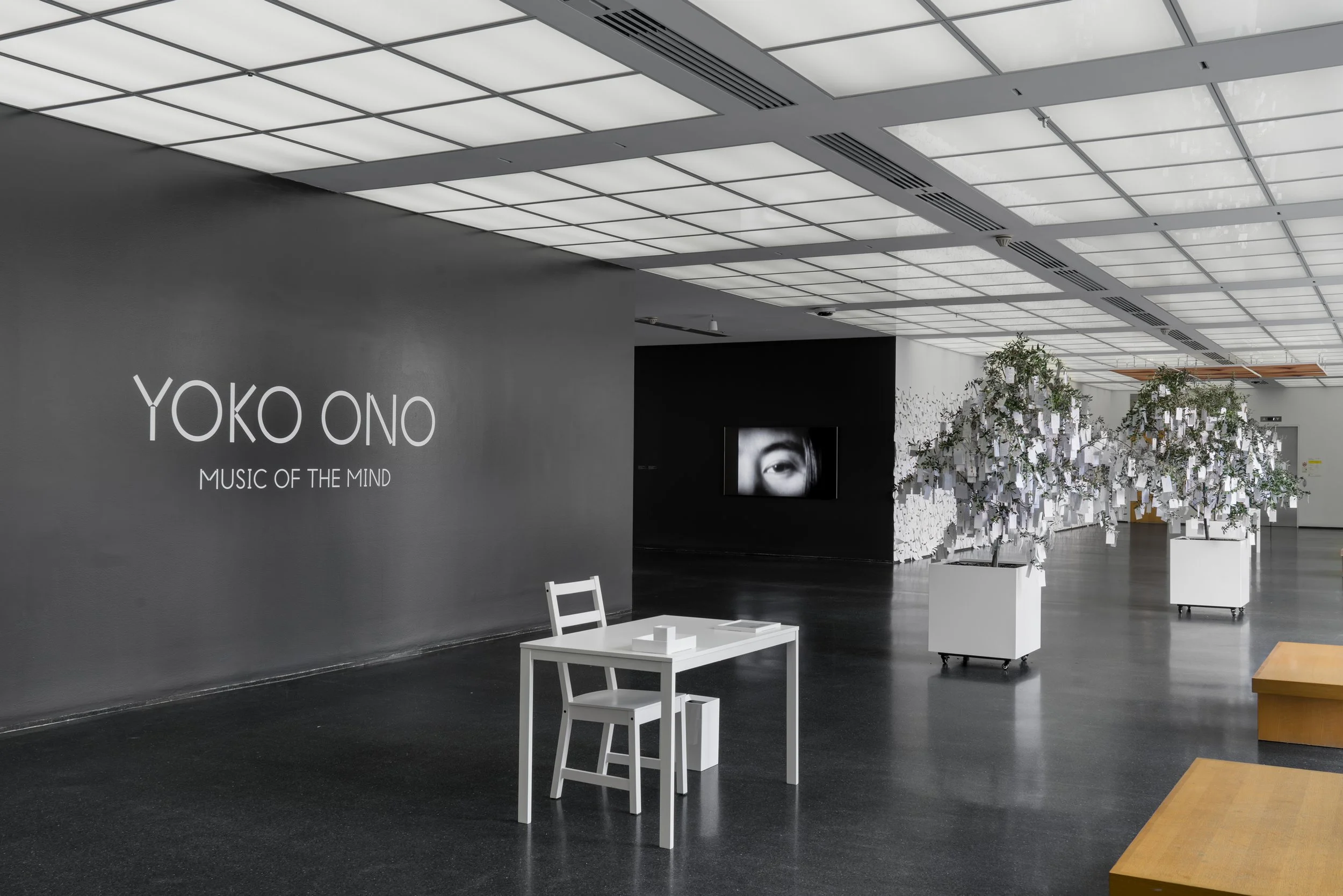
The lobby of Yoko Ono: Music of the Mind. Yoko Ono: Music of the Mind, MCA Chicago, October 18, 2025–February 22, 2026. Photo: Bob. (Robert Chase Heishman).
INTERVIEW & REVIEW
Yoko Ono: Music of the Mind
Museum of Contemporary Art Chicago
Oct 18, 2025 - February 22, 2026
By Adriannah Popkey
INTERVIEW
Adriannah Popkey: First of all, how special is it to be able to have this exhibit? In case you couldn't tell by my reactions in the space, I am a huge fan of Ono's work. I learned so much about her career while I was in school. It just feels so amazing to be able to access this breadth of her work, and also just feels so special that this is still the only North American museum hosting this exhibit at this moment in time. Sure, I anticipated that would change, but in and of itself, having it be so accessible right here in our backyard, is so lovely, and like you mentioned, being exposed to her work through her music, as I feel many people are, or her legacy of supposedly breaking up the Beatles, I think this will, expose people to just a different side of her, which is so wonderful.
Jamillah James: Just understanding that she had an entire life.
I know! I know, I think it's something that's so lost on people, her pre-John Lennon legacy, which is so amazing. I mean, even just seeing the photos of her with John Cage, just hanging out on stage, seeing all of those sheets of Grapefruit, which just had me starstruck, and staring at the wall, I felt so weird because everyone had filed out, and I was just lingering and staring at the wall, because it just was so wild. I think something super interesting to me is how her work informs how, and the Fluxus movement in general, informs how we think about public art and interactive art. I just wondered if you had any thoughts about how the fluxus movement and conceptual art more generally, has allowed for this greater movement of public and interactive art, thinking about her Refugee Boat piece, and how it might even just be a draw for people to come see the exhibit because they can have a hand in a long lasting piece, or just because it's exciting to be able to interact with modern art when I think for a lot of people, it feels so inaccessible, there's this huge distance from it. So, if you feel like that is going to be a draw for people to come see, because for me coming today, it felt so weird. I was like, “Wow, this room is just so blank and white when the high expectation is that people have come in and marked it up already.” I’m curious to know any general thoughts you have about that aspect of interaction.
Interaction and participation are such a central part of Yoko's work; a lot of this stems from her childhood. I would say that participation, using one's imagination, and leaving things open-ended for the viewer are all essential parts of her work. She really treats the viewer as a collaborator or performance, performer in the realization of the work. I think sometimes the ideas of performance or conceptualism are challenging for you know, museum goers, how it's presented, how it's more of an ideas based practice, and not necessarily an art object, but Yoko's work kind of spans both the idea based prompt, based language based work, and then later on, she begins to progress towards making objects. And then, increasingly, the trajectory of the participatory works kind of follows, or is in parallel with, the various ways that she was working as an artist.
You think of her performance work starting from the 1950s, works like her instruction paintings, where she's asking the viewer to kind of imagine some kind of scenario to complete the painting, because it's just text-based. Cut Piece, probably her best-known work, invites people onto the stage to cut away her clothing. These are the gestures that Yoko has made… (laughs) I'm on a first-name basis!
(Laughs) I know, I think that's so amazing!
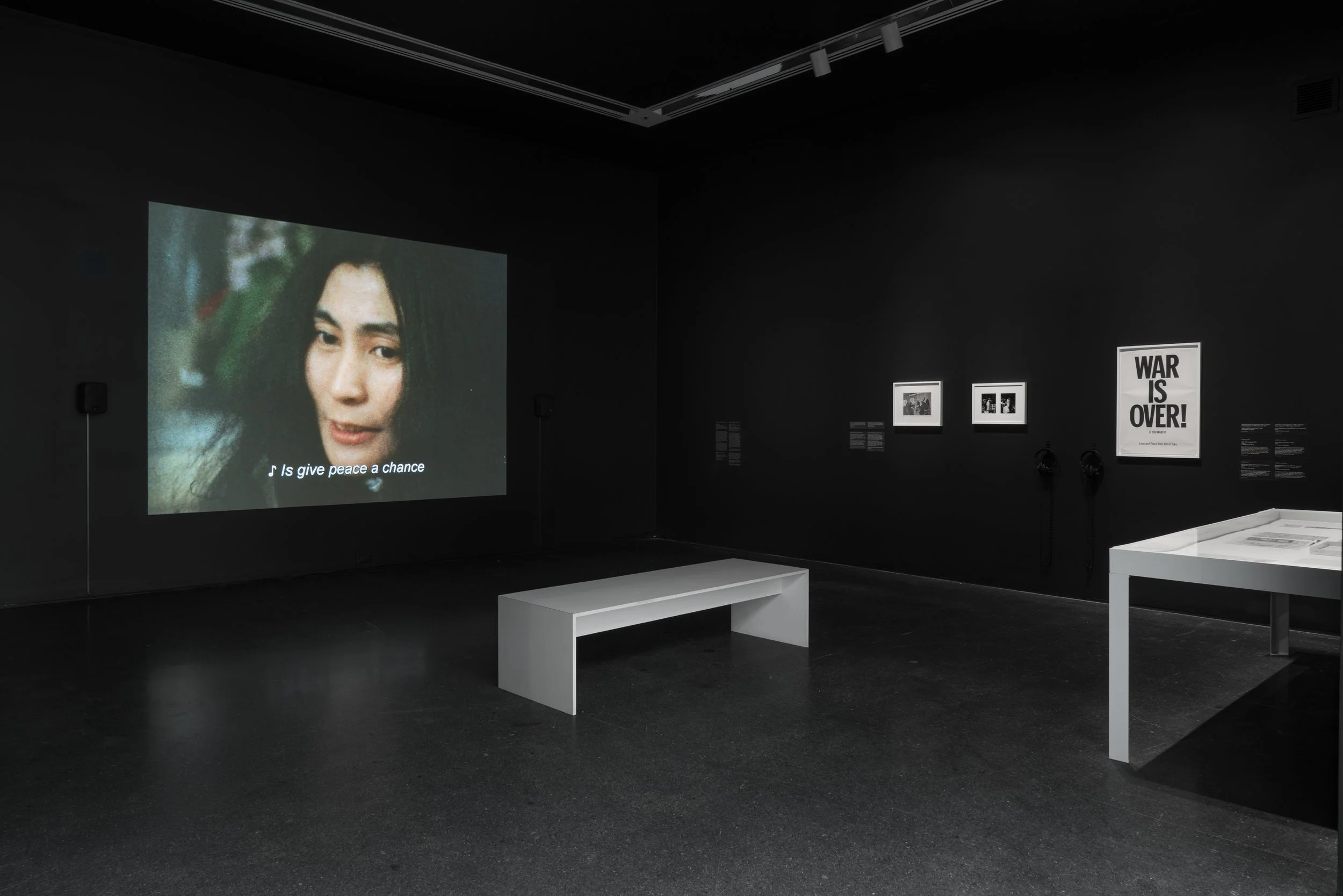
A still from Bed Peace (1969) is shown in a room including memorabilia from Yoko Ono and John Lennon’s collaborations. Yoko Ono: Music of the Mind, MCA Chicago, October 18, 2025–February 22, 2026. Photo: Bob. (Robert Chase Heishman).
I mean, these are cornerstones of her work and bring the viewer toward being open to manifesting someone else's ideas. I think it often is that people come to museums and they expect to have their experience choreographed in a very particular way. So, not being able to touch work, not being able to get close up with up close with work, but this exhibition really subverts that; there is the documentation aspect of all her performance work. We have film and film documentation of her performances, her performance cut piece, also Lighting Piece, aka Match, which was a Flux film that was produced in '66, and then moving towards the present, where the ideas are still circular, she's still invested in people being part of the work. So later, things like Helmets, Pieces of Sky from 2001, invites people to take a puzzle piece. They can take several puzzle pieces. They can, you know, assemble a piece of the sky. The Add Color Refugee Boat, which you mentioned, I think that's going to be very popular with viewers, being able to leave a part of themselves or to express their ideas, both through, through, add color. Also, the Wish Trees. Also, My Mommy is Beautiful. There'll be these moments where people can have very personal experiences with Yoko's work. And I think that's really the beauty of her work, that she's not controlling of her ideas, of her intellectual work. She's leaving a lot to chance, leaving a lot to the viewer to collaborate and complete the work with her. I think that'll be something that the public will really enjoy.
Like you said, even just having spent a brief amount of time with her work previously, and then being able to spend so much time with it today, something that I thought was really impactful was how her themes and motifs, although like her methods shift, she has, one of the most consistent...ideologies isn't the right word, but her constant use of like the word sky and blue, we have snow, we have purity. All of these, these earth-like themes were just something I kept having come back to me because as much as this exhibition is a chronological journey, it feels so cohesive, which I think is also in part due to how the exhibition is arranged, as well, the fact that the entire gallery is kind of one big circle. I feel oftentimes, when you attend something so comprehensive of an artist's work, you're so conscious that "this is the beginning and this is the end" and I think it's so great that that's maybe a little bit less present here due to the amount of interaction that a viewer can have a part in, but also just because of the way that Ono's work is. It never feels like you're just walking through her life, but instead of sort of stepping into her world, like it's really immersive, and I think that's really amazing.
This brings me to my next question, which A) has to do with, as you said, you feel like you're on a first-name basis with her, and I can't imagine how you feel your relationship with her has changed over this process. I mean, I can't imagine how familiar you've become with her work, but also in becoming so familiar, how you decided what to supplement the existing exhibition with? I thought it was so wonderful to be able to see the students of the daughter of Allison Knowles, which is really amazing.
It's a flex.
It was so crazy. You said that, and I was like, “This is just unbelievable.” But how did you decide what the personal MCA touches, so to speak, would be on an exhibition that's already so comprehensive?
Sure, this is a common thing that museums do, hosting other institutions' exhibitions, and I've done this so many times over the course of my career, and it's something that I really like, because I want to support the work of my colleagues, who are brilliant people and put together fantastic shows. And with this exhibition, I got to see it in London. And then, during this process of making it for the MCA, I went to see it in Berlin. Every time I want to put a little bit of my own imprint on the exhibition, it's always a negotiation with the curator. In this instance, a lot of conversation with Yoko studio, which is directed by Conor Monaghan, and also connected with this is John Hendricks, who is a longtime collaborator, friend, Fluxus scholar, you know, has written what I think is the definitive book on Yoko Ono with Alexandra Monroe. Being able to work on triangulating what the MCA version would look like has been a learning experience, and a learning experience I'm used to working with artists directly, and in this case, I've been working with her studio instead. There are a lot of ideas that were bounced around, you know, between us. You know, maybe we could show this work like, for instance, I wanted to show this work called A Maze from 1971 would be impossible (laughs).
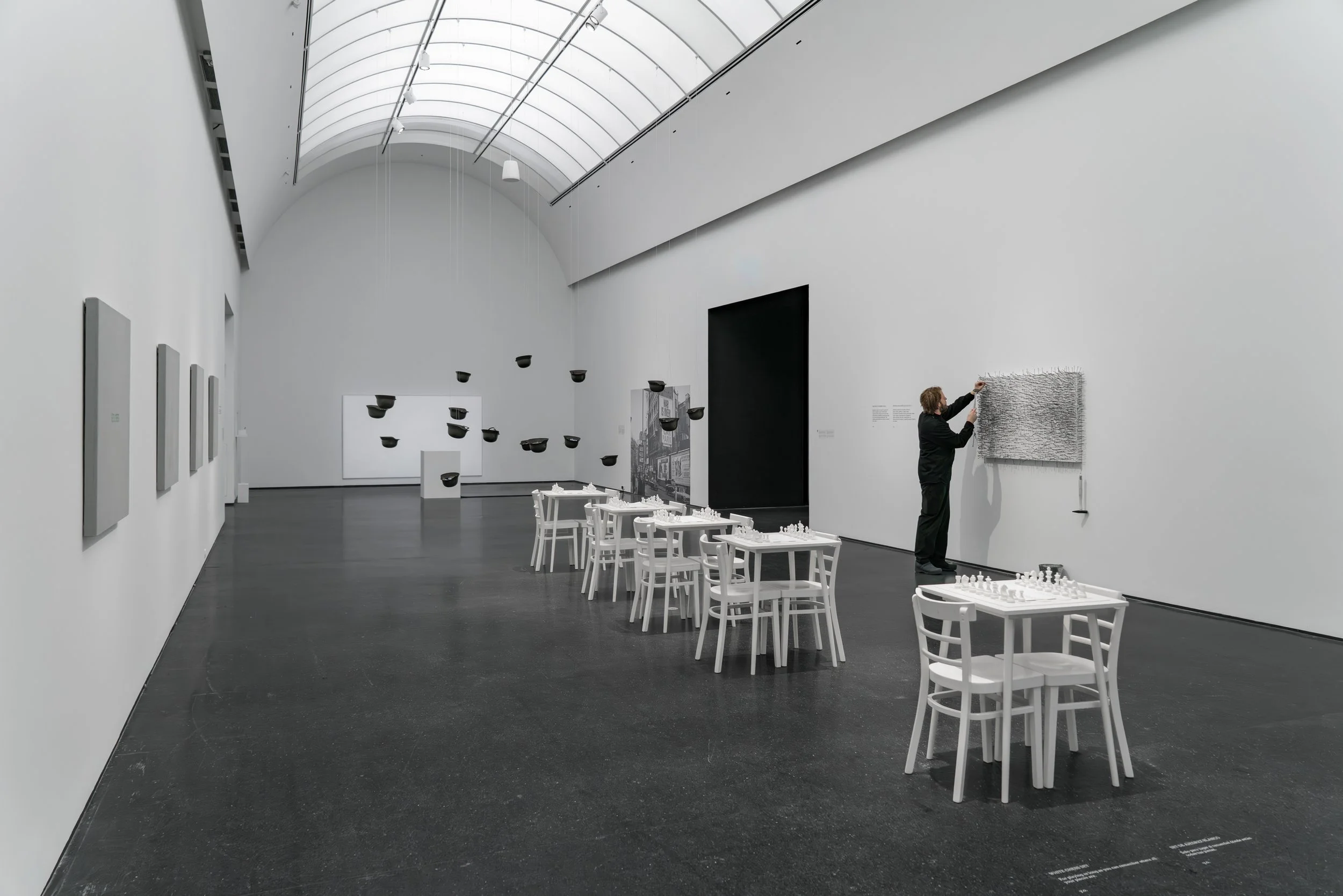
A patron contributes to Painting to Hammer a Nail. Yoko Ono: Music of the Mind, MCA Chicago, October 18, 2025–February 22, 2026. Photo: Bob. (Robert Chase Heishman).
(Laughs) Logistically speaking, I don't know how...
It would be fantastic, but we did a lot of rabbit-holing about what to include in the exhibition, how to make this distinct from the original show and subsequent shows. So for Chicago, the new editions are Mend Piece from 1966, where people can mend together broken plates and saucers using tape and twine, and glue. We added the Blue Room event, which was presented at the Gropius Bau in full and partially at Tate London. They did two of the sentences at Tate Tate London, Tate Modern. So being able to stage the Blue Room Event is different. Our Turner gallery would be empty. Otherwise, there could have been a discussion about showing a film in there or having the Add Color installation. And I was like, “No, we're going to do something a little bit more contemplative, a lot more open-ended, and give people a moment to relax after going through the show, because the show is so dense and it's a lot of information to take in.”
The performance aspect is new for this show, and it was something that I wanted to do immediately upon the MCA agreeing with Tate to do this show. There's a space within the exhibition where, periodically, there'll be performances by local university students, activations of Yoko's Grapefruit, and different instructions within Grapefruit. I think it's a really exciting proposition, because I think the average museum goer does not usually encounter live performance in the galleries, and because of our relationship, or historical relationship, to performance, you know, I think we're able to do this and do it properly. So, you know, that's an exciting, exciting element that I know Juliet Bingham, the originating curator, was really excited about. Also, giving more space to the music room so people can max out, and they're listening to a playlist of Yoko songs and Free Time, a public access show that Yoko and John, and Jonas Mekas were on, is a new addition to the show. We were able to get archival tapes from WNET, which is the host of the show. In these instances, my touches on the show are pretty light. The show, in and of itself, is fantastic, so there are no improvements to be made. Only, you know, supplementing to show different angles of Ono's career.
In addition to those, is there a piece or a subset of Ono's career that you were really able to dive deep into that isn't necessarily included in the exhibit, but just now that you've had so much time to spend with her, I can say that for me, selfishly, as someone who enjoys her work so much that you wish you had the time and resources and space, like you mentioned The Maze, to be able to introduce to the world?
Yeah. I mean, there were other installations that I was interested in staging more recent works, flag poles that are staged to talk, I think about nationhood, being nationless, etc. It's always really challenging to work with the city to get public artwork through, so that was nixed pretty early in terms of the areas that I really delved into with this exhibition. I was really keen to learn much more about the instructional paintings. I just recently staged an exhibition at the MCA called the Living End: Painting and Other Technologies, 1970 to 2020, and a large component of that was performance, performance artists thinking about painting. And to know that Yoko also was doing that kind of work was really exciting for me. So that was one thing I really latched onto in the research for this exhibition, but there's just an incredible breadth of work that she has. And I am in awe of what Juliet and Patrizia were able to do when making this exhibition. I think people, the public, will also be really excited to really dive into the work.
I mean, based on my personal experience here today, I just felt so moved to be able to experience it. And also, it felt, in a strange way, really wonderful to be able to see everything before it was realized, you know. It felt sort of like I got to be in Yoko's brain and in those instructions where she's like, "just imagine a square canvas, and you turn it into a circle," etc, etc, etc. But seeing everything, like all of the bare Wish Trees and those fully white Refugee Boat, it just felt like a really cool convergence of her intentions, and being able to anticipate the amazing experiences that the public is going to have.
Yeah, it's really active. It's an active exhibition. It's like a living organism, essentially, where the more people come to the space and interact with things, the more it's going to change. I think that that's something that Yoko really appreciates, because she wants, she wants to bring the viewer in and have the viewer imagine, whatever they will, in terms of, how they interpret her instructions, her prompts to people, and the open endedness and, the not having a right or wrong way of interacting with the work, I think, will set the average viewer at ease. And then there'll be an openness to, you know, the complexities of Ono's work.
I like, just to wrap up, the choice to have the….I'm forgetting the specific name, but the closed-circuit TV of the sky, I just think it's perfect. It's so circular, you know it, it allows for that emphasis of the openness in and of itself, to be kind of the closing note, and I really appreciate that choice.
It was one that I was really persistent about. I mean, the show is largely chronological, but there are these, you know, interventions, if you will. For instance, the last main gallery has a mix of things from the 2000s and also the 1960s and 1970s to show that there's like a consistency of ideas, that her trajectory was consistent throughout. Ending the show with Sky TV, which was made in 1966 and was an early example of work and artwork using closed-circuit television, closed-circuit technology, I thought was a thoughtful way to end the show. The motif of the sky is so important to understanding her work. It connects back to a deeply personal place with her exposure, her experiences during World War Two, and looking to the sky to kind of transport herself somewhere else, having this imagined experience with imagination, built experience with the sky. So, having that be the palette cleanser at the end of the show, it expands it in a really lovely way. And I think people really enjoy that.
I couldn't have said it better myself. I completely agree. Well, thank you so much for your time.
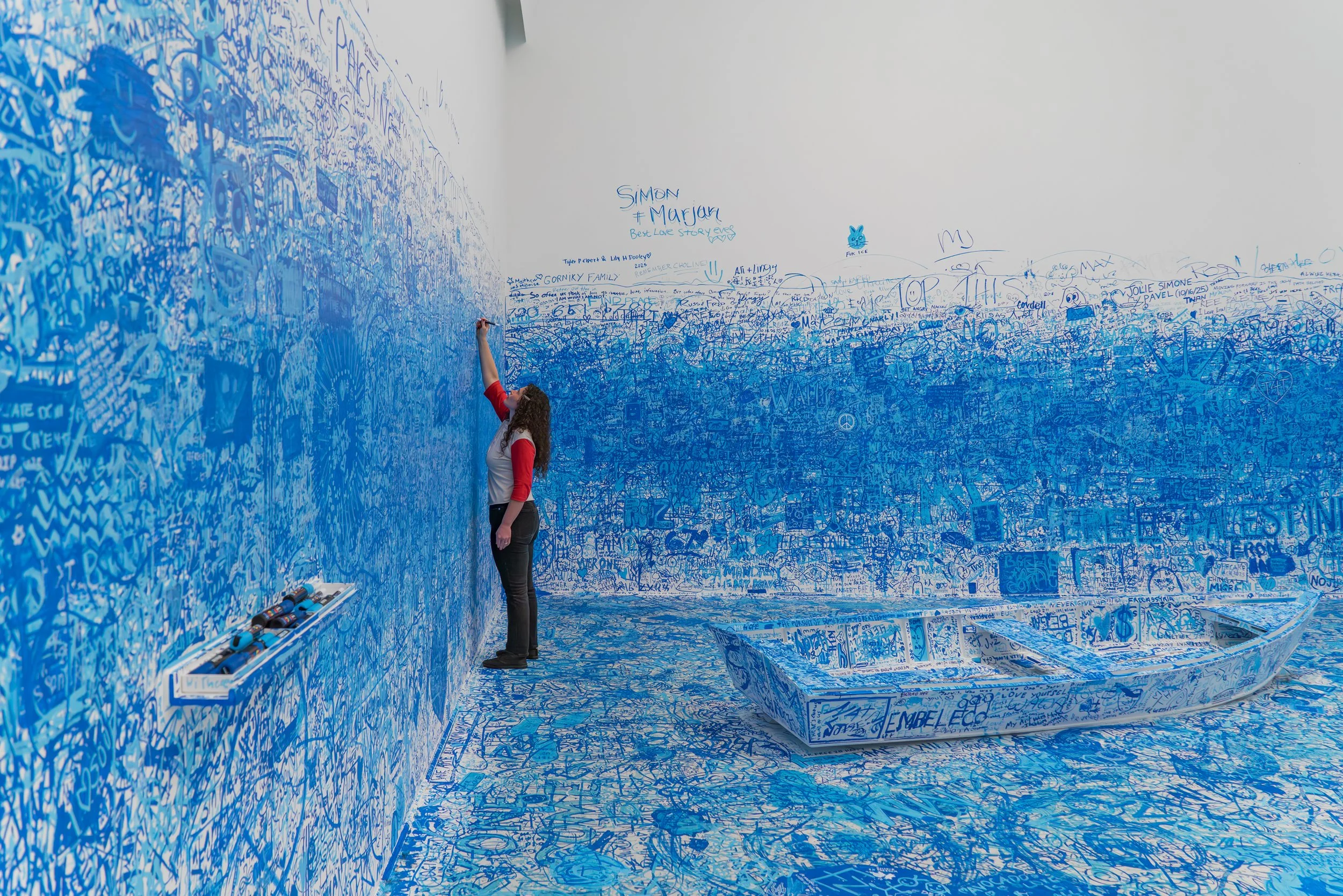
A patron interacts with Refugee Boat. Yoko Ono: Music of the Mind, MCA Chicago, October 18, 2025–February 22, 2026. Photo: Bob. (Robert Chase Heishman).
REVIEW
The first thing I encountered at Music of the Mind wasn’t an artwork, but a pair of visitors standing before one. They cocked their heads, whispered, then finally announced that they “just didn’t get how this could be art.” Their skepticism wasn’t malicious, it was simply confusion, mild irritation even. Yet the scene struck me as a perfect entry point into Yoko Ono’s practice, because this moment of grappling is not a failure of the exhibition but the mechanism through which it succeeds. Music of the Mind is built precisely for viewers like them, people uninitiated into the world of conceptual art, who expect clarity and receive provocation instead, who arrive at a museum wanting to see objects but instead are asked to think, imagine, touch, and complete the works themselves. Ono has always aimed to “bring the inside out,” to make the viewer’s interior reactions part of the artwork, and here, that dynamic unfolds in real time. The exhibition stages a space where unfamiliarity becomes activation and where skepticism is not an endpoint but the beginning of participation.
Curator Jamillah James leans into this dynamic, foregrounding the central principle of Ono’s career, that the viewer is not a passive observer but an active collaborator. James notes that Ono “treats the viewer as a collaborator or a performer…leaving things open-ended for the viewer,” and this is not merely interpretive framing. It is the architecture of the show. The retrospective consistently positions the audience not as witnesses but as co-authors, calling them into the work even when they resist the invitation. That friction is the point. Ono’s art operates through the viewer, whether through their actions, refusals, hesitations, or misunderstandings.
It’s also here that the exhibition engages, almost slyly, with one of the most relentless misconceptions around Ono’s legacy. Rather than foregrounding her relationship with John Lennon as the defining frame of her career, the exhibition sublimates that expectation. When the two appear, it is not in a hierarchy but as collaborators, an artistic match in the sense that they shaped and provoked one another. The show insists that they met not as celebrity and muse, but as equals in experimentation, each pushing the other toward more radical forms of artistic exploration. This repositioning feels long overdue, and the exhibition handles it with a dexterity that quietly rewrites entrenched public narratives.
A Work To Be Stepped On makes this relationship explicit from the get-go. It instructs viewers to do something simple, yet transgressive: step on the artwork. Standing before it, I felt the same impulse that paralyzed the two skeptical visitors, the instinct that you aren’t supposed to do that. That instinctive recoil became the real content of the piece. James remarks that “people come to museums and expect to have their experience choreographed,” and Ono dismantles that choreography with startling efficiency. The work is less about stepping on paper and more about watching oneself navigate an internal negotiation between etiquette and discomfort.
This negotiation extends throughout the exhibition, where works oscillate between invitation and provocation. On my initial visit, I encountered the Wish Trees entirely bare. The sight was unexpectedly haunting, an artwork designed to accumulate collective imagination rendered inert through non-participation. But rather than reading as failure, the absence felt like a quiet revelation; this is what it looks like when viewers choose not to enter the work. Ono leaves room for that possibility. Her vulnerability lies in surrendering control, trusting the public with the risk that they might not collaborate at all.
Other works demonstrate the volatility of participation. Periodic student performances of Ono’s scores from Grapefruit are ambitious but uneven. One performer’s exaggerated “listening” pose, in response to the prompt “listen to the sound of the earth,” felt self-conscious, as if the activation had turned into reenactment. And yet this awkwardness feels strangely aligned with Ono’s intentions. Participation is unpredictable, sincerity can curdle into performance, and the viewer-as-performer can fall flat. James intentionally frames the entire show as “a living organism where the more people interact, the more it changes,” and in this sense, even the misfires become a part of the ecosystem.
When interaction is organic, however, the results can be unexpectedly affecting. Watching archival footage of Ono’s performances, I felt myself tear up. Something about the vulnerability in Cut Piece or the unsettling intimacy of Fly hit with an emotional directness that eluded conceptual analysis entirely. Ono’s fraught relationship to sound as a child lends her sonic work a deeper resonance; what once overwhelmed her becomes raw material she reshapes into something simultaneously abrasive and contemplative. The viewer’s emotional response, however involuntary, becomes part of the artwork’s existence.
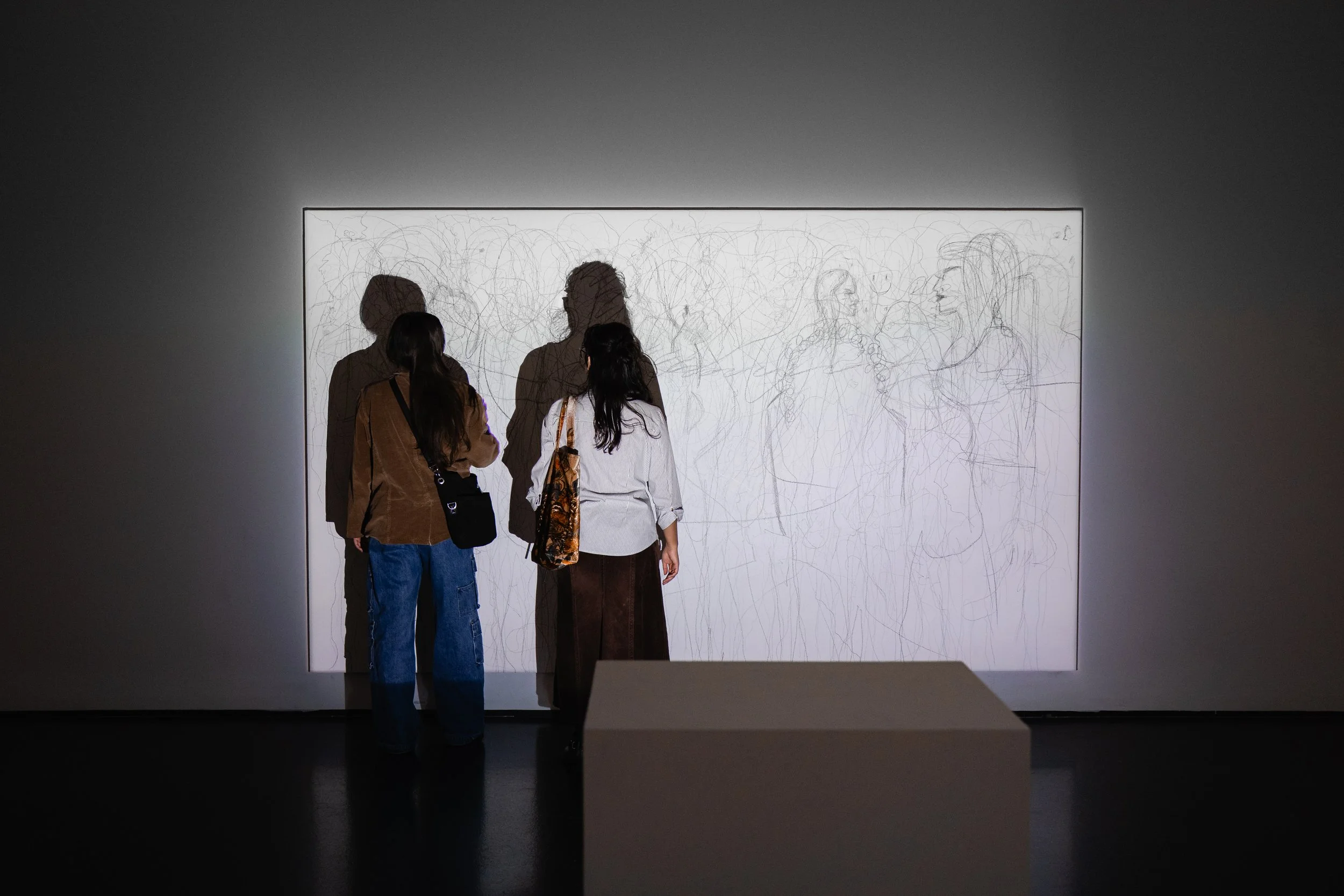
Two patrons examine Shadow Piece. Yoko Ono: Music of the Mind, MCA Chicago, October 18, 2025–February 22, 2026. Photo: Ricardo Adame.
The exhibition’s structure further underscores the viewer’s centrality. Rather than guiding visitors through a chronological progression, the curation intermingles works that span decades to emphasize the “consistency of ideas” in Ono’s practice. This approach highlights the persistence of Ono’s motifs: yes, fly, imagine, and touch. Even further, the exhibition reveals how her conceptual strategies remain consistent even as the cultural landscape shifts. The effect is circular, as opposed to linear, as the viewer experiences Ono’s ideas as something that returns and reactivates across time.
Even the quieter works rely on viewer presence to take shape. A looping image of hair suspended on a nail forces an encounter with bodily trace, subtle yet unsettling. Refugee Boat, overwhelmingly marked by visitor interaction immediately upon the exhibition’s opening, reverses the logic of Ono’s usual interactive works. Here, the viewer is perpetually a secondary collaborator, inheriting the residue of previous interventions.
The sound room featuring Ono’s music provides a rare moment of repose. James intentionally included it to give visitors “a moment to relax after going through the show,” acknowledging the mental labor the exhibition demands. Here, participation becomes receptive rather than performative. The viewer contributes simply by listening, by inhabiting the space of sound that Ono shapes.
The exhibition concludes with Sky TV, a closed-circuit image of the live sky above the museum. James calls it a “palette cleanser,” and indeed it offers a gentle release from the density of conceptual prompts and participatory demands. After so many works that depend on the viewer to complete them, Sky TV becomes a mirror for the exhibition’s entire logic. The sky continues whether or not anyone watches; the viewer changes nothing, yet the act of viewing fundamentally transforms the experience.
Ultimately, Music of the Mind thrives on the uncertainty of viewer engagement. Ono’s pieces behave like open circuits, as they only function when closed by the viewer’s imagination, hesitation, or action. This openness allows skeptics and believers alike to enter the work on their own terms. The two visitors I overheard at the beginning of the show may not have known it, but their skepticism was itself a form of activation. Their confusion actualized the very questions Ono poses: What counts as art? Who completes it? And what happens when the viewer becomes not a consumer but a collaborator?
The exhibition’s curatorial vision embraces this instability. The exhibition is not simply a retrospective. It is, instead, a testing ground for public encounter, a space where Ono’s lifelong commitment to bringing the “inside out” is enacted through the viewer’s own responses. Music of the Mind succeeds because it understands that unfamiliarity is fertile ground and that skepticism, when met with an open-ended invitation, becomes the first step toward participation. It is in that very moment, when a viewer crosses the threshold from resistance to engagement, that the exhibition reveals its true strength.
Adriannah Popkey is a writer based in Chicago, Illinois.
Like what you’re reading? Consider donating a few dollars to our writer’s fund and help us keep publishing every Monday.
