
REVIEW: Bruce Goff: Resurrected Pioneer; “Material Worlds” at The Art Institute of Chicago
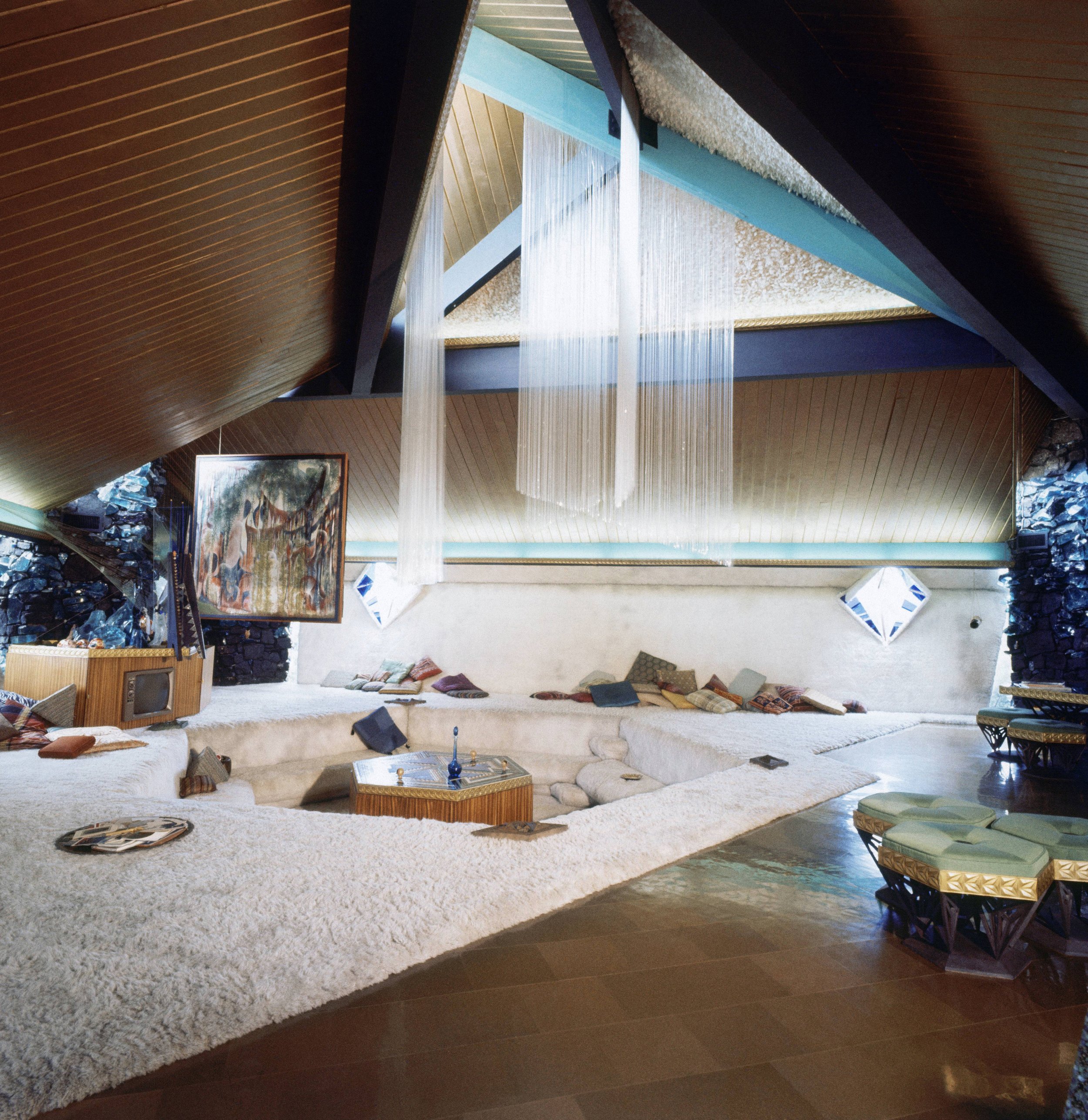
Bruce Goff. Living Room of Etsuko and Joe Price House, Bartlesville, Oklahoma, 1972 Photo by Horst P. Horst for Vogue. Courtesy the Art Institute of Chicago.
REVIEW
Bruce Goff: Material Worlds
The Art Institute of Chicago
111 S Michigan Ave.
Chicago, IL 60603
Dec. 20, 2025–March 29, 2026
By David Sundry
Popular architectural history, and popular American architectural history, is littered with numerous innovative practitioners, many with solid widespread practices, who for some reason never received much attention in their day and were ignored by east and west coast media and academic establishments that were carefully crafting the preferred narratives. The vast unconsidered landscape between the coasts was not worthy of attention except under very special circumstances. But, having said that, there were also many imaginative coastal architects who also failed to satisfy these narratives and receive media attention.
Philip Johnson, the self-appointed tastemaker, seemed particularly hostile to the Midwest pioneer spirit and Frank Lloyd Wright in particular. As one who brought the modern movement to the attention of the American public (he curated the Modern Architecture: International Exhibition at MOMA in 1932 at the age of 27) Johnson advocated largely for European architects or the steel-and-glass international style and dismissively labelled Wright as “the greatest architect of the 19 th century”— meaning a man of the past. At that time Johnson failed to recognize Wright’s third, and possibly the greatest, act in architecture which featured nearly 30 years of significant visionary work before Wright’s death in 1959 was about to begin. A few examples of the groundbreaking, cutting edge projects that Wright realized in this third act include the Guggenheim Museum in NYC, Fallingwater in Bear Run, PA and the Johnson Wax Headquarters in Racine, WI.
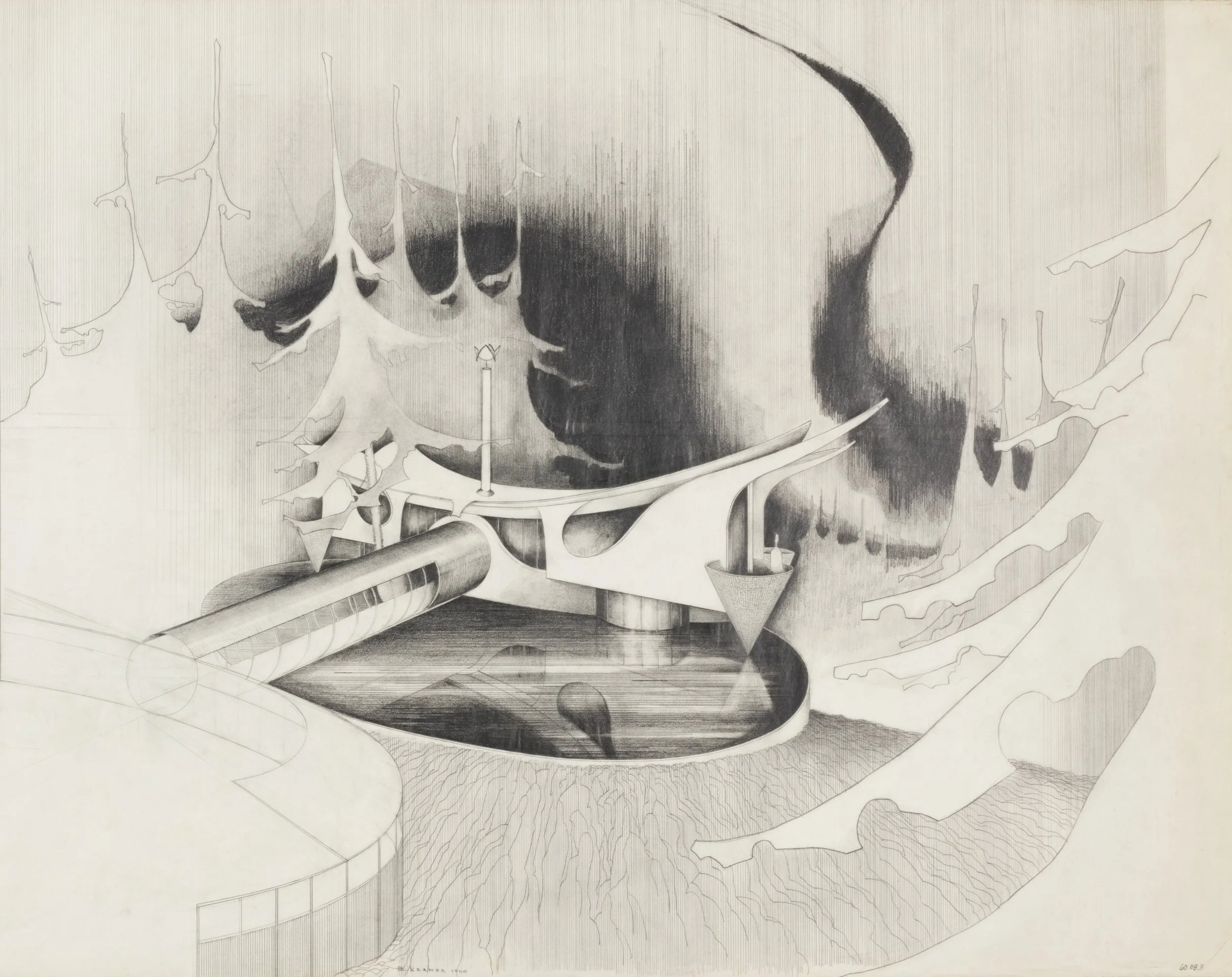
Bruce Goff and Robert Kramer. Elaine A. and William C. Gryder III House, Ocean Springs, Mississippi, Perspective, 1960. The Art Institute of Chicago, gift of Shin’enKan, Inc. Courtesy the Art Institute of Chicago.
I begin this review of Bruce Goff with this detour because East coast dismissiveness largely sets the stage for the strange marginalization of a visionary or, maybe it is better to say, an inspired disciple of Wright who continued to develop and advance the grammar of Wright’s philosophy of organic architecture. In fact, Wright was a mentor to the young Goff, a precocious talent who was born on the same date as Wright 37 years later.
Bruce Alonso Goff was born in 1904 in Alton, Kansas and was by all accounts a child prodigy. He was apprenticed to the architecture firm of Rush, Endacott & Rush at age 12 and designed his first building at age 14 or 15. He designed the Boston Avenue Methodist Church in Tulsa, Oklahoma, an art deco minor masterpiece, between 1924 and 1929 completing it when he was only 24 years old. While working at this firm the young Goff happened upon a 1908 issue of Architectural Record that contained the first of 16 landmark essays Wright wrote entitled, “In the Cause of Architecture”, that then prompted the adolescent Goff to pen a letter to Wright who was about 50 years old at the time. He received a reply, and a correspondence followed by a relationship began. Wright advised Goff to not seek formal training in school (Wright also did not receive formal training) and commented that he might “lose Bruce Goff” in the process. Wright invited Goff to join the Taliesin apprenticeship which Goff declined but Wright’s ideas continued to speak to the young Goff. Practicing at arm’s length, Goff matured into a devoted practitioner of Wright’s philosophy of organic architecture.
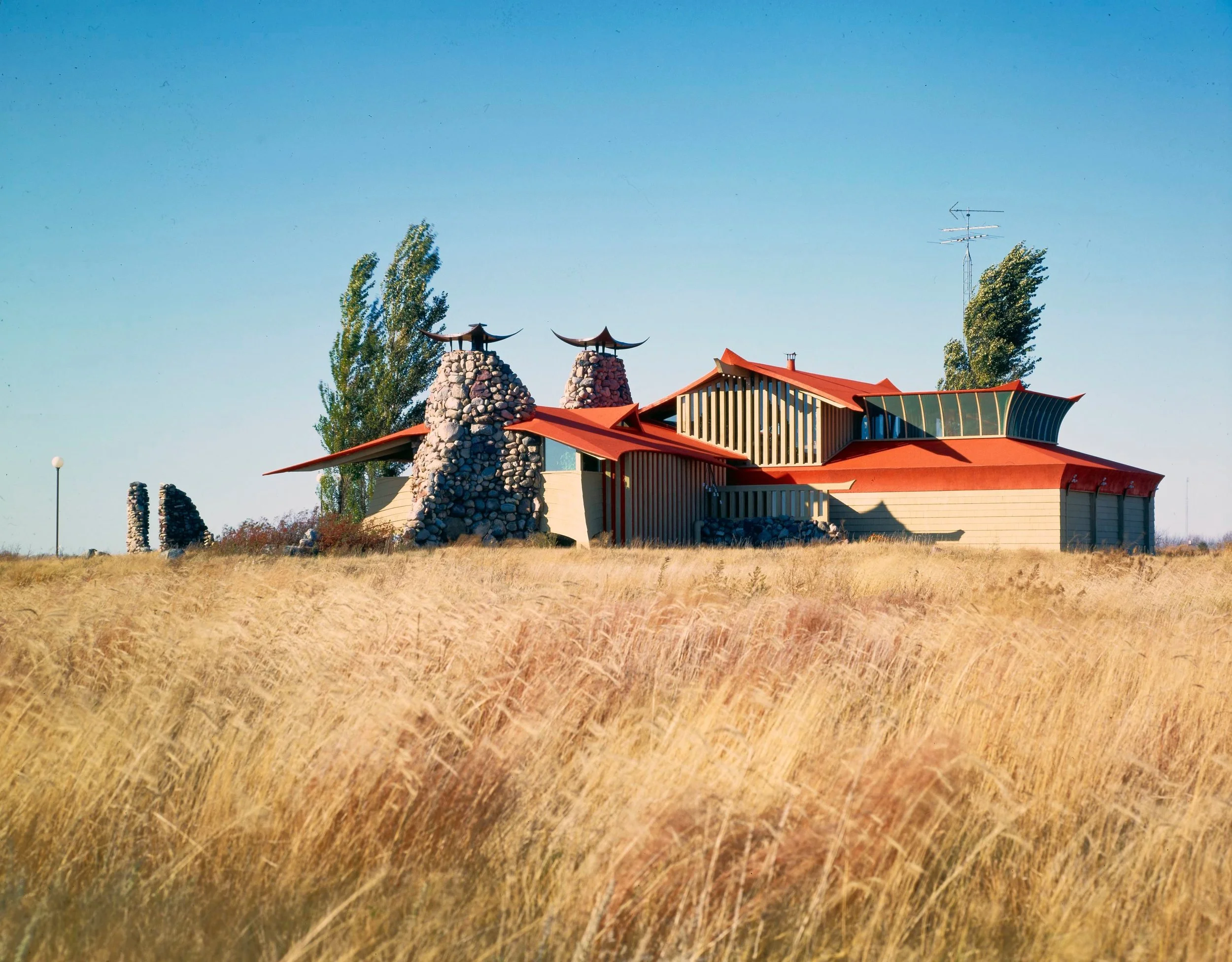
Bruce Goff. Glen and Luetta Harder House, Mountain Lake, Minnesota, 1980. © J. Paul Getty Trust. Getty Research Institute, Los Angeles. Photo by Julius Shulman. Courtesy the Art Institute of Chicago.
Wright proclaimed that nature furnished the fundamental law and order and this sense of the organic was indispensable to all great architecture. Goff supported this philosophy through his interest in natural materials and forms such as seashells, minerals, crystals, anthracite coal, goose feathers and tumble weed. As with Wright, Goff understood that everything has its own type of order and unity and live form and architecture develop from within and grow outward in concord with their elemental tendencies.
Despite Goff’s uncommon approach to building form and principle he sustained a successful career with over 150 completed buildings. And in a series of projects, beginning in the early 1950’s, Goff was able to quickly and expertly ingest fundamental tenants of organic architecture and to provide a brilliant inspired extension of Wright’s visionary architectural language. In buildings such as: the Bavinger House in Norman, Oklahoma; the Ford House in Aurora, Illinois; Shińenkan or the Joe Price Residence in Bartlesville, Oklahoma; the Durst-Gee House in Houston, Texas; the Al Struckus House in Los Angeles, California; the Hopewell Baptist Church in Edmond, Oklahoma; and the pavilion for Japanese Art in Los Angeles, California; Goff combined organic architecture principles such as individual site specific designs resulting in structures that harmonize with nature and human needs and merge the garden and the house. As Wright stated, “where does the garden end and the house begin?”
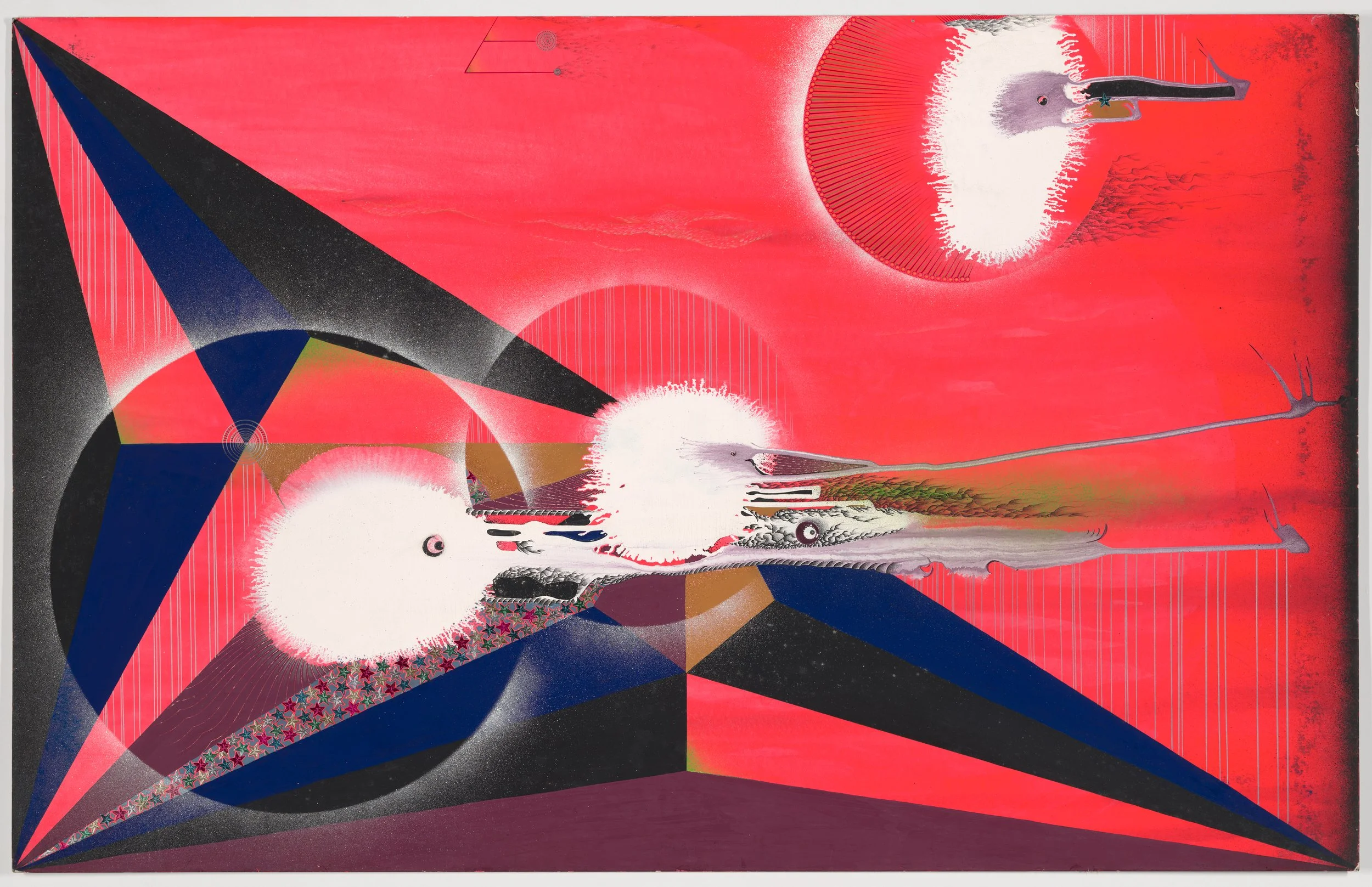
Bruce Goff. Untitled (Composition), 1956. The Art Institute of Chicago, gift of Bob and Sherry Faust. Courtesy the Art Institute of Chicago.
This is an architecture with forms that evolve through the expression of the individual. The process is rational, but it is a ‘thinking” as well as “feeling” process, an interpretation of nature’s principles and building in harmony with the world around them. Goff rejected the reductive orthogonal steel-and-glass approach of the international style. In his Bavinger House, a logarithmic stone spiral encloses a center steel mast that supports a suspended roof, stairs and curved multi-floor platforms (the thinking) while an indoor rock outcropping, floating ponds, chunks of glass cullet and myriad assemblages of natural and man-made materials provide a wonderous interior environment as rich as nature (the feeling). Goff extends Wright’s palette with a pop sensibility consisting of material investigations of commercial and consumer products, an exploration of Japanese and Asian cultures and 1940’s pulp science fiction adventure. In retrospect, a case could be made that Goff’s development of Wright’s philosophy is the precursor to the Las Vegas sensibility and Frank Gehry’s junk aesthetic of the 1970’s. Goff also combined organic principles with an embrace of provocative structures through a use of vernacular and industrial construction technique and cast-off materials. The Ford house employs Quonset hut steel ribs, which are usually used to construct conical shapes, to inventively form a mushroom shaped dome. These fantastical projects combine the everyday with the wholly specific in an almost uncategorizable construction, but one that supports the integrity of each material type and order and therefore unity. It is like the architectural equivalent of a coastal reef.
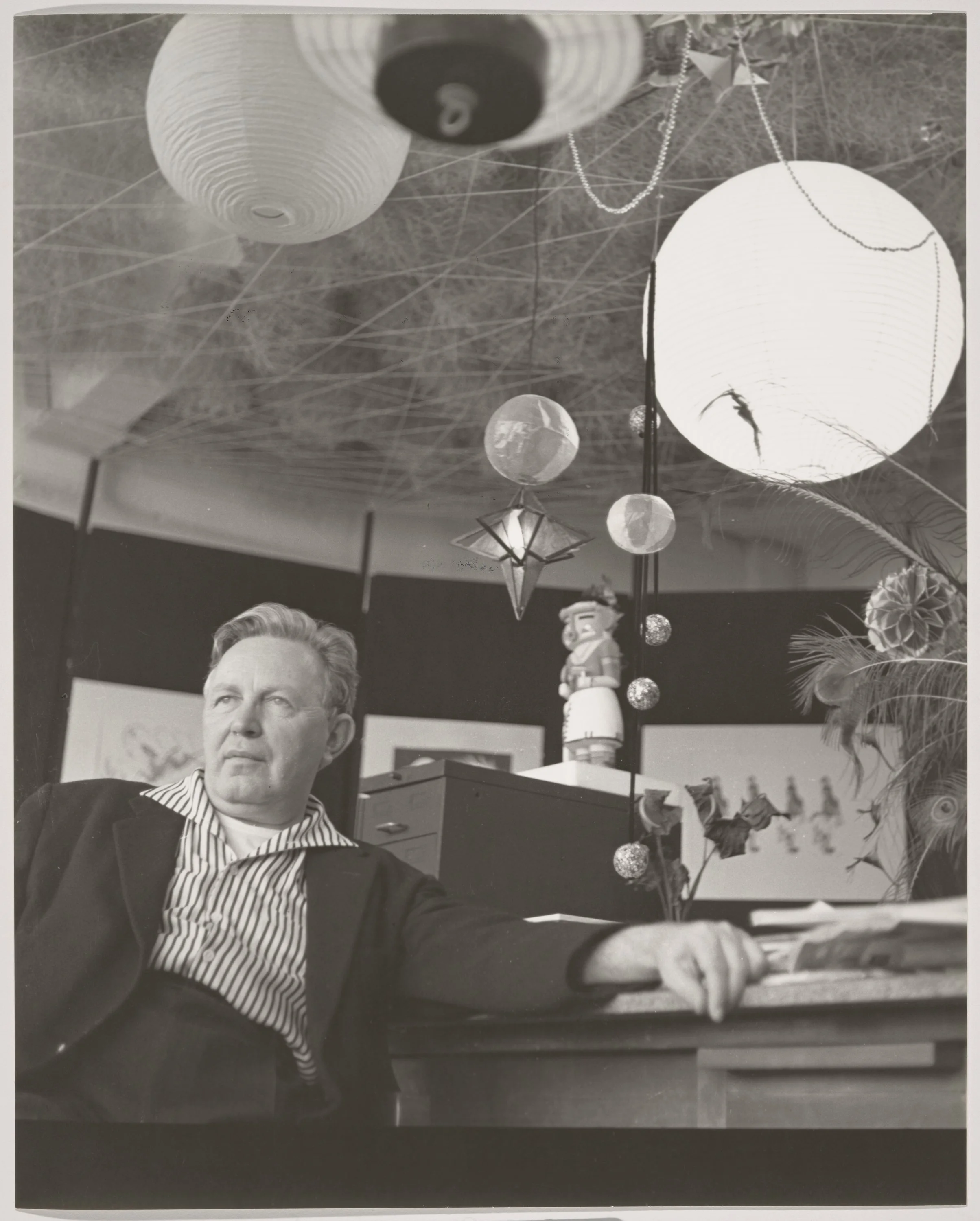
Bruce Goff in his Office at the University of Oklahoma, about 1954. Photograph by Philip B. Welch. The Art Institute of Chicago, Ryerson and Burnham Art and Architecture Archives, Bruce A. Goff Archive. Courtesy the Art Institute of Chicago.
This brief overview serves as an introduction to the excellent and long overdue retrospective at the Art Institute of Chicago entitled, Bruce Goff: Material Worlds, running from December 20, 2025 through March 29, 2026, the first in over 30 years. The Art Institute has a vast archive of Goff’s works (over 200) and the archive encompasses drawings, photographs, paintings, models, project renderings, as well as furniture, letters, clothing, custom-punched player piano rolls and an assortment of natural and man-made objects that inspired his work. The sheer variety of the archive helps to develop a broader portrait of Goff and the multiple dimensions and disciplines that he brought to bear upon his designs and projects. But this archive begs the question: if the Art Institute controls this vast archive then why has it taken so long to stage this overdue retrospective? And, in an era generally presenting artists with oppositional stances, why would it take 30 years for the Art Institute (or other institutions for that matter) to present an architect of this caliber who provided a serious alternative narrative to modern architecture? Notwithstanding, the exhibition provides a well curated array of excellently realized works and documents that convey Goff’s fantastical extension of Wright’s architectural language and a glimpse of the missed opportunities that could have resulted in a richer building language for last century.
But, unfortunately, as outlined briefly in the beginning, the narrow and tightly controlled politics of gatekeeping have suppressed a number of talented practitioners and inventive tangents. Is Bruce Goff yet another almost forgotten overlooked fly-over visionary radical? Hopefully this Art Institute retrospective of a Midwestern lone-rider can not only resurrect his image for the public but also nudge the coastal subway-rider to look just a little bit further afield from their conventional “radical” good taste.
David Sundry is Architecture Editor of Bridge.
Like what you’re reading? Considerdonating a few dollars to our writer’s fund and help us keep publishing every Monday.
