

REVIEW: Olivia Kan-Sperling, “Little Pink Book: a bad bad novel”
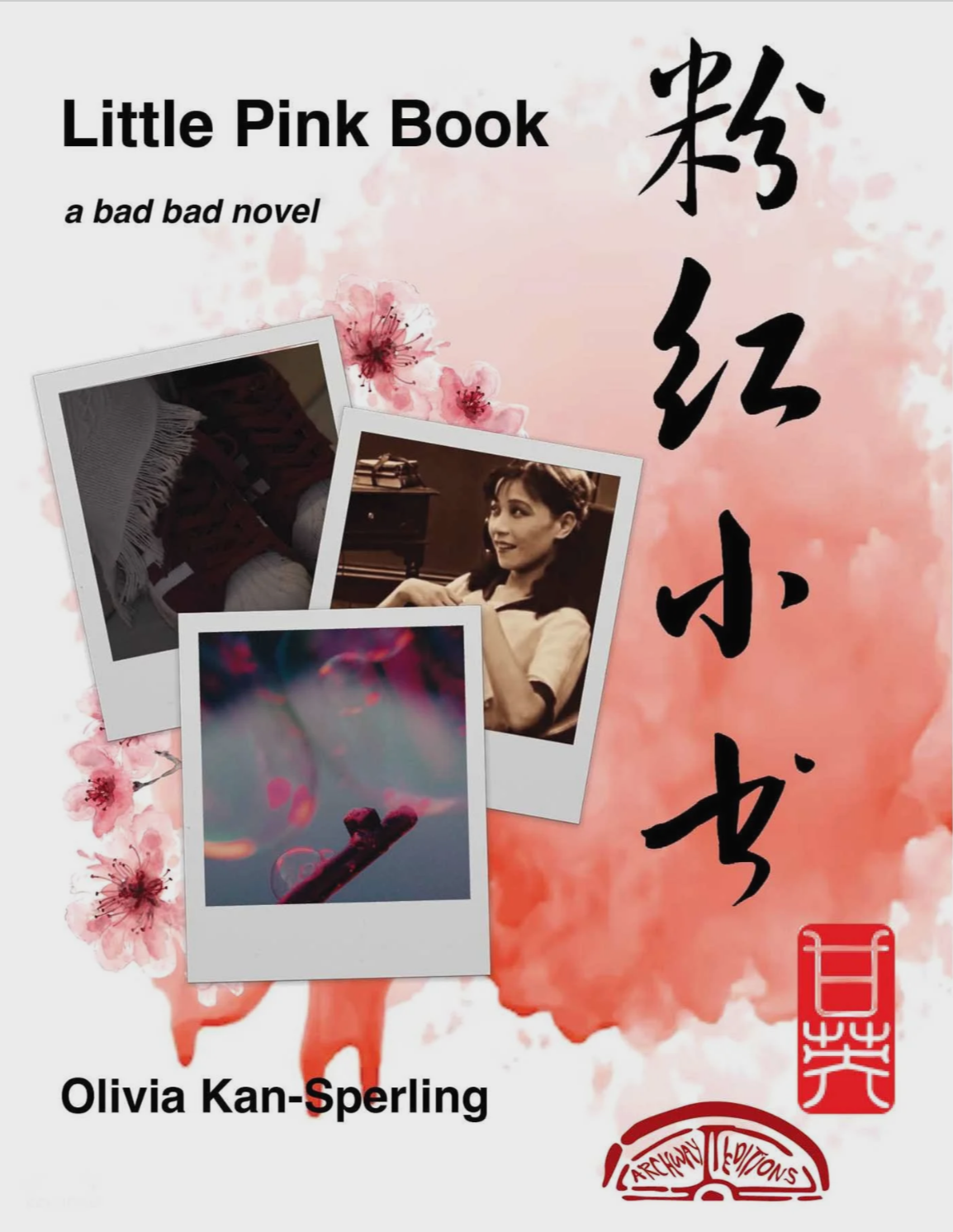
Cover, Little Pink Book by Olivia Kan-Sperling. Image Courtesy Archway Editions.
REVIEW
Little Pink Book: a bad bad novel
By Olivia Kan-Sperling, Translated by Chen S.
Paperback ($14.95)
Archway Editions
By Cecilia Brown
Little Pink Book: a bad bad novel is “wrong,” like how some guilty pleasures are “wrong.” Through her fan fiction and multidisciplinary novel, Kan-Sperling asks, why, in our attempts to discover ourselves, do we as writers and readers want misrepresentation, when it may initially seem impractical or harmful to explore? She takes readers to ugly and confusing situations that are somehow still beautiful, entrancing, and funny, where the violence isn’t glamorized by the overt aesthetics at play. In doing so she makes contemporary literature look like a prude—visually, linguistically, and thematically. I had never seriously considered that the novel could be more than tiny words typed out with black ink on a white page—until my time with the novel’s two main characters: Limei, and language itself.
Little Pink Book never set out to be “accurate” or well behaved. The novel was originally commissioned by artist (and friend of Kan-Sperling), Diane Severin Nguyen, to be a fan fiction text that would accompany her 2022 exhibition in Shanghai. The exhibition featured her sixty-seven minute-long film, In Her Time—a film about a young actress that falls in and out of reality, history, and fiction until they all fuse together. Because of this, we’re forced to experience these genres (reality, history, and fiction), which are commonly understood as independent and contradictory to one another, as able—and desirable—to function simultaneously. When this possibility is accepted and shown to us, we can begin to understand why it's so common for our desire for self-discovery to lead us toward forms—images, characters, cultures, stories—outside of ourselves. Nguyen’s work reveals that maybe it’s inaccurate to say this desire is escapist (avoidant or a detached “break” from reality). To visualize the future and to understand ourselves, we need to confront the relationship we inherently have with history and fiction, and explore the ways we can work within them. Little Pink Book uses the tool of re-enactment—specifically the perverse, troupe-filled, self-indulgent, and girly form of fan fiction—to do so.
Like Nguyen’s film, Little Pink Book follows a Chinese young woman living in Shanghai who desires intense self discovery, but she struggles with how to do this when life feels so infinitely mundane and lonely. To show herself that there is more to life, Limei hangs posters of beautiful and famous women on her walls like Ruan Lingyu, the most prominent Chinese silent film actress of the 1930s; Limei also writes songs, and in the evening while the sun sets, she blogs about her life online. When a “rude boy” (who we later find out is Kuai Shilei, an entertainment industry business professional who wants to make Limei a star) walks into the coffee shop she works at, the trajectory of her life and the control she has over it rapidly changes in ways she never could’ve imagined.
Little Pink Book begins with a prologue titled “He Lit Me Like a Match.” What plays out is a softcore rape scene (or maybe fantasy?) between a submissive “young girl” (whom we can later assume is the named main character, Limei, who we meet in the succeeding chapter) and a person only referred to by the ageless pronoun “he” (whom we can assume is the handsome entertainment industry professional with powerful eyes, Kuai Shilei, who enters Limei’s world in chapter eight). After following him up to the nightclub’s concrete rooftop, the young girl nervously giggles and suggests they go back downstairs and keep dancing. But he likes it up there, and so he lights himself a cigarette. Soon the pressure of five fingers is around her hipbone; her flimsy yellow sundress snaps; and his hand is around her neck. The scene ends incomplete but ready to satisfy the young girl. The calm last line of the prologue confirms that this controversial power-play is what the young girl wants:
“现在,眼前一片漆黑。她感觉到夜风轻抚着皮肤,手腕被紧紧地握 住。她能感觉到另一只手的手指在她的五官上游走——鼻子、嘴唇、 颧骨——她知道,他正盯着她看。”
“Now it was black. She was aware of the cool air touching her skin, the hand tight around her wrists. She could feel the fingers of the other running over the contours of her features — nose, lips, cheek-bones — and it was like he could see her.”
And because this is fan fiction (a form where authors are known to self-insert their fantasies) we can assume there’s something about this that Kan-Sperling likes as well.
Opening a novel about a sad, sensitive, and intense young girl with this sort of scene—with overly flowery and ornate purple prose; with so many excessive adjectives, adverbs, and metaphors about things that glitter, pulse, and shiver; with so many sparse paragraphs and large white spaces— is suspicious. Little Pink Book’s prioritization of abstract aesthetic gestures instead of our lovely Limei could be seen as an abuse of the great American novel, an abuse of East Asian women, and an abuse of language itself. But this presupposes a concerning, antisocial, and prudish view of what is and isn’t a permissible representation of a woman in a novel. This deviance from contemporary literature’s formal and narrative expectations is what makes Little Pink Book so salient and thought-provoking for young writers… and so deliciously petty.
Kan-Sperling conceptualizes character writing differently than how it’s depicted in Western writing. Limei herself seems to function more as an innuendo than a real person, an avatar for the author to play with, rather than a character whom she gets to know through writing them. This idea of a character functioning as an avatar is explicitly expressed in the novel, with an extra wink at a well-known pop-culture internet figure:
“黎美戴上她笨重的耳机。她将双膝抱紧,裹着的小脚丫在粉色的床 上留下了两个小小的印记。她轻轻低下下巴,望向窗外。雨水在城 市上空倾泻,垂直的灰色划痕。轻音乐中的黎美。”
“Limei put on her clunky headphones. She drew her knees in to her chest. Her small feet, with small socks on them, made two small impressions in the pink bed. She dropped her chin neatly and looked out the window. Rain fell on the city, vertical dashes, dark gray. Lo-fi Limei.
This isn’t a new exploration for Kan-Sperling. In her first book Island Time, her auto-fictional main character shares the same name as supermodel, millionaire, and member of the Kardashian family, Kendall Jenner, a person whom Kan-Sperling thinks has a lifeless face despite her million dollar designer outfits and mansion. By writing characters in this embodied, sensorial, and archival way, Kan-Sperling intrinsically links her identity, her lived experiences, and her personal relationships to her fictive characters. Understanding Kan-Sperling is key to seeing the purpose of her meta-ironic re-enactments of history, reality, and fiction.
Since Kan-Sperling’s work aligns more with fan fiction—a genre that merges fiction, nonfiction, history, and pop culture—rather than traditional romance fiction, holes and shadows (to put it plainly, confusion) will inevitably exist in her work. This creates a disorienting reading experience, but these layered, hazy shadows in our knowledge, in our perception, and in language are exactly what Kan-Sperling wants her work to explore and exploit. She wants to explore situations when language falters and becomes shadowy with meaning, manipulation, and innuendos. Little Pink Book’s misrepresentations urge readers away from an antisocial and prudish identity politics that shortsightedly focuses on determining a criteria for permissible representations. When we instead start asking what our representations do and what might we do with them, like philosopher Amia Srinivasan prompts in her essay, “VII — Genealogy, Epistemology and Worldmaking,” we can begin to see that combating harmful representations by controlling them and setting limits is not as practical of an approach as it may initially seem.
Language in Little Pink Book is a linguistic pursuit but also visual and sensorial. The section-marker page for part one titled “ROMANTIC, SENSITIVE, ARTISTIC” is where we see our first word printed with Barbie-pink ink instead of black ink. It’s the word, chaste. The next word a few pages later is two tight bows. In an interview with Spike Magazine1, Kan-Sperling reveals her intention: these are words that blush. They wink at the various ideas and images that the color represents in Western culture—girlhood, shyness—using the corporate-consumerist's most soulless color.
“尽管正值正午,夏日阳光在上海上空闪耀,但窗户透出的玫瑰色光 泽使得整个空间显得阴暗。被注入这颗泡泡糖般的气泡中,丽梅感 到寒冷、迟缓、黏腻。这种通常甜美而可爱的颜色——象征女孩与欢 乐的粉色——突然变得令人窒息。粉色也是内里的颜色,而这过于 贴近了,过于暴露内里。”
“Though it was high noon, and the summer sun shone brightly over Shanghai, the rosy tint of the windows made the space dim, and uniformly pink. Having been injected into this bubblegum bubble, Limei felt cold, slow, sticky. This usually sweet and nice shade—the color of girls and fun—felt, suddenly, claustrophobic. Pink was also the color of insides, and this was too much, too much inside.”
The novel is also visually unusual in the sense that its dual language (English and Chinese), which allows Kan-Sperling to further challenge our relationships with how we experience language in a novel. Kan-Sperling isn’t fluent in Mandarin, but grew up visiting family who used it. Because of this, she knows that several Chinese characters are straightforward in their pictorial origins, like 木, tree. In the same interview she states, “Chinese to me is something halfway familiar and foreign, between sense and a melody. I wanted the bilingual element to be a decorative feature that also reminds you that there’s something alien, incomprehensible, and sensorial about all language.”
Not just Kan-Sperling’s book-length pieces, but her criticism; her Instagram posts; her personal website (the web cursor being a $3,000 lace Chanel glove that only works sometimes); have a winking quality to them, an ambitious sensibility, a curiosity about constraints and contradictions: about what’s popular and what’s unpopular, what’s beautiful and what’s ugly, what’s prudishness and what’s an innuendo, what’s humiliation and what’s erotic, what’s Western and what’s Oriental—and a curiosity about her own identity position in each context. She even poses these questions through her author photo on the last page of Little Pink Book: a “just rolled out of bed” smartphone mirror pic, where she sits in a casual and intimate sitting position in a mini dress on the edge of her bed, Sally Rooney's Normal People coincidentally in frame, facing forward. In doing so, she challenges these constraints and contradictions, does what’s commonly understood as wrong, mistranslates (her lived experiences, her identity, Nguyen’s film, cultural contexts, reality into fantasy and fantasy into reality) in a way that’s hypnotically indulgent, critical yet receptive, and far from being epistemically regressive or in poor taste. By destabilizing its legacy, Little Pink Book creates new possibilities for what writing can look like.
By the end, our Limei is far from where we met her—a tension-filled rooftop scene with a handsome boy—yet she’s in a historically familiar scene—a pasture where she’s collecting eggs into her apron. Film, fiction, history, and reality have fused into something impossible to determine as Limei’s reality, a dream, a nightmare, or a film that Limei’s acting in. As this layered instability in language and reality is what Kan-Sperling set out to exhibit, she ends Little Pink Book triumphant and with a bow to her predecessors. In an ode to online fan fiction writers who can’t finish their story because they have homework to do, Limei’s story ends with an unreliable promise: “to be continued…” Although the ending is unreliable, it feels so real—and so, so right.
FOOTNOTES
1 Kan-Sperling, Olivia. “Olivia Kan-Sperling’s Swirly Syntax.” Interview by Cara Schacter. Spike Magazine, 30 July. 2025, https://spikeartmagazine.com/articles/interview-olivia-kan-sperling
