
REVIEW: “Rieles & Raíces: Traqueros in Chicago and the Midwest” at The National Museum of Mexican Art
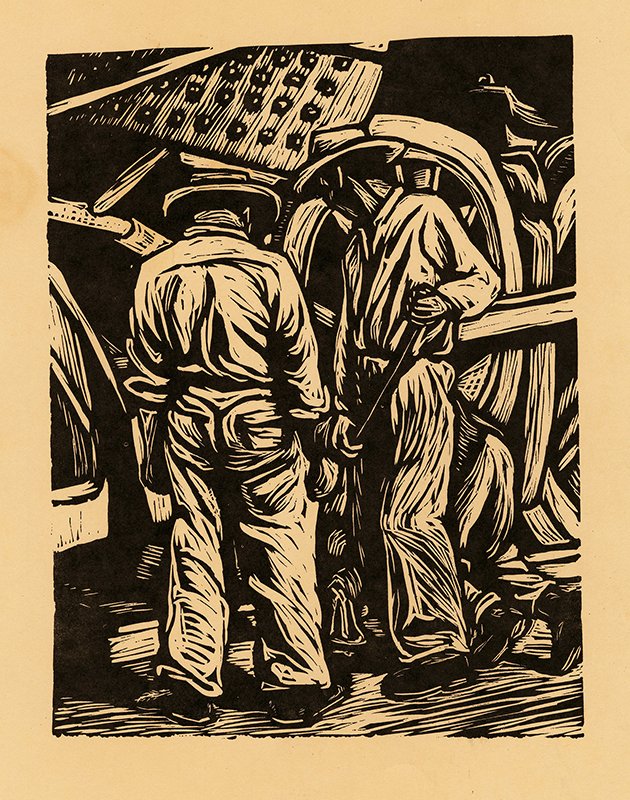
Sarah Jiménez Vernis, Ferrocarrileros, 1957, linocut, N.N., National Museum of Mexican Art Permanent Collection, 1999.328, Gift of the Rogovin Family.
REVIEW
Rieles & Raíces: Traqueros in Chicago and the Midwest
National Museum of Mexican Art
October 21, 2025 – April 26, 2026
By Sage Dunlap
When I first entered the exhibit Rieles & Raíces at the National Museum of Mexican Art, my eyes locked on a painting of Our Lady of Guadalupe framed at the back corner of the room. An icon of Mexican art and religious imagery, the portrait stood out amid surrounding diagrams, typewritten documents and 3-D train car models sitting on a table under the Holy Mother’s gaze.
The painting by Mexican painter Gonzalo Carrasco, undated but completed in the 20th century, originally hung in the Chapel of the C.B.&Q. West Eola Boxcar camp in Aurora, Illinois. The camp was one of many locations in the Chicago area where traqueros, or Mexican railroad workers, first settled in the Chicago area.
Rieles & Raíces, on display from November 21 through April 26, showcases the underrepresented legacy of Mexican railroad workers integral in building the foundation of America’s railroad network. In response to calls for labor, traqueros were among the first Mexican immigrants to arrive in Chicago in 1916. Through donations from the families and descendents of these workers, as well paintings, photographs and historical artifacts curated by Ismael Cuevas and Alejandro Benavides, the exhibition puts the contributions of underpaid, undervalued Mexican workers on full display, presenting the vital role Mexican immigrants have played in Chicago’s history.
With one room housing over 150 years of history, Rieles & Raíces packs information wall-to-wall. With paintings, maps and donated artifacts in conversation with one another, the sequencing of every piece feels intentional, carefully placed to chronologically cover the legacy of railroad workers from the 19th century to today. Tall wooden posts, roughly eight feet in height, organize information into a clockwise timeline around the walls of the gallery. Between them, framed portraits and dated documents give names and faces to the historical events described on these posts.
The exhibit explores the unjust factors that led to Chicago’s presence as an Industrial titan through the railroad industry. In 1862, Congress ratified the Pacific Railway Act, which authorized construction of a transcontinental railroad that would connect major hubs throughout the United States. Stolen land belonging to Indigenous populations was granted to railroad companies by the American government. Chicago became the largest rail hub in North America, which led many of these companies in search of cheap labor to recruit Mexican men and women up North to the Midwest.
Rieles & Raíces gives a new perspective to the railroad industry, focusing on the vibrant communities that settled in Illinois alongside the tracks they laid. Paintings hanging in the exhibit portray traqueros from different historic vantage points — Sarah Jiménez Vernis’ linocut print Ferricarriletos andMarta Sánchez’s Men Working on the Track sit on either side of the entrance, bookending the space with paintings created in 1959 and 2008, respectively. Between these paintings, the exhibit spans a comprehensive timeline of the arrival of traqueros in the Midwest in the early 1900s, the communities built around Boxcar settlements in the 1920s, the Bracero Program that brought Mexican laborers into the United States in the 1940s, and their mass deportation the following decade.
Paintings and photographs offer a glance at what work looked like, but personal belongings and artifacts donated by families of traqueros provide a closer look at their interior lives. Pullman-Standard company buttons belonging to Alfonso Quiroz remind us of the last two Pullman workers still residing in the town of Pullman, IL. Handwritten letters reveal the story of Alfonso Ayala, a New York Central Railroad worker who bought a home in Chicago’s fuller park neighborhood before self-deporting to Mexico during Operation Wetback, a mass deportation of Mexican immigrants spearheaded by President Eisenhower in 1954.
As stated in Rieles & Raíces, railroads capitalized on the housing discrimination that many Mexican workers in surrounding towns faced by confining them to dilapidated, on-site boxcars. Across Illinois, 20 boxcar camps housed railroad workers and their families alongside the rails they built, making these settlements the first Mexican communities in the state. Miniatures built by Alejandro Benavidos and Derrick James showcase two boxcar camps in Aurora and Chicago, giving a scaled-down look at the trains and surrounding facilities, such as the chapel of the aforementioned Lady of Guadalupe painting, which carried on cultural traditions despite harsh living conditions.
Rieles & Raíces composes photographs, paintings and historical artifacts to build a comprehensive archive of the lives and forgotten contributions of Mexican railroad workers. This approach both educates and recalls lost history, giving context to art and personal belongings kept by families of traqueros that serve as emblems of their sacrifice and exploitation. The exhibit is the first step in creating a permanent archive of Mexican Traquero history. The National Museum of Mexican Art is calling for any documents, tools, personal items, or art pieces that can relay stories of traquero history.
By spotlighting the first Mexican communities in the Midwest, the exhibit traces the historic impact that Latinx people have made in Chicago, a city that would not have its wealth, influence and industry without railroads and the exploited labor that laid their foundation. This year, with Operation Midway Blitz putting Chicago on the map as one of the largest hotpots for unjust immigration enforcement, Rieles & Raíces reminds us of the importance of recording and celebrating Latinx history.
___
Sage Dunlap is a writer based in Chicago, IL.
Like what you’re reading? Consider donating a few dollars to our writer’s fund and help us keep publishing every Monday.
