

INTERVIEW: Jennifer Eli Bowen on her debut essay collection, The Book of Kin: On Absence, Love, and Being There (2025)
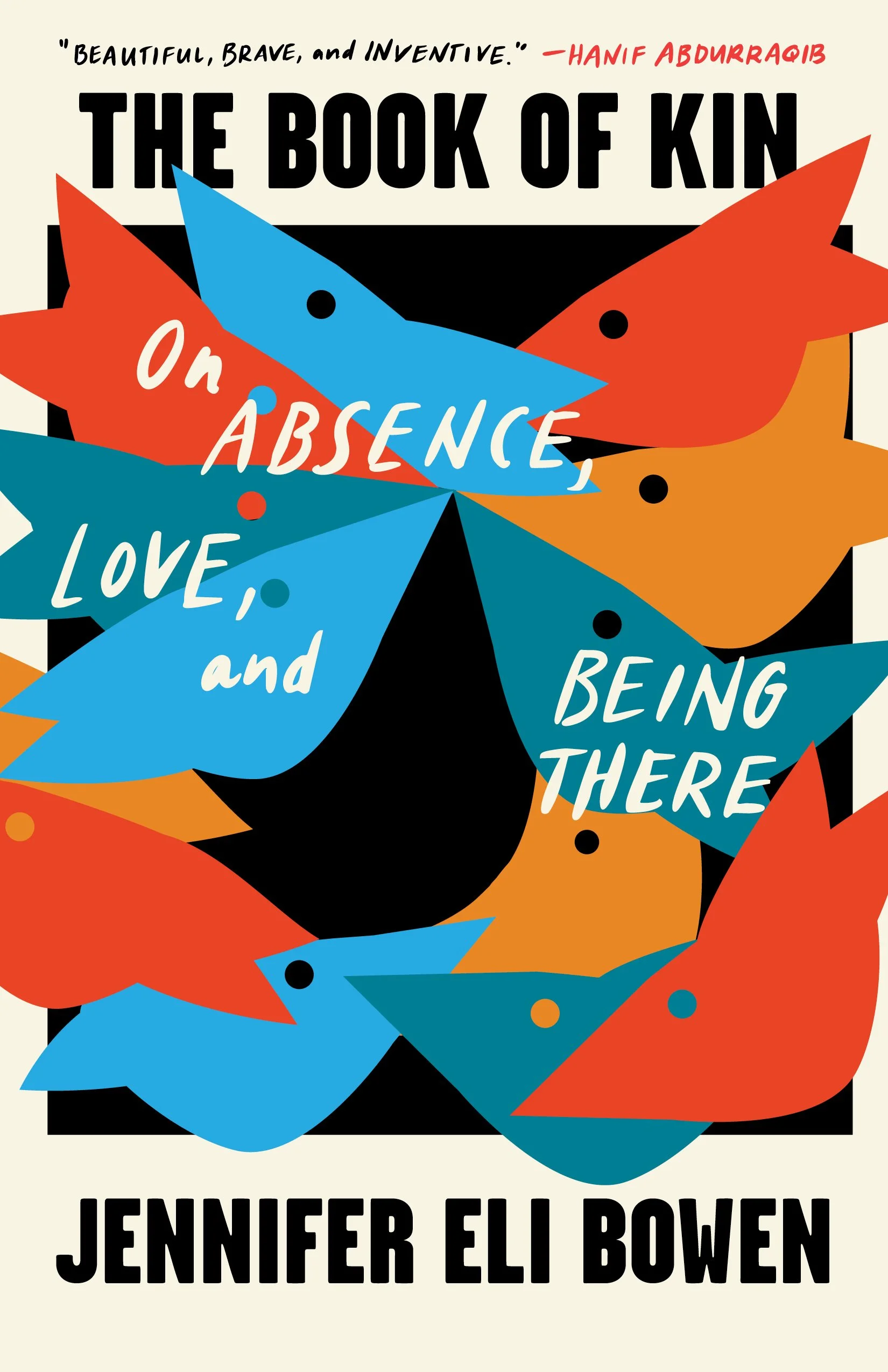
Cover, The Book of Kin: On Absence, Love, and Being There by Jennifer Eli Bowen. Image Courtesy Milkweed Editions
INTERVIEW
The Book of Kin: On Absence, Love, and Being There (2025)
By Jennifer Eli Bowen
Milkweed Editions
By Ruby Djuna Haack
I first met Jennifer Eli Bowen in 2022 when she hired me as a summer intern for Minnesota Prison Writing Workshop, an organization she founded in 2011 that brings creative writing programs into Minnesota prisons and creates mentorship and publishing opportunities for writers on the inside. I was hired to help put the final touches on a book project she and twelve incarcerated writers had begun three years prior, a project continuously impeded and stagnated by the pandemic and the confines of prison censorship. I spent most of that summer in the passenger seat of Jen’s car, our hair wet, our coffees in hand, as we embarked on our early-morning commutes to Faribault Correctional Facility. It was during these commutes, driving through the many small Minnesota towns that freckled the highway, chasing a sun that was already high in the sky, that Jen became not only a supervisor, but a mentor. I rambled, as I tend to do, about the many moving parts of the literary world that I didn’t quite understand but tried to piece together. Jen, generously, helped me make sense of it, and in doing so, taught me about writing’s political power, about its radical potential to unite, inspire, and mobilize communities across carceral walls.
Jen is a writer, editor, and educator. She is also an organizer, caregiver, and devout community-maker. It was while working under her guidance at Minnesota Prison Writing Workshop that I learned how art, when touched by many hands, can be a means of community care: a way to connect, grieve, and relish in all that makes us human. Jen’s debut essay collection, The Book of Kin, published by Milkweed Press in October, 2024, explores how this love is complicated by trauma, absence, precarity, and state confines. Her book serves as a testament to care, its many shapes and imperfections, and the ways we, despite our missteps, still try to “love right.”
This fall, I had the opportunity to sit down with Jen once again and ask her about her practice, her understanding of family, and how teaching informed the two. We spoke on the phone this time, me in my Chicago apartment, Jen in her home in Saint Paul. And yet, despite this distance, we picked up where we left off, as if it were a continuation of an old car ride, me in the passenger seat, Jen behind the wheel.
Ruby Djuna Haack: In this book, your understanding and depiction of family transcends the biological. You write, "Many of the men I meet in prison seem as startled as any of us would be to find they traveled from the first gasp to prison gates. They seem like our uncles, neighbors, fathers and sons. The reason for this is because they are, of course, our uncles, neighbors, fathers and sons." Now this, of course, could be literal, as many of us do have uncles, neighbors, fathers and sons who have been impacted by the carceral system. But it also, however, could be an invitation to redefine our understanding of family and to examine the different bonds and circumstances that connect us. I'm curious, in writing this book, how did your relationship to the concept of family change, and what does kin now mean to you?
Jennifer Eli Bowen: Yeah, boy. That is a big and complicated question, but I would take it in two directions. One, I moved a lot as a kid, often. And so I was pretty familiar with connections severing, or said differently, I lost community a lot and had to remake community. And there's a lot of grief in that, that I think for most of my life was ambiguous grief coupled by the fact that I didn't know a lot of my biological family. I've always kind of carried around a deep, dark pity party for myself because of that. And I don't want to say it's the same thing in prison, but I will say one thing that always moves me about the folks that I work with is the way they build bonds with each other over, say, 10, 20 years, because obviously they're living away from their family units. And so there do seem to be family structures built inside the prison. And so I think as I've gotten older, I've understood both as a product of our geography, or our living circumstances, or our family of origin, that sometimes we're happier and healthier if we embrace a different definition of kin. And for me, that means people who will look out for you, where there's reciprocity, sort of reciprocal care, I guess. And there don't have to be shared interests, but it makes it nice. And so yeah, it didn't intentionally change. I wasn't necessarily asking the book to do that work, but at the end of it, I think I did discover that I broadened my definition of who we can consider our people.
RDH: Do you feel like that changed when you started working in correctional facilities? Or has that always been your understanding of family, being someone who has refined and reshaped those connections throughout growing up?
JEB: I would say it's later in life, and it probably happened alongside my work in correctional facilities, but not because of it. I think it had more to do with aging and moving away from my biological family. And then also, of course, getting a divorce restructures your idea of your nuclear family unit. And so it really was a product of aging and my own changing life circumstances that happened to coincide with the work I was doing in prison. In so many ways, I think I was forced to redefine family, or maybe (I was) frustrated and finally ready to redefine family, if that makes sense. I have a friend who's a beautiful writer, Robin MacArthur, and she writes from the land that her grandmother and grandfather bought and built on, and then her parents, and now she lives on it. And so they all live in this beautiful place in the woods of Vermont. And I've always been so jealous that she has those deep roots visible right in front of her. And I think I finally reached a point where I understood that's just not the life that I was given, and that's not going to happen for me. And so through divorce, through the death of some family members, and seeing my community come together and support me, I think, has been a way of understanding, (or) relinquishing my old ideas of family.
This book, as you mentioned, spans across a long stretch of time. It begins with an exploration of your childhood and then follows you as you get married, start a family, get divorced, and then go through all the life that happens in between. And I'm curious, when did you start writing the essays for The Book of Kin, and at what point did you realize a book was taking shape?
Truthfully, I didn't know it was the book that I was writing, but the very first essay that's in that book I wrote probably 18 years ago.
Wow.
And there probably is still a sentence that I harvested from one of the pieces I wrote in undergraduate school when I was trying to understand my dad and my family. So those have been some of my central concerns since I've been writing. And you know, I wasn't convinced that I had a book. I just had an agent who asked for pages and then convinced me that it was a manuscript and to send her something, and then she started sending it out. And so it's been in part, like everything in my life, a community that came around me to help push me along. And I think, I think that's why it exists in the world now—not because at any point I decided, this is it, it's done. It was because there were people waiting for it.
That's so interesting. I remember a point in your book where you mention, and I can't remember if it was in high school, I think you were an undergraduate student, or journalism student, and it's in that essay where you talk about writing being a saving grace, being the first avenue where you learn that you are bright and have potential in a particular area. And it's cool to now learn that one of the essays that you wrote during that time is in the book. It feels like an homage to that young self.
Yeah. I think the passage you're thinking of may have been even as early as, say, junior high, when I finally had success in a class, you know, without extreme effort. And that's something I hear writers say quite often. They're writers because it's the only thing they could do.
Totally. You talk a lot about both in the book and then, of course, this essay as well, writing being grounded in community. And I know you as a person that is deeply involved and concerned with the well-being of your community, and the students that make up that community, and your book being grounded in familial relationships and love captures that really effectively. I'm curious, how has teaching and organizing informed your writing practice?
Yeah, thank you for saying that. To be honest, if it's informed it in any way, it's made it right-sized in my life. And so before I was teaching, before I was deeply embedded in community building, writing seemed like the thing that defined me, or it had, I think, an outsized importance in my life. And it is still important to me, and it's still important to the world, but it's just one thing. And I think, if anything, teaching and community has shown me that maybe the best thing that can come out of writing is when we're all developing alongside each other and hearing each other and giving feedback. Those deep connections that happen through writing are so much more important to me than a book or a publication, and that's a real relief to experience that. I like publications, you know. I will take awards. If anyone has them to give, I'm not going to turn them down, but those connections are what we're here on earth for, and what, at least, for me, make life worth living.
One thing that I was particularly impressed by, and we've talked about this earlier, was how tender and loving this book is, even as it explores the cold and foreboding institutions that make up our carceral system. And I think that this is successful because at the heart of each essay is this love for your sons, this love for your students, and a deep care for how you impact the lives around you, even those of chickens, those of plants, those you never knew. In your essay, "Attention" about a pedestrian strike on the train, you ask yourself, and thus invite the readers to ask themselves, "What is our obligation to this dead man whose body parts are being picked up outside as we sit and wait? What's our obligation to each other?" I think about this as a question of visibility and responsibility. Namely, what is our responsibility to those we can't see? And I'm wondering how you view art in this context. In what way does writing and art allow us a new perspective from which we can view the carceral system and the ways it affects our everyday lives? Do you see it as a tool to make the invisible visible, or is it unfair to put that much weight on a piece of art?
That is such a hard question, Ruby. I mean, it's a really good question. It's a hard one. I'm not gonna cop out, but I will say I think every artist probably has to come to their own comfort level with this answer, so the way I answer it maybe won't be true for everyone. I know, you know, I think it's a really, really dicey proposition to say we're going to let our writing make people visible. You know what I mean? I would worry there's some underlying kind of presumption in that, even while I think it's a worthwhile endeavor, it's a scary thing to decide that that's your writing's job, to make someone who is not you visible, even while some of my favorite work in the world is doing just that. This is an indirect way of approaching that question. But because of the work I do, people always want to ask me, like, do you bring art in for healing? And I was like, Oh, not really my job to decide. Like I would never put that pressure on art, or the person writing. Like, it's kind of its own magic between the maker and what is made. And there's some mystery there I don't fully know how to understand. And I think it's really good to leave it alone in some ways. You know what I mean? There's something magical about, when you're striving for art, it requires a certain level of complexity, and once you are aiming for that complexity, that's where the magic happens, right? That's where whole humans happen on the page, because it's not art, if it's a shallow character, right? Or if we can't smell it, if we don't feel present in it, if we're not having feelings, then maybe we haven't quite reached the level of art. And so I don't know what the mechanism is that happens for some people, where we've somehow healed or made someone visible, or created, say, a deeper understanding for others in the world. I don't know what that mechanism is. I know it happens. I think if someone went into their work with that intention, it might make it harder for that magic to happen, but that's just my own superstition, so I think that's a really roundabout way of not answering your question.
No, but I think that when you talk about the mystical, or the magic, that happens between the maker and what is made, I think that that's really interesting to think about, especially in a context where so often programming is used for "self betterment" in a way that feels maybe, what's the word...
Condescending, paternalistic, patronizing, dehumanizing?
Yes, exactly. There's a self awareness to your writing also that I wanted to shed light on. You seem to be constantly reckoning with your positionality in the carceral context. It's your essay, "The Wildest Show" where you write about arguing with a large, white correctional officer about your reporter access to Angola Prison. And you write, "We are two white people arguing over whether I can step inside where six thousand men, 80% of whom are Black, 95% of who will die there, remain caged." In conversations about your work, you talk a lot about the fragility of writing about prisons and all of the many dynamics that exist inside of them and the harms that they cause. Especially as someone who is not herself systems impacted, it takes a very careful hand to explore a system of oppression as an outsider, which, as I've said before, I think you do in a really nuanced, loving, and community-oriented way. And I'm curious, as someone who's worked in prisons for over a decade, how do you reckon with the space you occupy and with the subsequent responsibilities that come with that space?
Neurotically. It's a tricky space to occupy, as a teaching artist, as a human, because we get to leave, and so, you know yourself having gone in, that right there already makes it complicated. There's obviously the power imbalance, because coming in as volunteers, any accusation we could level towards someone could potentially really harm them. So just physically being in that space, it requires a lot of care, and then writing about it, of course, is really complicated, because there's no monolith. An incarcerated human is not a monolith. A system itself is not a monolith. Even within a system, facilities differ, within a facility, staff members differ, within a unit, the men differ. But because a lot of people on the outside don't have that access point, there's always the risk that anything you write is going to be read as a type, or the monolith. And so, yeah, it's really, really complicated. And I actually kind of hate doing it, to be really honest with you, for those reasons. I've never written anything that I feel doesn't risk doing as much harm as it does good, to be really frank, and I don't do that recklessly. I do it really fearfully.
Yeah, it's interesting to think about the levels of care that go into writing an essay when you're managing hyper-surveilled structures.
Yeah.
Especially, and I mentioned this earlier in my previous question, but especially in a context that is used to exacerbate sociopolitical, economic, and geographic divisions. It's really hard to navigate that with love and care in a tender way. And I think that's something that the book does really well, but it's also something to always reckon with as a writer in that space.
Yeah, thank you for saying that. The one advantage I have, I think, over the rest of the staff that work in there—or the privilege I guess I should say—is that, and you know this from coming in, especially because I teach often creative nonfiction—and I love to start from memory—the advantage I have is that I get to meet three-year-olds in their footy pajamas in their grandmother's kitchen on the page. You can't meet a three-year-old in their grandma's kitchen in their footy pajamas and not care about that person. You know what I mean? And particularly, many of the stories, I should say, that we read come from places of trauma. And so the stories that I am entrusted with are so complex, it's a really human place for a bunch of us to connect over a workshop table, and in that strange way, I feel like the affection and the love and the care I feel is sort of generated by the group as a whole. Because we're all sharing these pretty difficult stories, memories, narratives on the page. And so I want to just give credit to the community that's generating those stories. A lot of the fullness and care and love that comes through in the book is really what I have felt from the communities inside, and by way of reminder, I leave, and so I'm not importing that care and then exporting it with me. They work to create those conditions for themselves all the time, contrary to what TV shows and movies show us, because it's their "home," for better or worse. Zeke Caliguiri has said this forever: it's their communities, they're building the culture. And so I would say, borrowing his line, they're also building the care. And so I've taught in college classrooms, it does not feel the same. And there's probably something to be said for the survival. I mean, there's some existential questions there about how we build care to survive, but it's genuine care. And so I think a lot of what you experience in the book around that community is what they've taught me and shown me and created and modeled.
That's awesome. In your final essay, "Blueprints," you write, "Since my kids came into the world, I worry over how to love right. Or at least, how to love well, as if there's a formula, and I'll figure it out by sorting through my own family, my past and present, weighing it all against the rest of the world like little jerry-rigged case studies using my own shifting methodology." Now, this entire book is an exploration on how to love right in a world, as I mentioned, that works to enforce and exacerbate socioeconomic and geographic divisions. And I think that in this way, loving right could be seen as a radical act. To love loudly, as you put it, is to dismantle structures that silo us and write the traumas that live within us, or at least it can be an attempt to do so. And the essay, "Blueprints," is a series of vignettes, or case studies, of people being loudly loved or loving in the way that they know how. What was the thought process behind closing out the book with this essay? What do you hope the reader takes away from all of these examples of love?
I love your interpretation of it. That's a really beautiful interpretation for me. It was a hard essay. I was focused on the failures of my own, and then sort of trying to explore my mom's in a way that wouldn't be harmful to her when she reads it, and then juxtaposing that with like, basically just the other people and groups and instances and anecdotes of things I've watched to try to understand, but because it was kind of rooted in a place of, I don't know, acceptance but also, grief. Honestly, Ruby, it's like, why is it so fucking hard to get it right? Like, even when you're trying to care for people, your very act of trying is sometimes the thing that hurts them, and it's like, Are you fucking kidding me? Are you fucking kidding me, right? Now, the thing I was doing very consciously, very intentionally, because it felt like the loving thing to do, is the actual thing that hurt you? It feels really maddening. And I'm getting to a place of acceptance. I think that might be the essay where I mentioned getting older and walking by the windows and thinking, Oh, wow. We don't get to figure this out forever, there's an end. We're gonna do it and figure it out, and there's an end, and you don't know when your end is gonna be. And so figure this shit out. It felt kind of scary to me in some ways, but also, I think hopeful. That idea of regeneration, you know? I think there has to be some — did you say radical care?
Yeah.
I would almost wonder if there doesn't have to be — for me, and I love your interpretation better, I wish I felt more about that essay the way you do — I think, for me, there has to be some radical forgiveness, because we are so flawed, and even when we're trying so hard with the best of intentions, it's still really tough to get it exactly right. And so for me, if anything, it's an essay ending on radical forgiveness, for our humanness, and a lot of gratitude for the trying, which is, you know, all we can do.
Bridge Publisher Assistant Ruby Djuna Haack is from Portland, Oregon and holds a BA from Sarah Lawrence College. She was awarded the 2023 Mississippi Review Prize for Nonfiction for her essay, “Aftermath,” for which she was also nominated for a Pushcart Prize. You can find her essay, “Ruins” in The Rumpus, or her diary project on Substack at incasegodiswatching.substack.com. In her free time, she likes to make and trade zines.
Like what you’re reading? Consider donating a few dollars to our writer’s fund and help us keep publishing every Monday.
