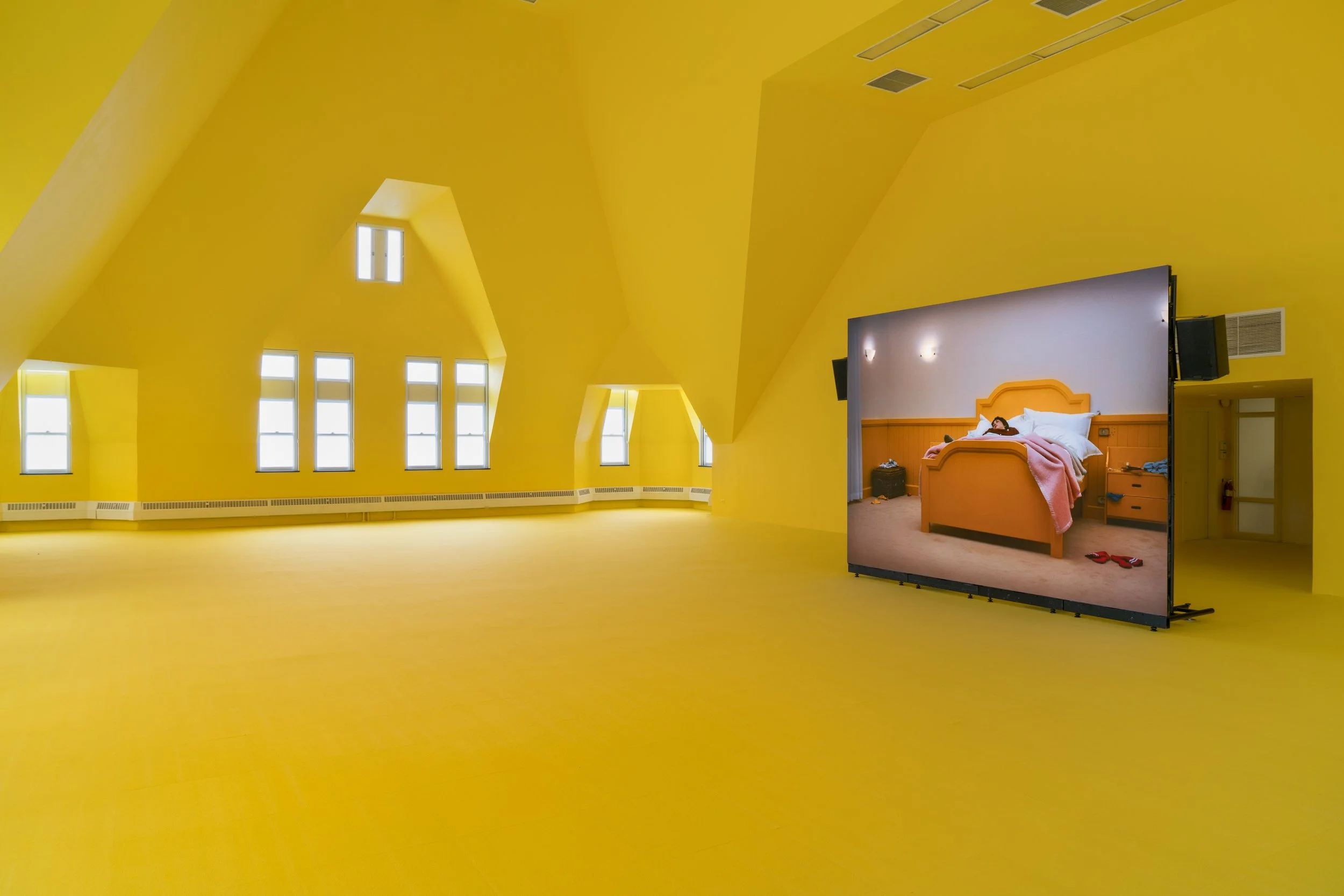
Diego Marcon, Krapfen, 2025, at the Renaissance Society at the University of Chicago. Photo by Bob.
REVIEW
Diego Marcon’s, Krapfen
Renaissance Society
5811 S Ellis Ave.
Chicago, IL 60637
Sept. 13 – Nov. 23, 2025
By Kristin Mariani
Diego Marcon’s Krapfen closed at the Renaissance Society two weeks ago, leaving me haunted by its hallows. The Italian artist, in his US debut curated by Myriam Ben Salah, presented this film through the double doors of Cobb Hall, confronting viewers with the backside of a gridded and clamped LED screen before they could face the unified front of it. Every inch of wall in the 3200 square foot gallery was rendered in an egg yolk veneer of yellow paint, complimented with matching wall-to-wall carpet and electric cables. The Ren’s gothic arched windows, opaqued with a white film, foreclosed the outside world of the University of Chicago’s campus, flattening the exterior light source for the unfolding of strange and familiar events.
Krapfen’s 4 minute and 44 second loop begins with the switch of a light, turned on by a dark haired figure lying prone on a bed covered by one pink and one baby-blue blanket. With face cocked toward the crack of a closet door, The Kid, a rosy-cheeked person with green almond eyes of non-specified gender, is aroused in a bedroom trimmed with egg yoke yellow wainscoting and matching wall to wall carpet. The Kid sits up and fixes their gaze outward, towards the viewer, conflating the gallery space with their own room. For five seconds, subject and viewer stare into each others’ interiors. This titillating pause is interrupted by a window blown ajar, white curtain flowing open to reveal a cornflower blue sky.
A crack in The Kid’s double door closet mirrors the Renaissance Society’s double door entrance.
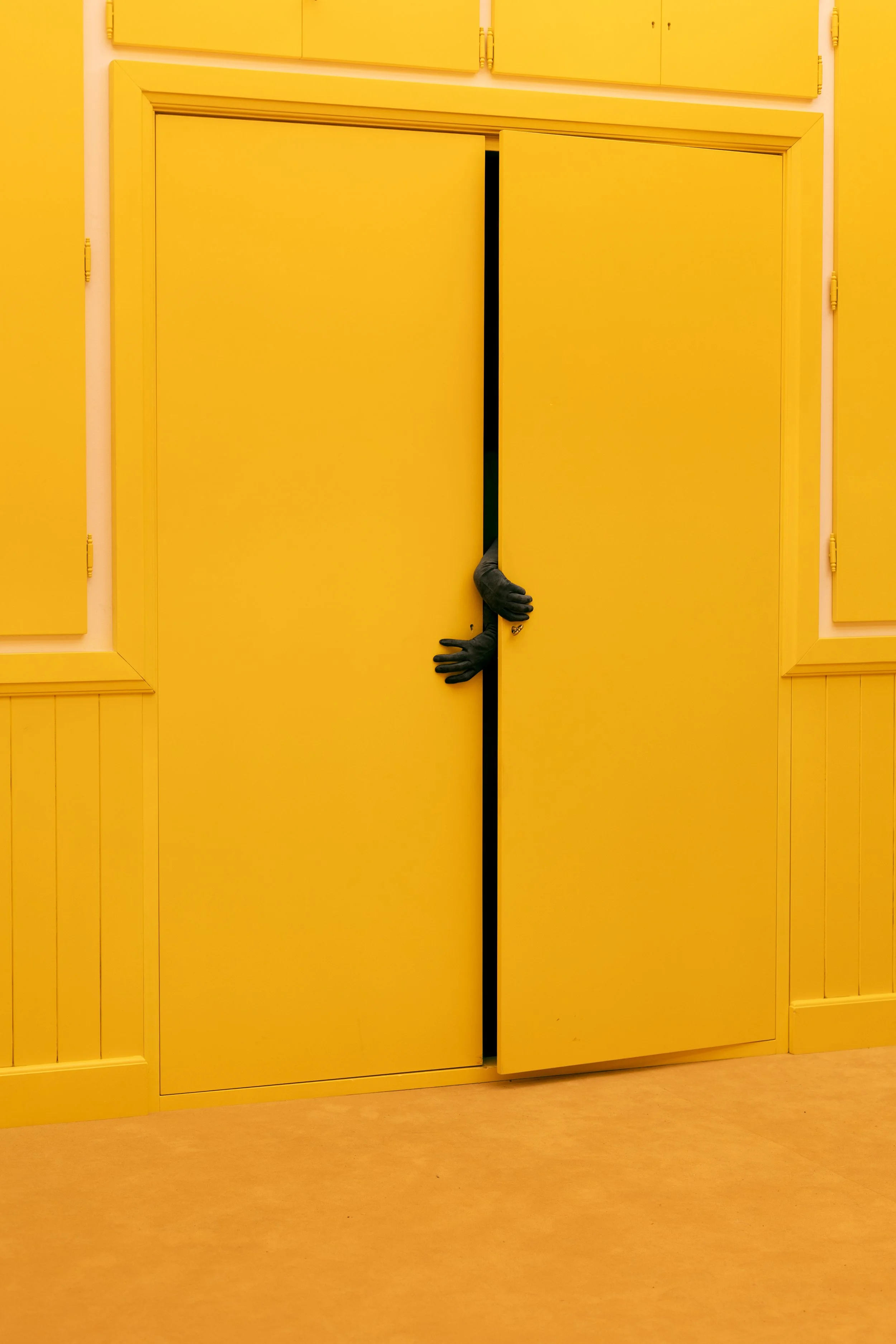
Diego Marcon, Krapfen (Gloves), 2025 © Diego Marcon. Courtesy Diego Marcon. Produced by Fondazione Sandretto Re Rebaudengo, Lafayette Anticipations, New Museum, The Renaissance Society, The Vega Foundation. Photo: Brigida Brancale.
The Dance:
A krapfen is a round jelly filled donut, German in origin. Krapfen’s particular krapfen is filled with apricot jam. Sweet content inseparable from its round form, the donut's hole is decentralized, its fill comes in from the side.
Krapfen, the film, is a dance with a libretto in the style of Italian opera that unfurls around the donut’s recipe. The film is chock-full of quick gestures and small details loaded with clues to countless unknowns. If one pauses the frame at the bookcase next to the closet, one will find on it the games “Guess Who” and “Ghost Castle.” Marcon’s films are gems of spooky weirdness, queering traditional structures, cracking veneers of gender and technology, presenting moving image objects inseparable from the interiors they occupy.
The dance begins with a suggestion and an order. The kid is dressed in a slouchy red jumper and dirty grey sweatpants, bearing a resemblance to Fritz from the artist’s 2024 film by the same name. Primary to this recipe is the arousal of clothing articles tossed about the room, hollowed shells of garments that come to life with song, celebrating the insides of a krapfen while their own content has eluded them, alluding to something else.
The animated garments appear in this order: The Socks, The Gloves, The Foulard, The Trousers, The Pullover.
What has shaped each garment has escaped it, with erotic undertones of what has slipped in and out of the soft forms. Physical impressions remain, revealing the compression of figures in cloth. Four voices occupy the conventionally gendered vocal ranges of soprano, tenor, alto, bass—inhabiting the hollowed garments—describing the moist sweetness to be felt in The Kid’s mouth should they take a bite of a krapfen. There are many loops and swirls in this dance: The Socks, red with white athletic stripes, tip toe around the bed to rouse the other garments. The Gloves submissively crawl back to the bed, signaling to The Kid with a grey sueded hand followed in rapid succession by a caress, a poke, and a choke. The striped foulard head slips under the fuzzy pink blanket in pursuit of The Kid, giving a phallic rise to its surface. The kid emerges, flushed from under the covers, and pulls a thread off their red jumper. The Trousers jump off the bureau and steer telescopically around the room with a contrapposto swagger, arriving cross-legged on the bed next to The Kid. The Pullover slides out from under the bed, taking hold of The Kid by the neck to enforce a series of turns around the room.
The tactility of these garments infuse the grains of the four voices, rendering the vocal textures suggestive, influential, coercive, authoritative. These anachronistic garments are from a time and place where opera meets nonsensical nursery rhyme. The cloth forms are seductive and supple, but an ordered system firm in the authority that they bear. They—the garments— are differentiated, detached from each other, but united in their animation as articles holding cultural memory and power, accessories to the room’s occupation. The parts act as separates, but make no mistake, this outfit is coordinated.
Gender is imposed in this way.
There is a sudden ta-da moment when all garments assemble like a four-folded exquisite corpse taking possession of the bed, then kicking The Kid off of it.

Diego Marcon, Krapfen, 2025, at the Renaissance Society at the University of Chicago. Photo by Bob.
The Closet:
The Kid is ejected from their own room by the quad of clothing, with closet doors opening to welcome the expulsion. A spotlight highlight’s The Kid’s shove into darkness. The Kid makes their own moves in the dark, playing a game of dress-up with the dance steps forced upon them, defying the confines of the closest with a tip toe, a crawl, a side-step, and a splay. This try-on is an embodiment of the recipe, not a step-by-step repeat. The Kid’s dance reshapes the presumed forms thrust upon them.
The impact of this absurdity is tremendous, a nonsense of historical voices and relational bodies, a hollowing of separate parts belonging together. What is present in the solitude? The mouth a receptacle to receive? A hollow interior waiting to be filled? The Kid is impressionable, bearing the gravity of this occupancy and lifted by it, leaving a speculative hollow with sweetness posed as content. Such a delicate thing to portray.
The kid never opens their mouth.

Diego Marcon, Krapfen (the kid), 2025 © Diego Marcon. Courtesy Diego Marcon. Produced by Fondazione Sandretto Re Rebaudengo, Lafayette Anticipations, New Museum, The Renaissance Society, The Vega Foundation. Photo: Claudia Ferri.
Kristin Mariani is an artist, Couture Editor of Bridge, and Founder of RedShift Couture.
Like what you’re reading? Consider donating a few dollars to our writer’s fund and help us keep publishing every Monday.